GRAINES Summer School, St Andrews, 7-10 June 2015

Category: News (Page 4 of 7)

Day One Reflections: Challenging Closed Containers

Raj and Saunier both challenge the notion that Europe is a closed container and a self-defined space. They claim that Europe was defined in relation to other parts of the world and that non-Europeans played a critical role in this process. The same insight could be applied to the history of the United States. Placing the early history of the North American colonies in the context of competing European empires highlights the ways in which different regions were shaped by European commercial and intellectual networks. Through expansion in the nineteenth and twentieth centuries, the United States began to more actively shape global networks and in the process to define a unified national identity. It also began to more actively participate in the global production of knowledge. An avenue for further research might be the impact of US participation in European and then North American expansionary networks on the development of US scientific institutions. In particular, American philanthropic initiatives in the areas of global health and economic development in the second half of the twentieth century have profoundly shaped US scientific practices and institutions.  Most historians have privileged the perspective of US aid agencies and scientists and have not adopted the kind of approach advocated by Raj. Much of this scholarship is still assumes that knowledge is diffused outward from Euro-American experts and it gives relatively little consideration to the role of non-Western actors and research practices.

Jan Koura, Mattie Dungy

Day One Reflections: Rethinking Saunier’s scaled histories

During Monday afternoon’s session, Jakob Vogel and Alexander van Wickeren presented a group discussion question regarding Pierre-Yves Saunier’s approach to scaled histories. Saunier insists that traditional scaled histories are nested and hierarchical approaches which reinforce a ‘methodological nationalism’. He asserts that all historical scaling should be relational (hence, equitable) rather than hierarchical. Clearly, he supports transnational history at a micro, local, national or globe scale. But is Saunier also suggesting that local history simultaneously functions as global history? If so, this interpretation of scale accurately describes Dundee’s whaling efforts in the 19th century. This local industry operated within a transmaritime context with regard to geography as well as cultural, scientific, economic and environmental history. If Saunier is arguing for this point, then Dundee’s local-global whaling industry produced a subdued national scale of history.

Considering this, does Saunier’s scalar assertion necessarily fit all historical studies? Do instances exist in which a hierarchical local-national-global scale of history works more effectively than a relational perspective? What if there are instances in which traditional understandings of nationalism must be examined? For instance, take the issue of sport and Cold War politics in which countries like Czechoslovakia existed between two ideological superpowers. While an international game of hockey game was a local sporting event occurring in a specific arena and city, political authorities frequently appropriated results for propaganda purposes at any number of levels. Nationally, sports figures transformed into ideological heroes. At a transnational level, eastern or western blocs could leverage something as innocuous as a sport score to persuade people of the success of the victor’s own ideology and civilization and the failures of the other.

Tomas Vojacek & Matthew Ylitalo

Unconference Proposal: Geographies of Social Movements

Working on the social movement of unemployed person we are interested discussing on the mapping of decision making, claim-making and the circulation of political ideas through this (trans)national networks. The general definition of social movements is, that they are networks that point towards the transformation of social issues as f.e. child care, women’s rights, ecological themes and also labour relations. Social movements are networks of individuals or organizations. Most of the time social movements are studied through these individuals, mobilizing networks. In my opinion this approach ignores a lot of the political content of the movements. But we think that applying a network and transnational approach can be very fruitful for the research on social movements. We would like to propose three entangled perspectives on such social movements by taking up the discussions on scale:

At first, we like to investigate the interorganizational networks of local, regional, national and transnational movements and organizations. How did individual and collective actors tried to get in contact with other social reformers in other European states or even on a global level? Can detect divergent agendas of social reform that were not translatable into the other context? How did trans-border circulations of concepts change while being circulated? The concrete actions can also transfer into more circulation of ideas, knowledge or even action-forms. Secondly, we like to narrow our focus on „assembly“ spaces, that means places like conferences rooms where social refomers met and debated their issues. Are is

specific cities that were relevant fort he gathering of actors, or not? Which conditions determined the selection of cities and places of meeting? One can for instance can think of language, or the centrality or leader figures/organizations as main influences for the selecting of certain places. As an example the unemployment movement in Switzerland has always chosen a central city in the middle of the language border (french/german) to decide over national problems concerning unemployed persons. Thirdly, we would like to ask how social movements were entangled with political spaces by taking into account a wider notion of public focusing on media or political areas Where political decisions are taken? Which spaces are chosen for this in social movements? In which spaces does the protest take place? In my project this is very visible through massive street protests on EU-summits from the mid 1990s on, which was the starting point for a transnationalization of the movement. It can be concrete spaces, but also virtual ones. The aim is to think of movements not as singular events, but of long-time prepared actions, depending from many conditions and influences. The spatial dimension therefore is crucial.

 Alexander van Wickeren, Anina Zahn

Day One Reflections: Putting boundaries back into networks

By Ignacius Villar de Rohde and Jordan Girardin

Networks are often seen as quintessentially transnational mechanisms: they cross traditional boundaries – political, ethno-linguistic, cultural, religious – and challenge our mainstream understanding of social and spatial realities. For instance, the republic of letters is a great example of how the Enlightenment was spread throughout Europe despite the lack of political stability. This morning’s presentations underlined the decentralised nature of the spread of printed information throughout Europe, highly dismissing the political map of that period. It seemed ambiguous in which way these networks operated: were they physically visible? How actually significant was the connection between actors? Did it include an economic aspect beyond that? Ultimately, the ‘interconnected’ aspect of networks seems quite overwhelming and may sometimes be overrated, giving the impression of a very open world and society challenging all other forms of establishment. Having said that, as historians, we are aware of the impact of these exchanges and how they contribute both to multiple national historiographies and to wider phenomena on the continental scale.

However, these networks are not universal and therefore highlight different boundaries that are also strong and worth analysing and exploring. Even if national frames are transcended by the aforementioned exchange of ideas, their appeal remains limited to certain elites of society: Erasmus’ epistolary correspondence may indeed seem very widely spread geographically, but his own network embraces other frontiers that are of a social nature. This makes us wary of new issues; are social frontiers more engrained in our societies than national ones? How often were they crossed, how socially mobile are they? How do we map them? Should they be more depicted in our visualisations?

This is something we believe has been underrated as networks often seem to be seen as transgressive and positive, bringing together actors on a regional scale, but highlighting latent divisions on a local scale.


Space Agencies in Europe: National Institutions, Intergovernmental Networks, and Space Beyond The Global

My name is Scott Schorr, and I am a postgraduate student at the University of St Andrews. I am currently completing an MPhil in Computer Science (‘15), and plan to enter a PhD in History following this degree. Previously, I have completed an M.Litt in Modern History (‘13) and MSc in Computing and Information Technology (‘14) at St Andrews. I am from Pittsburgh, Pennsylvania in the United States.

My research interests in history include European integration, History of Science, History of Technology, and Sociology of Knowledge. I also have a hobby interest in data visualization which can be applied to these fields.

My presentation will include an historical survey of Europe’s national and intergovernmental space science facilities. My M.Litt dissertation was on the founding period of the European Space Agency (ESA), and its predecessor institutions the European Space Research Organisation (ESRO) and the European Launcher Development Organisation (ELDO). I am currently completing a journal article as an extension on this topic, and hope to submit within a few months.

See you at the Summer School!

Readings:

All material by John Krige.

Bonnet, Roger M and Vittorio Manno. International Cooperation in Space: Example of the European Space Agency. Cambridge, Massachusetts: Harvard University Press, 1994.

Johnson, Stephen B. The Secret of Apollo: Systems Management in American and European Space Programs. Baltimore: John Hopkins University Press, 2006.

Madders, Kevin. A New Force at a New Frontier: Europe’s Development in the Space Field in the Light of its Main Actors, Policies, Law and Activities from its Beginnings up to the Present. Cambridge, England: Cambridge University Press, 1997.

Ulrike Lindner (Cologne), Actors and Ideas between European Empires (Reading & Discussion Group)

The period under investigation here, the period of High Imperialism 1870-1914, was, to a large extent, shaped by growing rivalries and increasing diplomatic tension between the European nations. However, these years were also interpreted as witnessing a large spurt in globalization, resulting in a world which was interconnected in many ways. Technical and economic globalization also reached the colonial European Empires in Asia and Africa. There international connections often developed as the European powers co-operated on matters such as, for example, laying telegraph lines and establishing steamer connections. However, European empires co-operated on many other issues, as has been shown in recent research, actors engaged in inter-imperial exchange and ideas on the administration of colonies, on how to fight small wars against the colonized etc. etc. circulated between imperial powers. The session will investigate these forms of circulation and pay special attention to an institution founded for the exchange of colonial knowledge between imperial European powers. Traditional diplomatic history has usually interpreted the differences between the discourses of colonial policy and antagonistic foreign policy by suggesting that before 1914 the colonial periphery was insignificant as it was unable to have any impact on the growing European rivalry. We will try to argue from a less Eurocentric perspective. Global interconnectedness, exchange of ideas and imperial co-operation could be found at the same time as rivalry between the European imperial nations.

#1 Week to Go

One Week to go and we are looking forward to seeing you all here at St Andrews.

If you browse through the Programme and Reading you will see a few updates. On the Programme, we have now added venues and slightly changed times here and there. Also, we had to say goodbye (sadly) to the Eden Distillery Tour as it would have been too tight – but will make up with a local whisky tasting instead (at extra costs, but reasonable for what you get). We have added a few additional Reading suggestions – more general readings that we hope will relate to a number of the projects and interests. One or two may be added by Wednesday morning.

How to get started? On Sunday: Most of you will be travelling and will arrive at some point at St Andrews. Your residence McIntosh Hall is literally just across from the bus station, a 3-4 minute walk (cross City Road – be aware this is GB and people drive on the ‘wrong’ side of the road, keep left and walk up Abbotsford Crescent; you will see the large building). Check in and try to make the best of the day. The Old Course (the oldest in the world) is closed for golf but open for walks and strolls down to the beach. It is nice – even as a non-golfer. The cathedral is well-worth a visit (be aware: it is in ruins, but impressive). Have a swing into the Tourist Office on Market Street, they have nice Mp3 guided tours as well.

Where to meet? We would like to welcome you at 6pm at St John’s House. It is on South Street and will be our main venue for most of the summer school. St Andrews is tiny and it really is only a 5 min walk from McIntosh Hall. So if you do not make it Sunday, that is the place to be Monday morning. Sunday evening there will be refreshments and nibbles and hopefully we can make the best of the (currently nice, but chilly) St Andrews weather and St John’s Garden. Sunday evening, St John’s will be open 6-8pm. Late arrivals should find us in the Central after 8pm. As the name of the pub suggests: the Central is very central (Market Street, see map above, opposite to the Tourist Office).

What else is there to do? Not much. Ideally, do all the reading that relate to the key note and the different workshops and discussion groups. Even more ideally, dip into the suggested readings. Even more ideally, start interacting and leave a comment on other participants’ projects (I have seen the first comments coming up). Even more ideally, keep the Unconference in mind and come up with a suggestion.

As you see under Unconference, three proposals have already been posted. Please keep posting ideas, latest by Tuesday midday of the summer school. Ways to submit your ideas: just write a Post as most of you have done already, or a Comment, or just send it as an email to graines.interconnected@gmail.com and we can put it up for you.

That should be it. The weather has treated us nicely over the past few weeks – but it is Scotland (not Munich, Boston, or Florence in June; bring a woolly jumper, it is chilly). Questions are more than welcome any time. If we do not hear from you, have a save journey.


All the best from the organising GRAINES team.


#2.5 Weeks to go – Read, Play, Share & (Inter-)Act

We are getting closer – roughly 2.5 weeks to go and we will meet for INTERCONNECTED at St Andrews.

Thank you first of all for the fantastic posts on your projects, your interests and key readings. The quality of posts and projects is outstanding and we are very much looking forward to learning more with and from you here at St Andrews. It is a pleasure to see the willingness to share and add your views, expertise and voices. This is something we would like to transfer into the actual three days we will have together – and ideally beyond.

Now, as you see the core programme for Monday and Tuesday is pretty much set. We have a number of workshops where we will be working as a large group, though most workshops will have an element of smaller groups allowing for discussion and interaction built into it. We also have Philipp Ther’s key note lecture for Monday evening. Tuesday AM we decided to offer two alternative workshops, one by Roberto Sala related to databases, the other – more reading and discussion focused, by Ulrike Lindner on the movement of actors and ideas in imperial contexts. For all these workshops you find key readings under programme and / or readings. For some workshops, like the Monday AM by Andrew Pettegree & Arthur der Weduwen or by Roberto Sala on databases Tuesday AM there are additional tasks (see under programme and “play” with the USTC database and the www.lonsea.de).

The general idea is that we have most of Monday and Tuesday together as a larger group (though we will split up here and there), allowing us to learn together and discuss more general issues around networks, connections and their relation and relevance to transnational history.

Wednesday is kept open – deliberately so. This is the day we seek to organise around your expertise and around ideas stemming from the concept of an “unconference” during which we will break up into smaller groups. This is the day when we need your initiatives, your willingness to share, your offers to present (your topic, a text, an idea, a problem, a tool or piece of software). Some of you may have been to an “unconference”, for instance a THATCamp. If not feel free to browse the links for ideas.

On the general idea of an “unconference”: They are rather spontaneous, they are based on the idea of sharing & creating knowledge. They are open in their format of discussion group, reading groups, making and sharing. Roughly around 1.5hrs. There is also something they are NOT: they are not based on the more traditional format of panels and long papers, followed by Q&A. So, those of you who have kindly offered to present something, please bear this in mind. We will try to slot you into the unconference day but with short & sharp presentations (in the region of 7-10 mins MAXIMUM). Please do bear this in mind.

Our suggestion for “Homework 2.0” for the next 10-14 days is the following.

More Homework

More Homework

1) Start READING what is on offer so far relating to the workshops.

2) Start PLAYING with USTC, lonsea.de or GIS for Historians if you wish to learn more on mapping and visualisation of networks. There (most likely) be a St Andrews-led contribution on this for the “unconference”.

3) (INTER-)CONNECT – Start or keep READING the project posts and around the suggested reading. Ideally, start making connections – intellectually connecting your project to any of the others, see similar problems or overlapping questions. From there, ideally, WRITE another POST or COMMENT that relates your project to another. It could be the start for a contribution to our “unconference day”.

4) SHARE AND CONTRIBUTE – Make yourself familiar with the ideas of an “unconference” and try to come up with a potential contribution for Wednesday. More on this HERE.

5) Finally, get started with your running regime for the early morning runs – 7am sharp it will be. (By the way: this was shot at St Andrews West Sands.)

If he can do it - you can do it

If he can do it – you can do it


This is (pretty much) it. Any questions and comments are welcome. We will let you know the precise venue and meeting for the Sunday evening drink in the coming days.

Best wishes from sunny St Andrews (today),

the GRAINES team

P.S. Follow, share, interconnect via Twitter #Graines2015

Hunting Whales and Making Knowledge: Dundee’s Globalisation through Trans-Maritime Whaling, 1750-1914

My name is Matthew Ylitalo, and I am a first-year PhD student in Modern History at the University of St Andrews. Previously I studied in the United States before completing an MLitt at St Andrews. At Interconnected, I am keen to discuss processes by which one may identify existing networks ‘hidden’ within written sources and documentation. Furthermore, I desire to understand better how others are applying transnational and spatial history theories and methods to problems in their research.

Over the last fifty years, authors worldwide have contributed to a vast literature on whaling in the
Whaling Map East Coast US

Whaling Map East Coast US

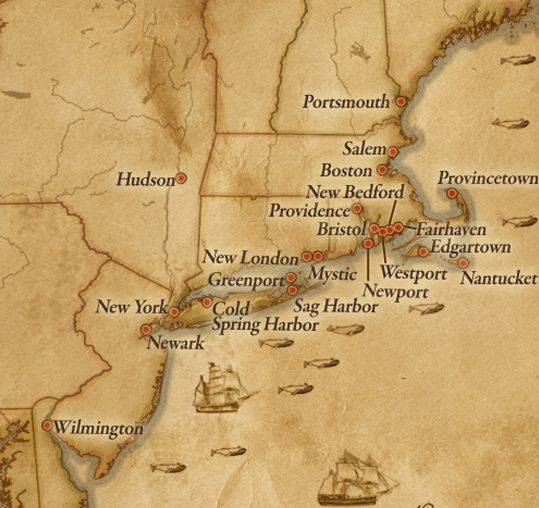
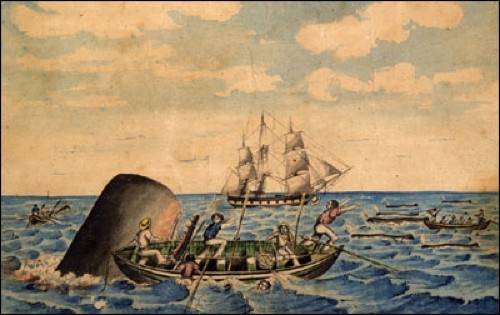
long nineteenth century. Many of these narratives are written from an almost exclusively national and/or economical perspective. This circumscribing approach has effectively relegated whaling narratives to the realm of niche histories mostly cut-off from the local-global frameworks which brought it about. As a result, the participation of non-Western and remote actors in transnational whaling networks, the globalising roles of artisan industries, and the resulting production, circulation and refashioning of knowledge are not well understood. My research endeavours to identify these transmaritime relationships, analyse its transfers and epistemic migrations and assess what impact these exchanges had on Dundee, Scotland, in comparison to other transatlantic whaling ports.
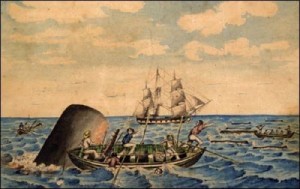
Whaling Ship

Whaling Ship

Many towns throughout coastal Scotland engaged in whaling during the nineteenth century. On a transatlantic scale, ports such a New Bedford, Massachusetts and later, Sandefjord, Norway far outstripped Dundee in the magnitude of their whaling operations. But while most whaling communities followed an ephemeral pattern of existence, which consisted of hunting whales intensively for several decades, falling into decline and then realigning to different locally- or regionally-oriented commercial orbits, Dundee’s wooden whalers plied the icy waters of the ‘northern fishery’ for over 160 years. During that time, Dundonians established strong economic and cultural links with Shetlanders, Newfoundlanders and the Inuit of the Arctic. The Scottish diaspora seems to have extended these connections even further to Australia, New Zealand and Canada. By the late-nineteenth and early-twentieth centuries, exploration committees of the ‘Heroic Age’ sought out Dundee’s whalers for support in polar expeditions. Furthermore, prominent scientists from Dundee and St Andrews, such as Sir D’Arcy Wentworth Thompson, became influential figures within the whaling and scientific communities. Through the agency of its whaling crews, Dundee’s transmaritime interconnections between local experience and global structures not only helped materially shape today’s city, but also it laid planks for how modern polar science and environmental conservation would develop. Although never the geographical ‘the gateway to the North’, by the early twentieth century, Dundee, even with its whale trade flagging, could claim that in many respects, it was the ‘City of Discovery’ for knowledge of the polar regions.


Key subject-matter texts used in research:

Burnett, D. Graham, The Sounding of the Whale: Science and the Cetaceans in the Twentieth Century (London, 2012).

Headland, Robert, ‘Geographical Discoveries in Antarctica by the Whaling Industry’ in Basberg, Bjørn; Ringstad, Jan Erik and Wexelsen, Einar (eds.), Whaling and History: Perspectives on the Evolution of the Industry (Sandefjord, Norway, 1993).

Jackson, Gordon, The British Whaling Trade (London, 1978).

Latour, Bruno, Reassembling the Social:  An Introduction to Actor-Network Theory (Oxford, 2005).

Russell, Lynette, Roving Mariners:  Australian Aboriginal Whalers and Sealers in the Southern Oceans, 1790-1870 (Albany, 2012).


Tomlinson, Jim, Dundee and the Empire: ‘Juteopolis’ 1850-1939 (Edinburgh, 2014).

Tønnessen, J. N. and Johnsen, Arne O., The History of Modern Whaling, trans. R. I. Christophersen (Berkeley, 1982).


Key transnational, spatial and transcultural readings and articles of interest:

Baker, Alan R. H., Geography and History: Bridging the Divide (Cambridge, 2003).

Clavin, Patricia, ‘Defining Transnationalism’, Contemporary European History 14/4 (2005), 421-39.

Clavin, Patricia, ‘Time, Manner, Place: Writing Modern European History in Global, Transnational and International Contexts’, European History Quarterly 40/4 (2010), 624-640.

Iriye, Akira, Global and Transnational History:  The Past, Present, and Future (Basingstoke, 2013).

Tyrrell, Ian, Transnational nation : United States history in global perspective since 1789 (Basingstroke, 2007).


Sacking Kenyan workers in Uganda: nation-states and migrants’ trans-border (imperial) networks

As a second-year master student from SciencesPo Paris, I work on mass expulsions from the standpoint of nation-building in postcolonial Uganda (1966-1972). My master’s dissertation deals with two of these events; the sacking of about 20,000 Kenyan workers in 1970 and the expulsion of 55,000 “Asians” (meaning people of Indian descent in East Africa) by Idi Amin in 1972.

Encountering networks where they were not (initially) expected

During a fieldwork conducted in July-August 2014, I confronted the governments’ narratives of the “Kenyan sacking” (national archives) with the views expressed by the Kenyan migrants themselves (interviews). They turned out to be quite dissimilar. On the one hand, in the national archives, the narrative was taking the shape of an interstate crisis between Kenyan and Ugandan ministers in the middle of which migrants found their future in Uganda in jeopardy; but, on the other hand, the former expellees had a very different version to offer, a version in which they displayed agency through colonial-inherited networks.

Therefore, I happened to take interest in trans-border networks in East Africa and I am hoping to learn more over the analysis of transnational networks and find inspiration at GRAINES.

Integrating imperial trans-border ties to national(ist) policies

The immigration and labour policies behind the Kenyan workers’ crisis in 1970 were conceived and implemented

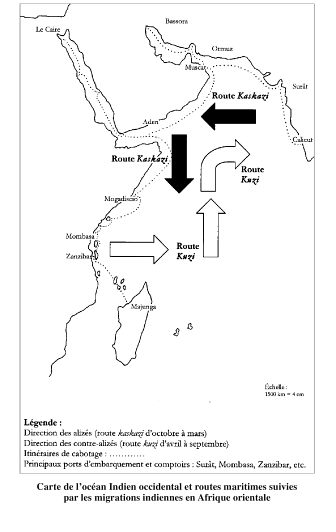
Western Indian Ocean routes of migration. Michel ADAM (dir.), L’Afrique indienne: les minorités d’origine indo-pakistanaise en Afrique orientale, Paris, Karthala, 2010, p. 12.

Western Indian Ocean routes of migration. Michel ADAM (dir.), L’Afrique indienne: les minorités d’origine indo-pakistanaise en Afrique orientale, Paris, Karthala, 2010, p. 12.

by the Ugandan Government in order to favour the employment of Ugandan citizens inside Uganda. However, this very national(ist) policy ended up being faced with the permanence of local trans-border links with Western Kenya. These connections which had been established when East Africa was still a “British” region allowed for expellees’ agency and frustrated the government’s attempt at “Ugandanizing” employment opportunities. Therefore, whereas immigration and labour policies are intrinsically seen as “national” problems, there is an equal need to combine the national approach with a more transnational outlook. Thereby, we might get a greater understanding of the role of imperial connections initiated within the British Empire and perpetuating themselves beyond independences.

Meanwhile, we are witnessing an important renewal of the historiography surrounding the so-called “Asian question” in East Africa (ie: the problems and challenges faced by the people of Indian descent in East Africa after the independences of Kenya, Uganda and Tanzania). There is an increasing pressure to re-contextualize the presence and activities of Asians in East Africa within the British imperial mobility space opened in the Indian Ocean. However, the historiography has concentrated exclusively on Asian populations and, consequently, it has so far failed to adapt its conceptual framework to other migrant populations whose fate has been forgotten (ie: Kenyans).

    We advocate for a need to review the histories of “Africanisation” and “Ugandanisation” of economic opportunities by both enlarging the “Asian focus” and by taking into account the imperial connections which migrants settled in Uganda enjoyed.

Readings

  • Broader references on the Indian Ocean imperial space may include : Thomas R. METCALF, Imperial connections: India in the Indian Ocean arena, 1860-1920, Berkeley, University of California Press, 2007 ; Sugata BOSE, A hundred horizons: the Indian Ocean in the age of global empire, Cambridge, Mass, Harvard University Press, 2006.
« Older posts Newer posts »