GRAINES Summer School, St Andrews, 7-10 June 2015

Tag: networks

How to be a global player. The Basel Mission between faith, trade and internationalism, 1910 – 1925.

My name is Matthaeus Feigk, I’m a 2nd year PhD-candidate at the Basel Graduate School of History and the Institute for European Global Studies at the University of Basel. The research project I’m working on is entitled How to be a global player. The Basel Mission between faith, trade and internationalism. 1910 – 1925. I obtained my Bachelor as well as my Master degree at the University of Heidelberg (2013).

My PhD-project surveys the Basel Mission as a global stakeholder, respectively a participant in global networks during the investigation period from 1910 to 1925. This is from the World Missionary Conference in Edinburgh to the Basel Mission’s return to the mission areas it had lost during the First World War. Rooted in Germany as well as in Switzerland, the society had by 1900 become one of the largest German-speaking protestant missions. It did not only maintain mission areas from Western Africa to China but also operated through its trading company, which played a crucial role in the cocoa trade as well as in industrial weaving and brick manufacturing in India.
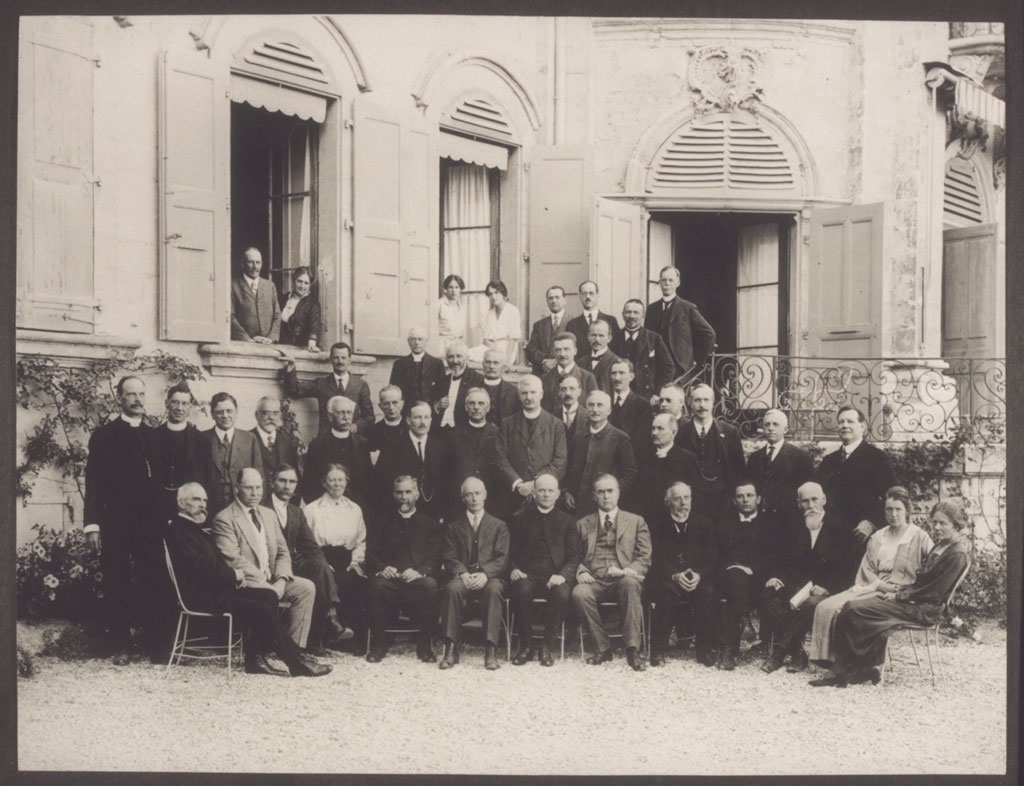
QS-30.033.0006

The international line-up of the missionary meeting at Crans, Switzerland, June 1920. Third row, second from right, with sun glasses: Friedrich Würz, Mission Inspector of the Basel Mission. BMA QS-30.033.0006.

Owing to its Pietist origins, the Basel Mission was from the start part of existing international networks in the protestant world. Numerous supporting associations in Switzerland and Germany contributed to the transnational Swiss-German organizational structure within the missionary society. Moreover, the Basel Mission maintained strong personal connections to German and British missionary circles as well as to Switzerland’s political and financial elites.
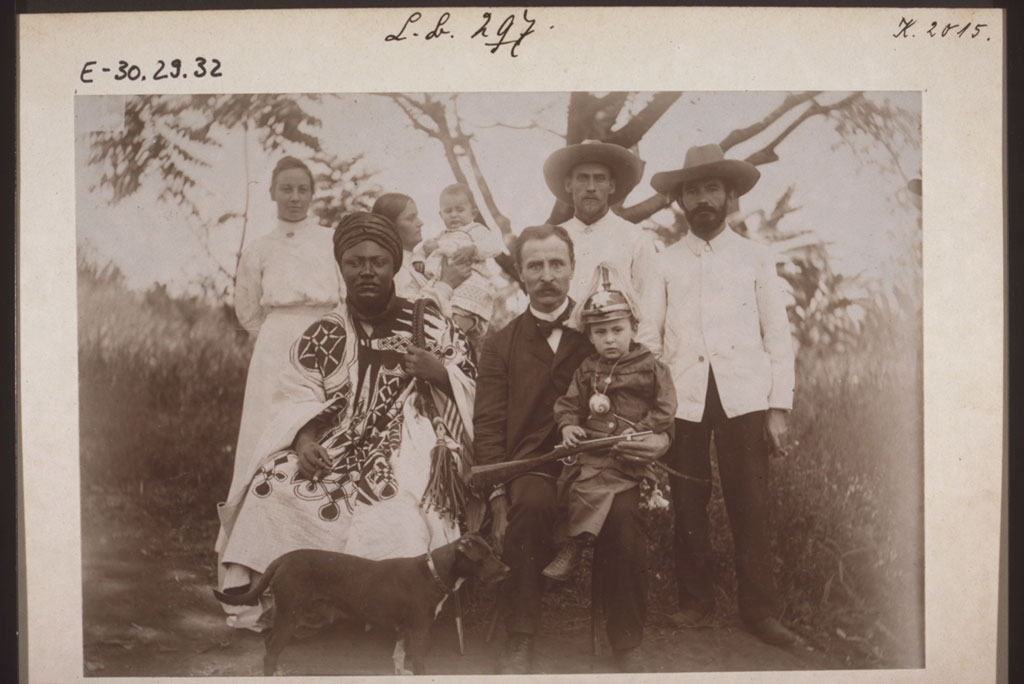
E-30.29.032

King Njoya of Bamun, Cameroon, with Basel missionaries in 1908. Note the little boy’s prussian spiked helmet! BMA E-30.29.032. (Also shown in Jenkins, Paul: A short History of the Basel Mission, Basel, 1989)

My project analyzes the role of this organization and its members in the protestant internationalism emerging in the late 19th and beginning 20th century. It is therefore based on an approach in social sciences, which emerged during the last decade and emphasizes the relevance of religious non-state agents and their networks in shaping a global civil society beyond religious frame-works. Consequently this is not a doctoral thesis situated in theology or the religious studies. I consider the Basel Mission to be a globally operating organization and a transnational organization in itself, connecting not only colony and metropolis, but also personal and institutional stakeholders within Europe and across the Atlantic ocean with religious, scientific, administrative or commercial background.
How did the Basel Mission use this contacts to overcome the crisis of the First World War? To what degree was the Basel Mission involved in the new surge of internationalization within the European missionary community after the war? Did interdependencies and mutual influences exist between religious and secular internationalism?

Readings being essential to my project are for example Rebekka Habermas: Mission im 19. Jahrhundert. Globale Netze des Religiösen („Mission in the 19th century. Global networks of the religious“) as well as Abigail Green and Vincent Viaene: Rethinking Religion and Globalization, in: Id. (eds.): Religious Internationals in the Modern World. Globalization and Faith Communities since 1750. Both texts point to the vast transnational spaces created by religious actors in general (Green and Viane) and by missionaries from the German-speaking countries in particular (Habermas) through correspondence, journeys and exchange forums and highlight their thereby emerging relevance for the history of internationalism.

My investigation allows to engage in research debates such as 1.) a methodological definition of the parameters reproducing a network 2.) the role of religious motivations in this context and interdependences with the non-religious sphere, and 3.) a widened perspective on Switzerland as a “colonial power without colonies” (Purtschert, 2012) as well as an important hosting country of international organizations.

Bibliography:

Abigail Green and Vincent Viaene: Rethinking Religion and Globalization, in: Id. (eds.): Religious Internationals in the Modern World. Globalization and Faith Communities since 1750. Basingstoke et. al. 2012, pp. 1-19.

Habermas, Rebekka: Mission im 19. Jahrhundert. Globale Netze des Religiösen, in: HZ 287 (2008), pp. 629‐679.

Mettele, Gisela: Weltbürgertum oder Gottesreich. Die Herrnhuter Brüdergemeine als globale Gemeinschaft 1727–1857. Göttingen 2009.

Purtschert, Patricia et al. (eds.): Postkoloniale Schweiz. Formen und Folgen eines Kolonialismus ohne Kolonien. Bielefeld 2012.

Sluga, Glenda: Internationalism in the Age of Nationalism. Philadelphia 2013.


Travelling networks by Martin Schaller

Who I am

Hello and welcome to my first blogpost. My name is Martin Schaller. I am a PhD-candidate in Modern History at the University of St Andrews but currently living in Vienna.

In 2009, I commenced my studies in history and economics at the University of Vienna. After obtaining Bachelor degrees in both subjects I relocated to St Andrews in 2012 where I graduated with a MLitt in Modern History. The focus of my research is the outside perspective on the Habsburg Empire. I am examining British and German travel accounts to better understand how this huge entity in the middle of Europe was perceived and located during the 19th century – after all it was situated on the crossroads between East and West Europe. This is only a rough outline of my PhD-project but I am more than happy to discuss details during the Summer School.

A longer research period in Vienna allowed to concurrently work in the R&D-Department of the Austrian National Library, coordinating the Europeana Newspapers Project, a project that focused on newspaper digitization and its refinement by applying Optical Character Recognition. My involvement within the Austrian National Library facilitated a deeper understanding of the foundations necessary to allow Digital Humanities to work with historic material.

The research I am doing

For the Summer School I am preparing a small scale project that is aimed at clarifying some issues in my general research. Hence, what I am doing here should at some point feed into my PhD-project.

Traveller’s networks – textual networks

The notion of ‘networks’ often evokes the idea of researching the relationships between people but this is certainly only one form of networks. Equally important, though not that often in the centre of interest are connections between people and goods, the interconnection of different goods but also between objects in general.

To limit the topic to a manageable size I concentrate on British travel writers on the Habsburg Empire in the 1820s and 1830s. The genre of travel literature on continental Europe was thriving at the time. Influenced by late Enlightenment ideas of knowledge accumulation and progress, the genre kept the agenda of collecting and distributing knowledge into the 19th century.[1] Besides technological and economic development the political situation of the researched time period aided the boom. As a scholar remarked: “…years of Napoleonic war had whetted the public appetite for information and sketches of places so recently famous…”[2] In short, a lot of British travellers were on the continent, visiting also places not necessary found on traditional itineraries.

In the course of my research for the Summer School I realized that there are actually two types of networks relevant to understand travel and travel writing of the time: a more abstract type of intellectual network and a more tangible personal network. In the following lines I would like to describe both kinds of networks briefly.

Networks based on writings?

As any publication, travel literature was not only published but of course also discussed. Reviews, sometimes even reviews of reviews, appeared in newspapers and magazines across Great Britain commenting on each published travel account and thus fostering a discourse on the Habsburg Empire. But this process was certainly not unidirectional. German speaking audiences were highly aware of the ongoing discussions and had, despite official censorship, access to them. Thus by examining biographies, primary works and their reviews we are able to trace a highly interesting net of responses and counterstatements across borders. This net allows for valuable insights into transnational links that formed certain ideas about a foreign entity.

A more tangible network is the result of the social practice of travel. 19th century travellers faced a problem also known to modern day travellers who voluntarily relinquish modern tourism infrastructure: How to get in touch with locals? The answer of the time was the letter of recommendation. A contemporary traveller furnished with appropriate letters was able to unlock doors and enter circles otherwise closed. This was also an important possibility to acquire new information that would later help to sell the book or render it controversial and thus have a direct impact on the narrative these travel writers were producing eventually.

What I can offer

I see myself as a person who knows both the ‘user’ and the ‘producer’ side in Digital Humanities. I can give insights in technologies that are used in creating the digital content from historical documents (first and foremost OCR) that allow for visualisation and further analysis by researchers. However, my main motivation is to meet and discuss with researchers and students applying a transnational view on History.

Bibliography:

As outlined above, my research is much more focused on transnational history than on the study of networks. Therefore my selected works have a bias towards the former. However, I am convinced that these articles and books are also relevant to understand networks across borders.

Scales do matter; I my opinion also for the study of networks. Therefore I’d like to suggest the following, more theory driven article, which examines the relationship between scales and transnational history: Bernhard Struck, Kate Ferris and Jacques Revel, Introduction: Space and Scale in Transnational History, in The International History Review, 33:4, pp. 573-584.

A good overview of traveling and travel writing as a research topic as well as the social practice (and hence networks) of travel gives: Hagen Schulz-Forberg, European Travel and Travel Writing: Cultural Practice and the Idea of Europe in: Hagen Schulz-Forberg (ed.), Unravelling Civilisation: European Travel and Travel Writing (Brussels 2005), pp. 13-42.

On transnational history and my own research, I see two works as really important: Larry Wolff, Inventing Eastern Europe: The map of civilization on the mind of the Enlightenment (Stanford 1995) and Maria Todorova, Imagining the Balkans (New York, Oxford 1997).


[1] Casey Blanton, Travel writing: The Self and the World (New York 2002), pp. 3-4, 15.

[2] Helen Heineman, Mrs. Trollope: The Triumphant Feminine in the Nineteenth Century (Athens 1979), p. 121.

Workshop on Trans-Imperial Networks

The programme keeps growing. We now have a confirmed contribution by Fabricio Prado (William & Mary, USA). Fabricio will run a session on his current research, provisionally entitled ‘Trans-Imperial Networks in the South Atlantic: the Rio de la Plata -Rio de Janeiro connection 1777-1808’.

It will be a pleasure to see Fabricio joining us for the summer school. He will be here in May for 10 days as the William & Mary Visiting Fellow in 2015. The fellowship is part of our teaching staff exchange between both universities that run a joint International MA undergraduate degree.

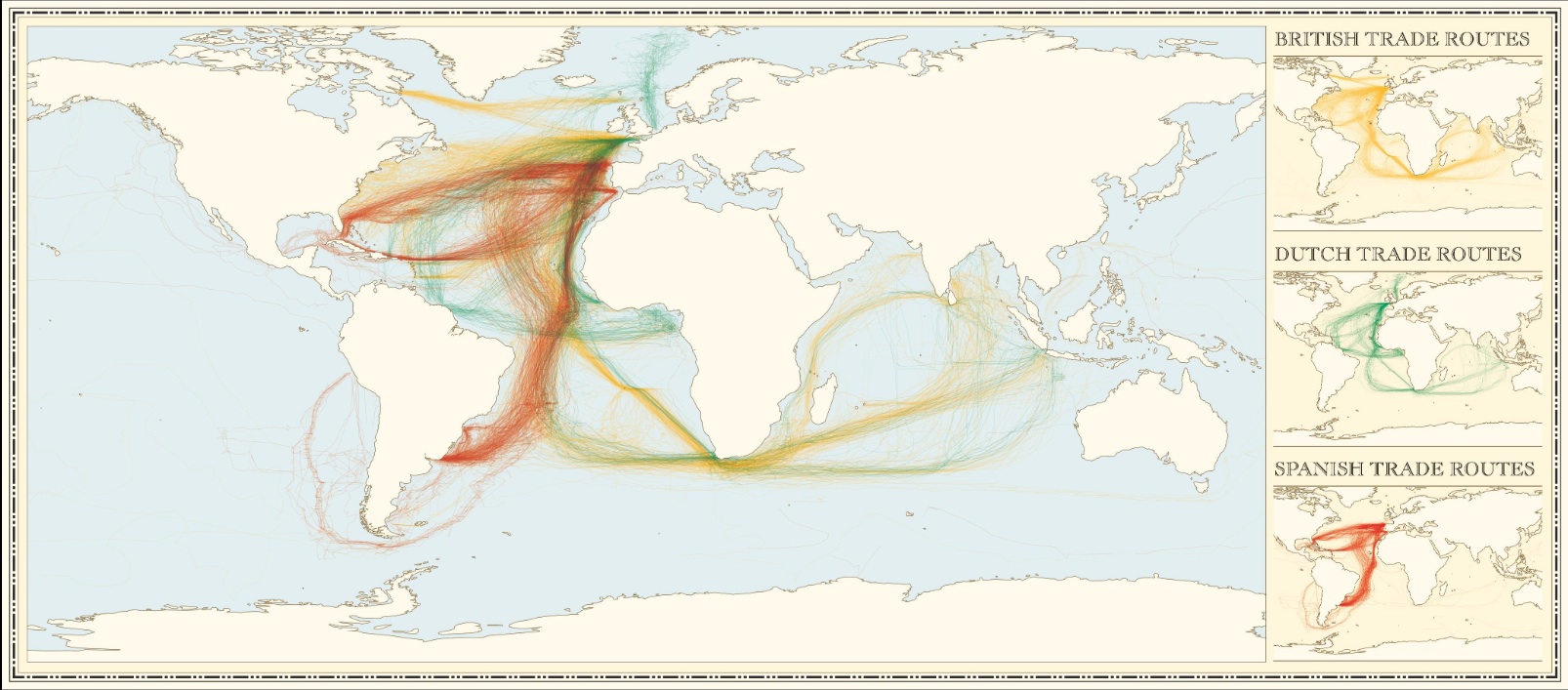
English, Spanish and French Shipping between 1750-1800

English, Spanish and French Shipping between 1750-1800

With his expertise and interests in social and commercial networks between different regions of the Atlantic, as for instance New England to Rio de la Plata in the last decades of colonial rule in Latin America, he will make a great contribution to the summer school.

Programme update

The programme for Interconnected is growing and we will keep adding in the coming days and weeks.

We now have a workshop with Andrew Pettegree and Arthur der Weduwen (both St Andrews) on ‘Network practice in the early modern news world’. Professor Pettegree has been running the University Short Title Catalogue project for many years at St Andrews. He has recently published his bestselling monograph ‘The Invention of News‘ (Yale 2014).

Philipp Ther (Vienna) will be leading a session on ‘The global 1989 – networks of neoliberalism’. His contribution will go back to his latest monograph on transformation of the old continent, i.e. Europe.


Welcome

Welcome to the third GRAINES summer school. Following the 2013 summer school on Margins at Menton and the 2014 theme of Cities in Transformation in Vienna, this year’s theme is Networks.

The summer school will be hosted by the Institute for Transnational & Spatial History, St Andrews 7-10 June 2015. It is co-organised by the GRAINES network and generously supported by the School of History, the Institute for Intellectual History at St Andrews and the AHRC-funded project on Global Cities.

Screen_Shot_2014-08-20_at_11.25.13_AM.0GRAINES is a loose and informal network that brings scholars from a range of historical topics and periods together, it combines the universities of Basel, Cologne, SciencesPo Paris, Prague, St Andrews, and Vienna. We co-organise and co-host workshops and reading parties. Our mission is to support graduate schools and allow them to move between our institutions, depending on their needs and research interests. The summer school has been the key meeting over the past two years.

Over the past three years we have worked on broader themes that we think are relevant for scholars working in European and non-European history from the late medieval to the late modern period. In early June we would like to welcome you to discuss with us the theme of networks and the role of networks in transnational and global history.

The past summer schools have brought together some 30-35 scholars each year from GRAINES institutions and beyond. Participants are mainly PhD researchers and staff from GRAINES partners. A number of places are reserved for Masters / MLitt students.

The spirit of the summer schools is to share and collaborate for a few days, to discuss our research and work together. It is based on knowledge production and sharing rather than consumption.

GRAINES is not a formally funded organisation. The summer schools are subsidised by our home institutions, but we do rely on participants to be prepared to share costs. We try our best to keep costs low and the meeting affordable. The fees cover B&B accommodation and catering during the summer school.

The main St Andrews organisers this year are: Konrad Lawson, Giada Pizzoni & Bernhard Struck.

Mail: graines.interconnected@gmail.com


[contact-form][contact-field label=’Name’ type=’name’ required=’1’/][contact-field label=’Email’ type=’email’ required=’1’/][contact-field label=’Website’ type=’url’/][contact-field label=’Comment’ type=’textarea’ required=’1’/][/contact-form]