GRAINES Summer School, St Andrews, 7-10 June 2015

Tag: Europe

The Lyon International Sample Fair as a hub for business associations, 1916-1918

Lyon Fair organizational chartlyon fair
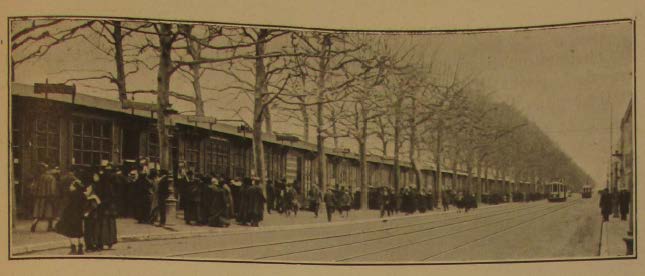
 

I would like to discuss an article-in-progress on the Lyon International Sample Fair during the First World War. This event was held for the first time in March 1916 and continued to convene every spring thereafter. This was the largest trade fair to be held on Allied soil during the war and it was the only one that welcomed both foreign exhibitors and buyers in substantial numbers.

While the Lyon fair initially facilitated trade in and out of Europe, by 1918 its primary function was not to support the movement of goods but rather to foster social and organizational relationships. In encouraging American firms to participate in the 1918 fair, the US consul in Lyon wrote: “It is of small moment whether or not they [exhibitors] can make contracts in view of conditions, but it is most important that they be put in touch with active buyers, and there is no better way than this.”

The First World War stimulated a remarkable proliferation of “sample fairs.” These were events where producers exhibited models and negotiated contracts for future delivery with wholesalers, commission agents and other intermediaries. While there had only been one sizeable sample fair in Europe prior to 1914, in Leipzig, there were more than thirty by 1921.

The Lyon fair, like most of the other new sample fairs, drew heavily on the financial and organizational resources of the local chamber of commerce. The Lyon Chamber of Commerce used its ties to foreign business associations and consular networks to recruit exhibitors and also to help support the execution of orders placed at the fair. During a period of flux when many firms were trying to replace longstanding relationships with suppliers and clients that had been disrupted by the war the fair was an attractive trade venue in large part because it offered a pool of potential trade partners who were generally vetted and backed by some kind of organizational guarantor, either formally or informally. In other words, the fair drew large crowds not merely because it offered a wide selection of products but also because it provided access to a large number trustworthy business networks.

Hubert Bonin, Catherine Hodeir, and Jean-François Kline eds., L’esprit économique impérial (1830-1970). Groupes de pression & réseaux du patronat colonial en France & dans l’empire, (Paris: Publications de la SFHOM, 2008).

This edited volume on elite organizations within the French empire analyzes many of the kinds of networks that operated at the Lyon fair. Many of the contributions highlight the role played by chambers of commerce and other business associations in the formation of distinct regional and municipal imperial economic systems and colonial cultures. I think that Lyon Chamber of Commerce welcomed foreign exhibitors at the Lyon Fair in part because they were trying to establish the city as an international gateway to certain trade networks within the French empire. However, the Lyon Fair had to compete with the Bordeaux Sample Fair, which was also established during the war. The Bordeaux Fair was smaller, but it was much more explicitly billed as a point of access to French imperial trade networks.

Phillip A. Dehne, On the far Western Front: Britain’s First World War in Latin America (Manchester: Manchester University press, 2010).

This work examines efforts on the part of British business associations and officials to restrict German commercial activity in Brazil, Argentina and Uruguay during the First World War. It illuminates the way transnational commercial networks responded to the disruption of international trade during the First World War. Like the local business association Dehne discusses, the Lyon Chamber of Commerce insisted that its activities were contributing to the broader “economic war” against the Central Powers. Dehne shows that the “economic war” had ramifications well beyond the formal restrictions established by the Allies because the temporary disruption of German foreign trade stimulated a flurry of private, often uncoordinated efforts to take over German commercial positions. It also produced a clearer delineation of national political allegiances within commercial communities.

Harald Batheit and Nina Schuldt, “Between Meat Grinders and Luminaries: International Trade Fairs as Temporary Clusters,” Regional Studies, Special Issue, Clusters in the Global Knowledge-based Economy: Knowledge Gatekeepers and Temporary Proximity, 42, 6 (Jan. 2008), 853-868.

I have found social scientists’ analyses of present-day trade shows useful as I have tried to think through the Lyon fair’s various social and organizational functions. Historians have generally analyzed twentieth-century trade fairs as marketing events or public spectacles. Batheit and Schuldt have shown that many activities happen trade shows beyond advertising and shopping. They have notably argued that trade shows offer lots of opportunities for informal and impromptu social interactions, which create an extremely rich information environment. They suggest this enables attendees to branch out from their established “clusters” of trade partners in relative security. This article helped me analyze the physical layout of the Lyon fair. The fair itself consisted in a collection of small, detached exhibition buildings. However, the organizers eventually began to offer common meeting spaces, social events and formal conferences, which would have allowed for a greater number of chance meetings.


A “New” Big Science?

My project focuses on European large-scale research in the post-Cold War. Did European big science change after the end of the cold war? And if yes, how and to what extend? While some scholars treated big science as an exclusive feature of the Cold War, it did not vanish away with its end. Seemingly echoing Alvin Weinberg’s words from the early 1960s, “Big Science is here to stay”, a widespread sense emerged among those studying big science that large-scale research is a seemingly enduring phenomenon of the 20th and 21st century, but it changed throughout the last decades.

The notion of big science is still elusive. Discussions frequently centre on What makes big science a particular way of doing research? and To what extent does it differ from other, smaller research projects? To bring some clarity to this fuzzy conceptual framework, I may introduce the notion of big science laboratories. Although it does not appear as a truly innovative idea, it may shed systematic light on the understanding of big science as well as it may help me to structure my conceptual as well as empirical work. For those who have never heard before of big science, but would like to gain a first impression, I recommend the readings from John Krige (2003) and Olof Hallonsten (2014) (see below).

Big science laboratories (as I understand them) have a massive material centrepiece – such as accelerators or light sources. They are geographically identifiable locations where scientific practice and materiality are physically co-located, but access is limited. The spatial distinction between inside and outside the laboratory is in some cases also an epistemological one: Karin Knorr Cetina for instance regards laboratory work in general as a detachment of objects from their natural, temporal and territorial regimes that she terms “enculturation”. Laboratories do not stage phenomena, but manipulate them. However, a general epistemological distinction between internal and external factors that bear independently upon the course of science is an unproductive way of analysis. These laboratories look like fenced-off scientific enclaves, but politics have quite real material, practical and discursive dimensions in these spaces.

I have been trained in political science / international relations (IR) and sociology. I also started to study physics and a strong focus on experimental physics let me certainly fall in love with large-scale experimental equipment. My project adopts a slightly different perspective as it has been so far the case for many big science studies. It focuses on the role of (international) politics arguing that to speak of European big science laboratories as entirely politicized is as much a naiveté as to speak of them as being politically neutral. While this is certainly nothing new for scholars of science and technology, it brings me to a conceptual middle ground for mutual learning between big science studies and IR theory.

While the study of big science is already widely spread among various academic fields, the discipline of IR still lacks a conceptual repertoire to handle the dynamics of large-scale research in the international system. The relationship between international relations and big science seems , however, particularly obvious. Politics matter when large sums are invested and different cultures melt in collaboration, when Nobel Prize-worthy discoveries are at stake and research and development touch upon issues of national security, power and economic growth. The site selection processes as well as the necessary financial long-term contributions and commitments by the member states have ever been subject to heavy political contestation.

General methodological reflections in IR have often been too narrow and in many cases, science and technology are limited to exogenous, residual factors in the international system. Moreover, the exclusive focus on the state-as-actor is insufficient for a nuanced understanding of the big science-international politics nexus. Materials, scientists, experts and tools rather easily challenge traditional understandings of the state and its territorial limits of authority. They wave together global connections of in-kind contributions and expertise, transnational collaboration and commitment.

I read Bruno Latour, Andrew Pickering or Sheila Jasanoff (see below), but none of these approaches really satisfied me. I came across some papers that have been published from IR scholars trying to conceptually bridge IR theory and science studies (Mayer and Acuto (2015) or Herrera (2003), both have been really inspiring!). They adopted one of the classics in the history and sociology of science and technology: John Law’s and Thomas Hughes’ ideas on sociotechnical systems. Law’s paper On the Social Explanation of Technical Change. The Case of the Portugese Maritime Expansion (1987a) has really provoked an aha-moment and I strongly recommend reading it! I also recommend a second paper from Law that is quite similar to the first: Technology and Heterogeneous Engineering: The Case of Portuguese Expansion (1987b). And of course: Thomas Hughes’ Networks of Power (1983).

Their approach(es) provide a valuable middle-ground that enable both IR theory and big science studies to grasp and trace agency beyond formal political contexts and institutions. By neither favoring social nor technological explanations, it intends to treat science and technology as endogenous variables of the international system refusing instrumentalist and externalist perspectives. The sociotechnical approach also enables me to trace big science’s dialectic change throughout the last decades emphasizing how new forms were built upon the old without total replacement and to what extend there is both, novelty and continuity. Asking for the “how” instead of the “why” challenges IR’s most fundamental orientation: Understanding order instead of change.


Readings:

Hallonsten, Olof (2014). The Politics of European Collaboration in Big Science. In: The Global Politics of Science and Technology – Vol. 2, Mayer, Maximilian, Carpes, Mariana and Ruth Knoblich (eds.), 31-45, Berlin, Heidelberg: Springer.

Herrera, Geoffrey L. (2003). Technology and International Systems. In: Millennium. Journal for International Studies 32 (3): 559-593.

Hughes, Thomas P. (1983). Networks of Power. Electrification in Western Society, 1880-1930, Baltimore and London: John Hopkins University Press.

Jasanoff, Sheila (Hg.) (2006). States of Knowledge. The Co-Production of Science and the Social Order. London: Routledge.

Knorr Cetina, Karin (1999). Epistemic Cultures. How the Sciences Make Knowledge. Cambridge, Mass.: Harvard University Press.

Krige, John (2003). The Politics of European Scientific Collaboration. In: Companion to Science in the Twentieth Century, Krige, John and Dominique Pestre (eds.), 897-918. New York: Routledge.

Law (1987a). On the Social Explanation of Technical Change. The Case of the Portugese Maritime Expansion. In: Technology and Culture 28 (2): 227-252.

Law, John (1987b). Technology and Heterogeneous Engineering: The Case of Portuguese Expansion. In: The Social Construction of Technological Systems. New Directions in the Sociology and History of Technology, Bijker, Wiebe E., Hughes, Thomas P., and Trevor J. Pinch (eds.), 111-134, Cambridge, MA: MIT Press.

Mayer, Maximilian and Michele Acuto (2015). The Global Governance of Large Technical Systems. In: Millennium. Journal of International Studies 43 (2): 660-683.

Pickering, Andrew (1995). The Mangle of Practice. Time, Agency, and Science. Chicago: University of Chicago Press.