Interconnected – Actors, Objects and Ideas on the Move in Transnational & Global History
The Programme is subject to changes and will be updated regularly. We have some key readings here as well as exercises (Andrew Pettegree & Arthur der Weduwen; Roberto Sala). For further readings please also check under Programme.
Sunday, 7 June 2015
Travel to St Andrews, Arrival, Check in McIntosh Hall
6pm Welcome Reception (St John’s House, South Street)
8pm Pub “Central” (Market Street)
Monday, 8 June 2015, Venue St John’s House, South Street
AM
9.00am Coffee & Tea (Undercroft, St John’s House)
9.30am Welcome and Introduction
10am-12 Andrew Pettegree & Arthur der Weduwen (St Andrews), Network Practice in the Early Modern News World
It was in the sixteenth and seventeenth centuries that Europe first developed a commercial market

Object Network
for news. New readers and new technologies combined to create a healthy market for news pamphlets, illustrated broadsheets and eventually newspapers. An essential prerequisite for such a market was an infrastructure of news gathering. Here Andrew Pettegree and Arthur der Weduwen probe how big data projects such as the Universal Short Title Catalogue can reveal currents of international information flow, and how the development of an international book market provided the essential basis for this transnational information network.
Exercise & Reading Suggestion:
Compare data in the USTC for publications by Martin Luther and Desiderius Erasmus. What does this reveal of the impact of, respectively, the Reformation and Renaissance? Reading: Andrew Pettegree, The Invention of News. How the World Came to Know About Itself (Yale 2015)
Noon Lunch (Undercroft & Garden, St John’s House)
PM
2pm Jakob Vogel (SciencesPo) & Alexander van Wickeren (Cologne), Spaces and Knowledge: New Perspectives on Interconnections in History (workshop) (Old School Library, St John’s House)
Interconnection has long been seen from separated points of reference. In this respect, historians have lately been much concerned with exchanges between different regions, nations or nation-states as well as the cooperation between empires. Secondly, there has been work done on global commodity chains that shows interconnections between spaces of production and consumption by following goods and products (e.g. sugar). Finally, we have research that focuses on scholarly
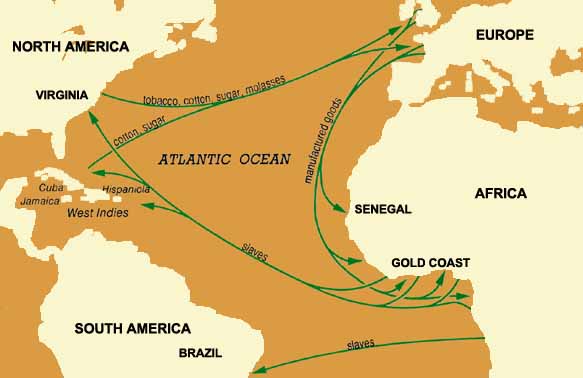
Trading Sugar & Slaves,
exchange in the modern world by taking into account institutions as the early modern “republic of letters” or the various scientific congresses of the 19th and 20th century as networks that enabled the production of knowledge.
Our workshop seeks to combine and integrate these perspectives by focusing on two examples: tobacco and minerals in the 18th and 19th century. It is our aim to show, how both objects allow us to trace connections between global, national and regional spaces, how socially different regimes of exchange emerged alongside materials and how European actors encountered specific orders of object-knowledge related to minerals and tobacco.
The workshop (c.120 min) seeks to combine presentations of papers with more active elements of group work and discussion. At first, we would like to split the participants into small groups and let them discuss (30 min) two methodological texts that we will circulate beforehand (see below). We would like to ask, how these texts could help us to rethink the relation between spaces, objects and knowledge and encourage the participants to present the results in the workshop (briefly, few minutes only). Subsequently we both present our research on minerals (Jakob Vogel) and tobacco (Alexander van Wickeren) (altogether 40 min) to give input for a more general and longer final discussion (20 min).
Texts:
Kapil Raj, Relocating Modern Science. Circulation and the Construction of Knowledge in South Asia an Europe, 1650-1900, Basingstoke / New York 2007, Kap. I: Introduction Raj, Relocating Modern Science Intro
Pierre-Yves Saunier, Learning by Doing. Notes about the Making of the Palgrave Dictionary of Transnational History, in: Journal of Modern European History, 6 (2008), S. 159-180. Saunier, Learning by doing
Coffee & Tea Break
4pm Post Day One: Unconference Briefing & Reflection and Sharing – 2x30mins Pair Writing – and blog posting (c.1 hour)
5.30pm Philipp Ther (Vienna), The global 1989 – networks of neoliberalism (Lecture)
Venue: School II, St Salvator’s Quad (Map)
Text: Philip Mirowski & Dieter Plehwe eds, The Road from Mont Pèleri. The making of the Neoliberal Thought Collective PDF: Mirowski & Plehwe eds, The Road from Mont Pèlerin (Introduction is recommended as background reading for lecture)
7.30pm Dinner MacIntosh Hall
Tuesday, 9 June 2015, St John’s House, South Street
(very AM – for early birds) Run: Golf courses & West Sands (7-8 km, meet 6.50am in front of McIntosh Hall – whatever the weather)
Running the West Sands
AM (we offer two parallel sessions)
9.00 am Coffee & Tea Undercroft
# 1 – 9.15am (ends ca. 12.30) Roberto Sala (Basel), Create your data! The value of relational databases for network analysis (workshop / playshop) (Old School Library, St John’s House)
Embodying the core of digital humanities, databases have been at the centre of discussion on historiography in the digital era. However, most debates concern applications within broad cooperative research projects with thousand of records. As historians seldom use databases for their own individual research, they have no skills in developing content management. This workshop aims to provide participants with the basic skills necessary for creating relational databases. We will initially focus on the elementary features of complex databases, using Filemaker Pro Advanced. We will then analyse the structure of an existing database, the League of Nations Research Engine (www.lonsea.de), and deal with theoretical issues concerning the analysis of historical networks. Finally, we will develop the structure of a database required for a fictional research project.
Reading: Claire Lemercier, Formal network methods in history: why and how?
#2 – 9.15am Ulrike Lindner (Cologne), Actors and Ideas between European Empires (Reading & Discussion Group) (Old Seminar Room, St John’s House)
The period under investigation here, the period of High Imperialism 1870-1914, was, to a large extent, shaped by growing rivalries and increasing diplomatic tension between the European nations. However, these years were also interpreted as witnessing a large spurt in globalization, resulting in a world which was interconnected in many ways. Technical and economic globalization also reached the colonial European Empires in Asia and Africa. There international connections often developed as the European powers co-operated on matters such as, for example, laying telegraph lines and establishing steamer connections. However, European empires co-operated on many other issues, as has been shown in recent research, actors engaged in inter-imperial exchange and ideas on the administration of colonies, on how to fight small wars against the colonized etc. etc. circulated between imperial powers. The session will investigate these forms of circulation and pay special attention to an institution founded for the exchange of colonial knowledge between imperial European powers. Traditional diplomatic history has usually interpreted the differences between the discourses of colonial policy and antagonistic foreign policy by suggesting that before 1914 the colonial periphery was insignificant as it was unable to have any impact on the growing European rivalry. We will try to argue from a less Eurocentric perspective. Global interconnectedness, exchange of ideas and imperial co-operation could be found at the same time as rivalry between the European imperial nations.
Texts:
John M. MacKenzie, European Imperialism: A Zone of Cooperation Rather than Competition? MacKenzie, European Imperialism-1
Ulrike Lindner, New Forms of Knowledge Exchange Between Imperial Powers: The Development of the Institut Colonial International (ICI) Since the End of the Nineteenth Century Lindner, New Forms of Knowledge
c.12.30pm Lunch Undercroft & Garden St John’s House
PM
2pm Fabricio Prado (William & Mary), Trans-Imperial Cooperation: Commerce and War in the South Atlantic, 1778-1810 (workshop) (Old School Library, St John’s House)
In the last quarter of the eighteenth century, a series of deep changes occasioned by warfare, imperial reforms, and imperial disputes changed the balance of power among Atlantic Empires. In particular, the Spanish Empire faced multiple crises, which many historians regard as having paved the way for the Spanish American independence movements after 1808. Spain’s involvement in intermittent warfare in Europe (mainly with Britain), purportedly severed the commercial flow between the Peninsula and the colonies and, subsequently, opened colonial economies to foreigners in the early 1800s.
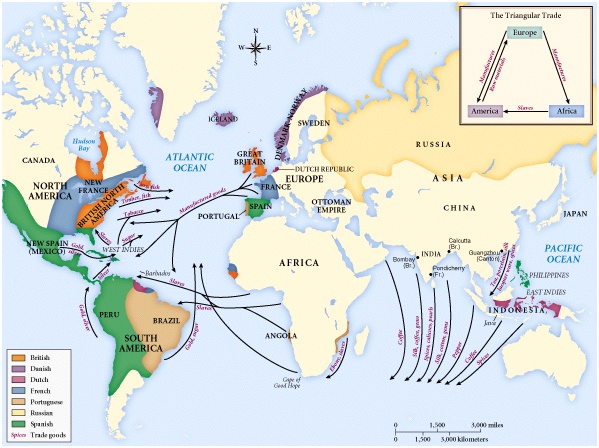
Atlantic trade 18th century
These processes are mentioned as crucial to the collapse of the Spanish colonial system.(Footnote 1) Nevertheless, such explanations were mainly formulated based on sources deposited in Metropolitan archives. By incorporating sources produced by local authorities of both Portuguese and Spanish empires into the analysis reveals a different picture. By cross-referencing multiple sets of historical records produced by different empires, places and authorities, the significance of trade networks between Portuguese and Spanish subjects in the South Atlantic, although formally forbidden, appears as crucial in allowing the flow of goods, people and information between Rio de la Plata and Spain in the late 18th century.
This session aims at examining the significance of trans-imperial networks in shaping the historical processes of the Atlantic empires. Rather than examining the processes of imperial reforms and warfare focusing exclusively on the relationship between colonies and metropoles, I suggest that exogenous processes were crucial for the very definition of empire in the 18th century Atlantic World. By focusing on trans-imperial networks between Spanish-American and Luso-Brazilian merchants, this session will approach the methodological challenges and techniques involved in writing and researching trans-imperial history and networks in the Atlantic World.
Texts:
1) Fabricio Prado, Transimperial Networks (draft material not for citation without permission) Prado, Transimperial Networks
2) Adelman Sovereignty and Revolution in the Iberian Atlantic Ch 1
Footnote: This explanation was originally advanced by the works of John Fisher, “Commerce and Imperial Decline: Spanish Trade with Spanish America 1797-1820,” Journal of Latin American Studies, Vol. 30 (1998): 459-479. John Lynch, Latin American Revolutions, 1808-1826: Old and New World Origins (Norman: University of Oklahoma Press, 1994). This line of interpretation still permeates recent historical works, especially the significance of war in disrupting trade, and interrupting commerce between Spain and its colonies: Stanley Stein and Barbara Stein, The Edge of Crisis: War and Trade in the Spanish Atlantic 1789-1808 (Baltimore: John Hopkins University Press, 2009), 207; also Richard Graham, Independence In Latin America: A Comparative Approach (Austin: University of Texas Press, 2013), and John Elliot, Empires of the Atlantic World (Cambridge: Cambridge University Press) 2006. A notable exception: Jeremy Adelman, Sovereignty and Revolution in the Iberian Atlantic (Princeton: Princeton University Press, 2006).
4pm Tea & Coffee (Undercroft, St John’s House)
4.30pm Post Day Two: Reflection and Sharing – Voting & Planning Unconference Wednesday (c.1 hour)
6.30pm Dinner McIntosh Hall
8pm Whisky Tasting at Luvians (at extra cost 15 GBP per person; 84 Market Street, not in Luvian’s bottle shop but in Luvian’s Cafe, opposite to market fountain)
Wednesday, 10 June 2015 – Unconference Day, Venue St John’s House, South Street
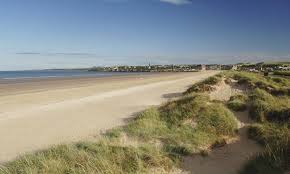
St Andrews West Sands
(very AM – for early birds) Run: Tour around St Andrews – beautiful views promised (12 km) (again meet 6.50am outside McIntosh Hall)
AM
9.00am Coffee & Tea (Undercroft Coffee & Tea)
9.15am Parallel Unconference Meetings, Workshops, Playshops, Discussion & Making Groups (c.90 mins)
10.45am Coffee & Tea
11.15am Parallel Unconference Meetings, Workshops, Playshops, Discussion & Making Groups
12.45 Lunch Undercroft & Garden St John’s House
PM
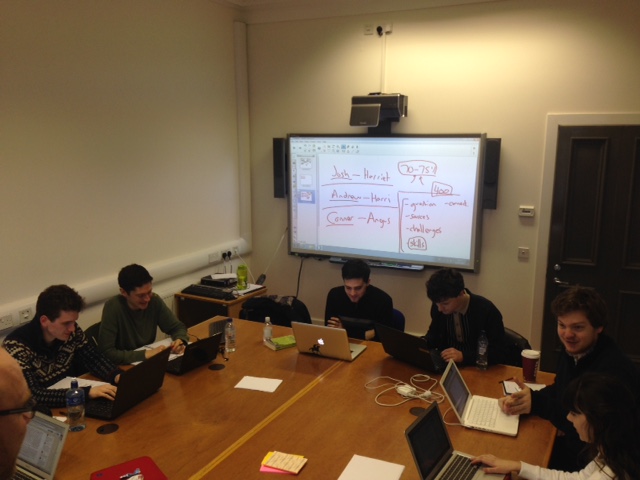
Pair Writing in Practice
2.30pm Pair Writing & Collaboration (2 rounds of 60 mins roughly with a brief break)
5pm PM End of Summer School – Reception / Pub
6.30pm Dinner McIntosh Hall
Thursday, 11 June 2015
(It’s sad but) Travel from St Andrews (or find a couch and just stay)
Recent Comments