My name is Matthew Ylitalo, and I am a first-year PhD student in Modern History at the University of St Andrews. Previously I studied in the United States before completing an MLitt at St Andrews. At Interconnected, I am keen to discuss processes by which one may identify existing networks ‘hidden’ within written sources and documentation. Furthermore, I desire to understand better how others are applying transnational and spatial history theories and methods to problems in their research.
Over the last fifty years, authors worldwide have contributed to a vast literature on whaling in the
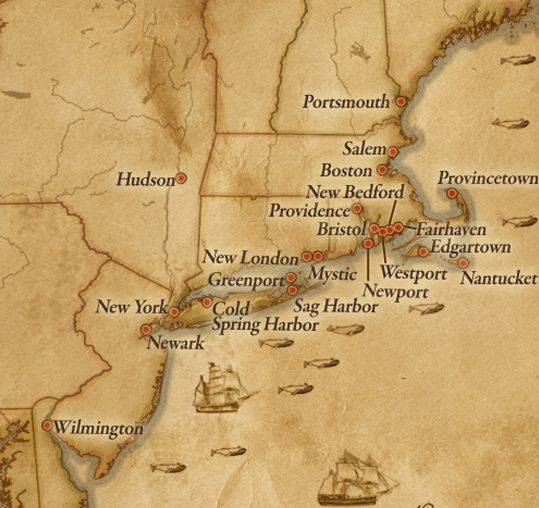
Whaling Map East Coast US
long nineteenth century. Many of these narratives are written from an almost exclusively national and/or economical perspective. This circumscribing approach has effectively relegated whaling narratives to the realm of niche histories mostly cut-off from the local-global frameworks which brought it about. As a result, the participation of non-Western and remote actors in transnational whaling networks, the globalising roles of artisan industries, and the resulting production, circulation and refashioning of knowledge are not well understood. My research endeavours to identify these transmaritime relationships, analyse its transfers and epistemic migrations and assess what impact these exchanges had on Dundee, Scotland, in comparison to other transatlantic whaling ports.
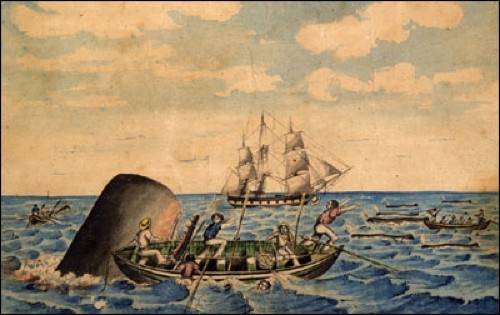
Whaling Ship
Many towns throughout coastal Scotland engaged in whaling during the nineteenth century. On a transatlantic scale, ports such a New Bedford, Massachusetts and later, Sandefjord, Norway far outstripped Dundee in the magnitude of their whaling operations. But while most whaling communities followed an ephemeral pattern of existence, which consisted of hunting whales intensively for several decades, falling into decline and then realigning to different locally- or regionally-oriented commercial orbits, Dundee’s wooden whalers plied the icy waters of the ‘northern fishery’ for over 160 years. During that time, Dundonians established strong economic and cultural links with Shetlanders, Newfoundlanders and the Inuit of the Arctic. The Scottish diaspora seems to have extended these connections even further to Australia, New Zealand and Canada. By the late-nineteenth and early-twentieth centuries, exploration committees of the ‘Heroic Age’ sought out Dundee’s whalers for support in polar expeditions. Furthermore, prominent scientists from Dundee and St Andrews, such as Sir D’Arcy Wentworth Thompson, became influential figures within the whaling and scientific communities. Through the agency of its whaling crews, Dundee’s transmaritime interconnections between local experience and global structures not only helped materially shape today’s city, but also it laid planks for how modern polar science and environmental conservation would develop. Although never the geographical ‘the gateway to the North’, by the early twentieth century, Dundee, even with its whale trade flagging, could claim that in many respects, it was the ‘City of Discovery’ for knowledge of the polar regions.
Key subject-matter texts used in research:
Burnett, D. Graham, The Sounding of the Whale: Science and the Cetaceans in the Twentieth Century (London, 2012).
Headland, Robert, ‘Geographical Discoveries in Antarctica by the Whaling Industry’ in Basberg, Bjørn; Ringstad, Jan Erik and Wexelsen, Einar (eds.), Whaling and History: Perspectives on the Evolution of the Industry (Sandefjord, Norway, 1993).
Jackson, Gordon, The British Whaling Trade (London, 1978).
Latour, Bruno, Reassembling the Social: An Introduction to Actor-Network Theory (Oxford, 2005).
Russell, Lynette, Roving Mariners: Australian Aboriginal Whalers and Sealers in the Southern Oceans, 1790-1870 (Albany, 2012).
Tomlinson, Jim, Dundee and the Empire: ‘Juteopolis’ 1850-1939 (Edinburgh, 2014).
Tønnessen, J. N. and Johnsen, Arne O., The History of Modern Whaling, trans. R. I. Christophersen (Berkeley, 1982).
Key transnational, spatial and transcultural readings and articles of interest:
Baker, Alan R. H., Geography and History: Bridging the Divide (Cambridge, 2003).
Clavin, Patricia, ‘Defining Transnationalism’, Contemporary European History 14/4 (2005), 421-39.
Clavin, Patricia, ‘Time, Manner, Place: Writing Modern European History in Global, Transnational and International Contexts’, European History Quarterly 40/4 (2010), 624-640.
Iriye, Akira, Global and Transnational History: The Past, Present, and Future (Basingstoke, 2013).
Tyrrell, Ian, Transnational nation : United States history in global perspective since 1789 (Basingstroke, 2007).
Recent Comments