My name is Pierre Nobi and I am a graduate student in my second year of Sciences Po Paris’s Master in history. My Bachelor was also at Sciences Po, and I spent a year in exchange at the University of Bath (UK). My current research focuses on the health service of the French expedition to Saint-Domingue (present-day Haïti) in 1802-1803. Traditionally, its presence in the historiography is reduced to a brief overview of the yellow fever epidemic that decimated the French army and a discussion on how big a factor it was to the failure of the expedition. Moving past military history’s fetishisation of this factor of defeat, I aim to uncover instead the various actors and medical practices of the health service, and examine it as a “colonial medical encounter” (Thoral, 2012).
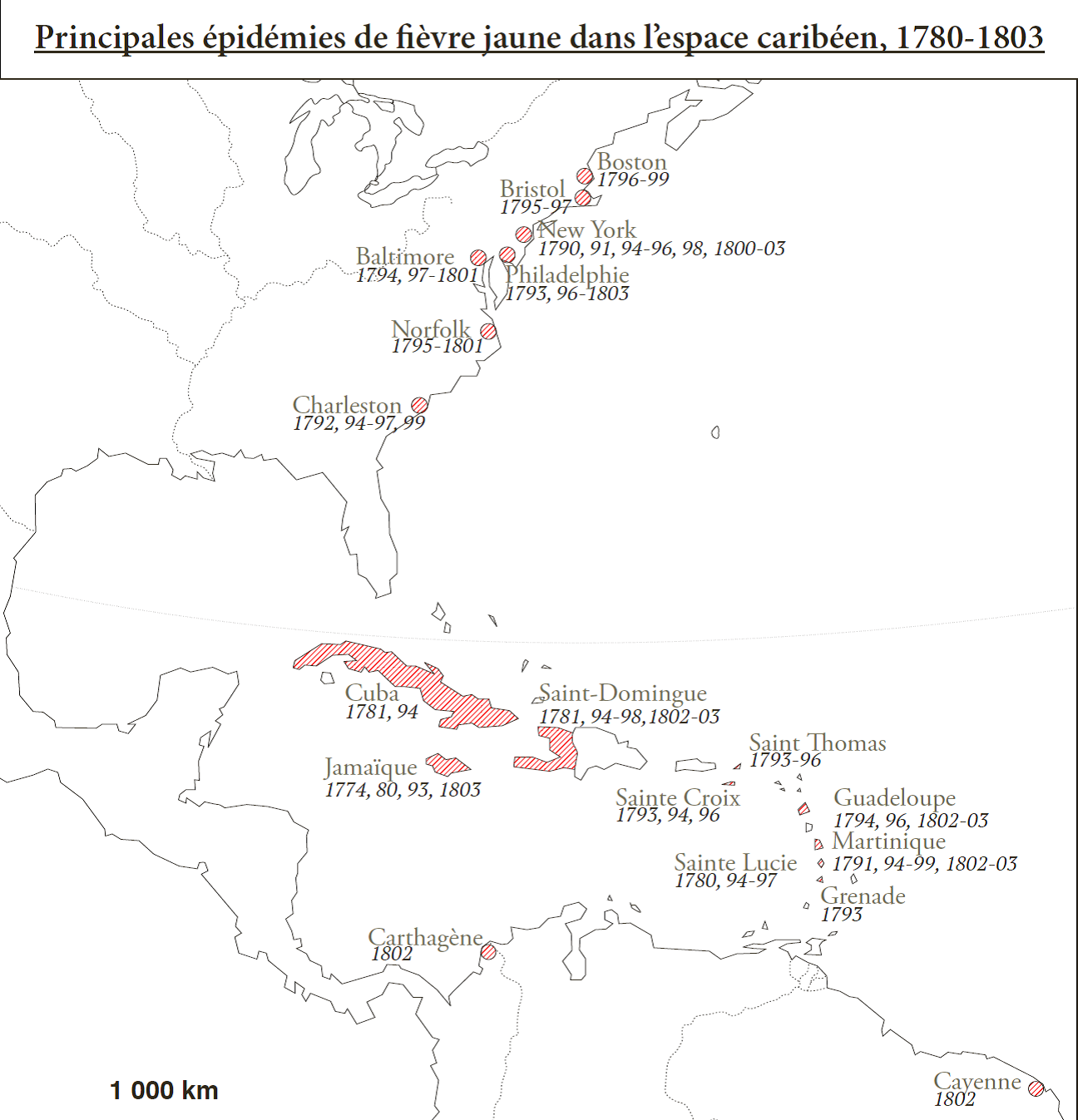
Thus, this health service must be replaced in the larger context of scientific developments in the colony of Saint-Domingue in the 18th century. I believe the geographical scope should be broadened too, as Saint-Domingue was at the heart of a well-connected Atlantic scientific world, and yellow fever epidemics plagued the whole of the West Indies, the Eastern coast of the United States and even Spain between the 1790s and the 1820s.
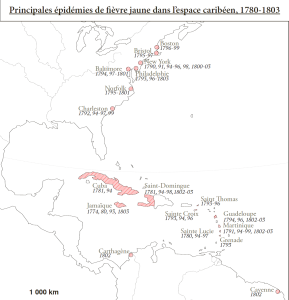
This map of the main epidemics in the Americas is still very much a work in progress
Transnational and network analysis are thus key approaches to my research, even though I still have much to learn about them, and thus I am looking forward to listening to your presentations and participating in the discussions. In my contribution to the summer school, I would like to present the two networks that the health officers turned to.
Creole network
While it is often described as if it were a homogeneous entity defined as metropolitan and military, the health service in fact incorporated numerous colonial physicians and surgeons, and consulted local botanists. Furthermore, while official healthcare was provided to soldiers in the colony’s hospitals, colonists and officers were often treated in their homes by women of colour. Health officers had the opportunity to witness, discuss and imitate this creole treatment. I am particularly interested in the process by which they appropriated this treatment and, much like the colonial physicians of the 18th century, “laid claim to the status of authors of new knowledge about American nature” (Murphy, 2011) by presenting these women as holders of a “vulgar” knowledge, leading to the “textual erasure” of their presence.
Atlantic network
The other network in which the health officers participated is the circulation of medical knowledge among physicians of the Atlantic world. French and British colonial physicians had already been sharing during the Seven Years’ war, but from the 1790s onward these exchanges boomed. Dominguan physicians emigrated during the Haitian Revolution and settled in the United States. They took part in the raging debate in America on the contagion of yellow fever, that also spread to much of the Atlantic world, and engaged the work of physicians from Britain and the West Indies. The health officers of the Saint-Domingue expedition inscribed their own research in this context, and they referred profusely to the opinion of American and British physicians. After the expedition, they presented themselves as American experts on yellow fever.
Bibliography
James Delbourgo and Nicholas Dew (eds.), Science and empire in the Atlantic world, New York, Routledge, 2008.
This edited volume is probably one of the key readings on history of science and colonization in the Atlantic. Delbourgo’ and Dew’s introduction, “The far side of the ocean”, lays the groundwork for the study of scientific journeys and research in the Atlantic, while the essays cover various geographic areas, such as Brazil, the United-States or Saint-Domingue. Susan Scott Parish’s essay “Diasporic African sources of Enlightenment knowledge” is also useful to understand the appropriation of African knowledge by colonial physicians.
Katherine Arner, « Making yellow fever American: the early American Republic, the British Empire and the geopolitics of disease in the Atlantic world », Atlantic Studies, 2010, vol. 7, no 4, p. 447‑471.
Katherine Arner’s work has many connections to my own research. This article retraces the connections of the yellow fever debate in the United States with a “multi-centered Atlantic world”, and examines the transnational networks of physicians involved. (Her recent PhD is more complete but also less easily accessible : Katherine Arner, The malady of revolutions: yellow fever in the Atlantic world, 1793-1828, PhD dissertation, John Hopkins University, Baltimore, 2014.
Arner, Making yellow fever american
Erica Charters, « Colonial disease, translation and Enlightenment: Franco-British medicine and the Seven Years’ War » in Frans De Bruyn and Shaun Regan (eds.), The culture of the Seven Years’ War: empire, identity, and the arts in the eighteenth-century Atlantic world, Toronto, University of Toronto Press, 2014, p. 69‑90.
Erica Charters explores the networks of translations and citations of the medical publications of French and British colonial and naval physicians, which lays the ground for the connections of the 1790s and 1800s I am studying.
Charters, Colonial disease, translation and Enlightenment
James E. McClellan and François Regourd, The colonial machine: French science and overseas expansion in the Old Regime, Turhout, Brepols, DL 2011, 2011, 694 p.
This book, by the two main historians of science in Old Regime Saint-Domingue, explores the French scientific-technico-medical “colonial machine” and the various gears of its network – colonial physicians, metropolitan and colonial academies or botanical gardens, or the ministry of the navy and the colonies.
Kathleen Murphy, « Translating the vernacular: indigenous and African knowledge in the eighteenth-century British Atlantic », Atlantic Studies, 2011, vol. 8, no 1, p. 29‑48.
This article studies the process by which colonial physicians present themselves as the sole authors of the knowledge provided by Amerindian and African informants.
Murphy, Translating the vernacular
Recent Comments