My Name is Martin Jeske and I am a PhD student at the department of East European History at the University of Basel (Switzerland), and a member of the Basel Graduate School of History (BGSH). I studied Human Geography, Cultural Sciences and East European History in Jena and Frankfurt/Oder (Germany), and also in Barnaul (Russian Federation). Prior to my studies at university I completed a professional training as a surveyor at the Thuringian survey ordnance in Gotha (Germany).
As one aspect of my recently started PhD thesis “Mapping an Empire. Territorialization, Cartography and Scientific Transfer in Tsarist Russia (1797-1919)” I research networks of European astronomers and mechanics to understand, how geodetic and astronomic methods and instruments found its way to the Russian Empire, which spaces could be mapped, and what the Russian progress could contribute to the European scientific development.
Permanent transnational exchanges between a great number of experts enabled the progress and standardization of cartography as a key tool for territorialization of European and colonial space in the 19th century. In order to reconstruct how those scientific ideas and objects had migrated and developed it is necessary to analyse who submitted what in which quality to whom and also how and when this happened.
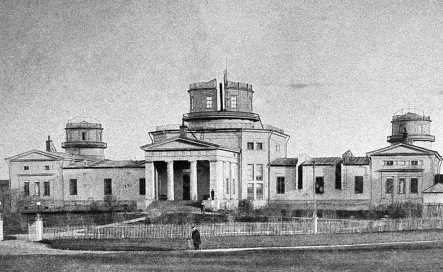
Pulkovo Observatory
Finding a suitable narrative to arrange the complex connections is a challenge. My interest focuses on Friedrich Georg Wilhelm Struve (1793-1864), the leading astronomer of the Russian Empire in the first half of the 19th century. His European-wide network of astronomers and mechanics can be regarded as crucial for the development of geodesy as a basis for advanced topographic cartography in Russia.

F.G.W. Struve (1844)
I use the approach of scientific transfer (Wissenschaftstransfer), which describes the move from knowledge, research methods and technologies across state borders. With respect to cultural transfers (Kulturtransfers) between the Russian Empire and its neighbours, the approaches of histoire croisée and entangeled history seem to be also suitable because they allow the research of interactions on different national, regional, and imperial levels. The concept of histoire croisée demands a historiography, which focuses on the actors, their conflicts, and solution strategies. Biographic and prosopographic perspectives can be applied, to investigate the role of such actors in the process of transfers. To reconstruct and analyse their communication and networks, which were constitutive for the exchange process, the development of mediators within the scientific transfer is relevant. The methods of historical network research should be used to visualize those scientific networks.
References:
Aust, Martin; Vulpius, Ricarda; Miller, Aleksej (Hrsg.): Imperium inter Pares: Rol’ transferov v istorii Rossijskoj imperii (1700-1917), Moskva 2010.
Düring, Marten; Eumann, Ullrich: Historische Netzwerkforschung, Ein neuer Ansatz in den Geschichtswissenschaften, in: Geschichte und Gesellschaft, Zeitschrift für historische Sozialwissenschft, Jg. 39, H. 3, (2013), 369-390.
Schweiger, Hannes; Holmes, Deborah: Nationale Grenzen und ihre biographischen Überschreitungen, in: Fetz, Bernhard (Hrsg.): Die Biographie – Zur Grundlegung ihrer Theorie, Berlin [u.a.] 2009, 385-418.
Stegbauer, Christian ; Häussling, Roger (Hrsg.): Handbuch Netzwerkforschung, Schriftenreihe: Netzwerkforschung, Bd. 4, Wiesbaden 2010.
Werner, Michael; Zimmermann, Bénédicte: Vergleich, Transfer, Verflechtung, Der Ansatz der Histoire croisée und die Herausforderung des Transnationalen, in: Geschichte und Gesellschaft 28 (2002) Nr. 4, 607-636.
Recent Comments