My name is Matthaeus Feigk, I’m a 2nd year PhD-candidate at the Basel Graduate School of History and the Institute for European Global Studies at the University of Basel. The research project I’m working on is entitled How to be a global player. The Basel Mission between faith, trade and internationalism. 1910 – 1925. I obtained my Bachelor as well as my Master degree at the University of Heidelberg (2013).
My PhD-project surveys the Basel Mission as a global stakeholder, respectively a participant in global networks during the investigation period from 1910 to 1925. This is from the World Missionary Conference in Edinburgh to the Basel Mission’s return to the mission areas it had lost during the First World War. Rooted in Germany as well as in Switzerland, the society had by 1900 become one of the largest German-speaking protestant missions. It did not only maintain mission areas from Western Africa to China but also operated through its trading company, which played a crucial role in the cocoa trade as well as in industrial weaving and brick manufacturing in India.
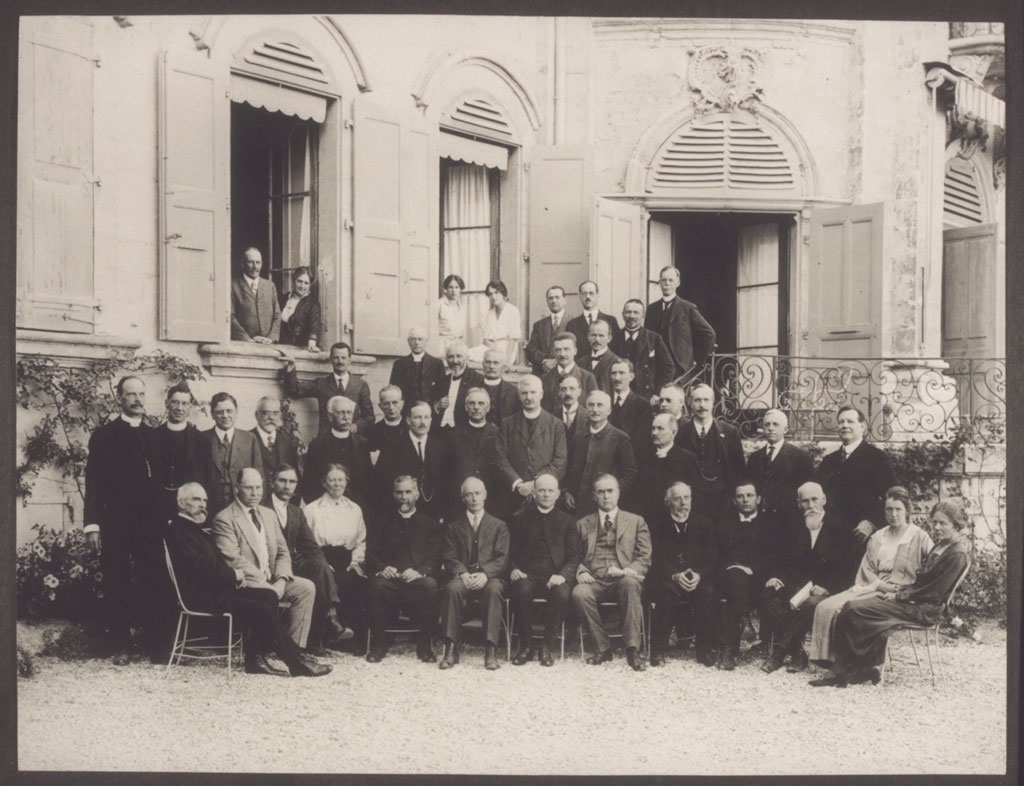
The international line-up of the missionary meeting at Crans, Switzerland, June 1920. Third row, second from right, with sun glasses: Friedrich Würz, Mission Inspector of the Basel Mission. BMA QS-30.033.0006.
Owing to its Pietist origins, the Basel Mission was from the start part of existing international networks in the protestant world. Numerous supporting associations in Switzerland and Germany contributed to the transnational Swiss-German organizational structure within the missionary society. Moreover, the Basel Mission maintained strong personal connections to German and British missionary circles as well as to Switzerland’s political and financial elites.
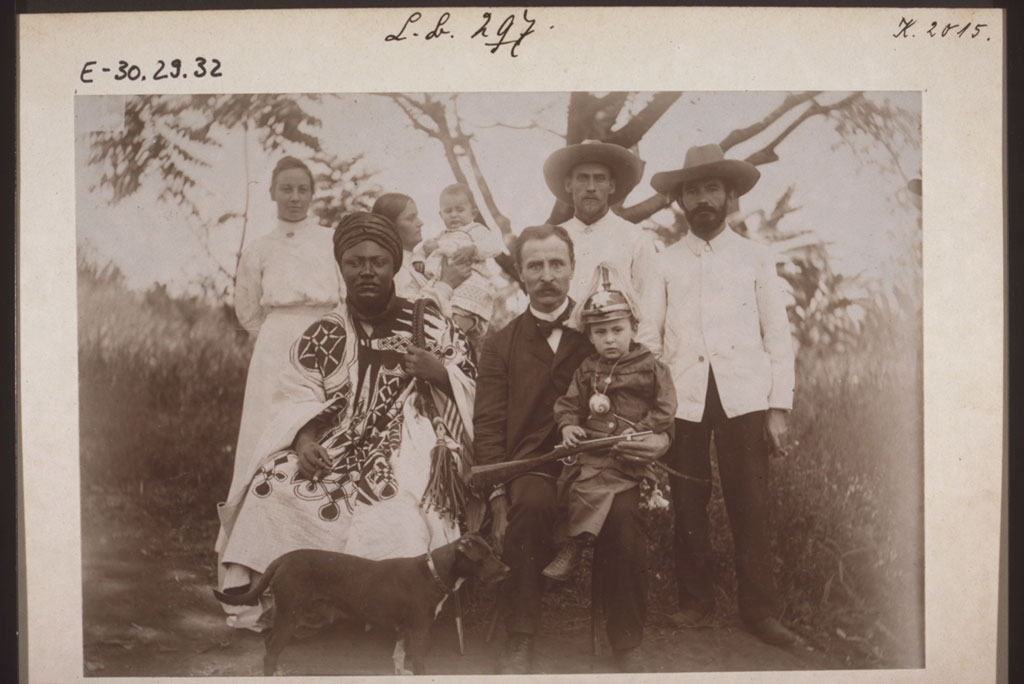
King Njoya of Bamun, Cameroon, with Basel missionaries in 1908. Note the little boy’s prussian spiked helmet! BMA E-30.29.032. (Also shown in Jenkins, Paul: A short History of the Basel Mission, Basel, 1989)
My project analyzes the role of this organization and its members in the protestant internationalism emerging in the late 19th and beginning 20th century. It is therefore based on an approach in social sciences, which emerged during the last decade and emphasizes the relevance of religious non-state agents and their networks in shaping a global civil society beyond religious frame-works. Consequently this is not a doctoral thesis situated in theology or the religious studies. I consider the Basel Mission to be a globally operating organization and a transnational organization in itself, connecting not only colony and metropolis, but also personal and institutional stakeholders within Europe and across the Atlantic ocean with religious, scientific, administrative or commercial background.
How did the Basel Mission use this contacts to overcome the crisis of the First World War? To what degree was the Basel Mission involved in the new surge of internationalization within the European missionary community after the war? Did interdependencies and mutual influences exist between religious and secular internationalism?
Readings being essential to my project are for example Rebekka Habermas: Mission im 19. Jahrhundert. Globale Netze des Religiösen („Mission in the 19th century. Global networks of the religious“) as well as Abigail Green and Vincent Viaene: Rethinking Religion and Globalization, in: Id. (eds.): Religious Internationals in the Modern World. Globalization and Faith Communities since 1750. Both texts point to the vast transnational spaces created by religious actors in general (Green and Viane) and by missionaries from the German-speaking countries in particular (Habermas) through correspondence, journeys and exchange forums and highlight their thereby emerging relevance for the history of internationalism.
My investigation allows to engage in research debates such as 1.) a methodological definition of the parameters reproducing a network 2.) the role of religious motivations in this context and interdependences with the non-religious sphere, and 3.) a widened perspective on Switzerland as a “colonial power without colonies” (Purtschert, 2012) as well as an important hosting country of international organizations.
Bibliography:
Abigail Green and Vincent Viaene: Rethinking Religion and Globalization, in: Id. (eds.): Religious Internationals in the Modern World. Globalization and Faith Communities since 1750. Basingstoke et. al. 2012, pp. 1-19.
Habermas, Rebekka: Mission im 19. Jahrhundert. Globale Netze des Religiösen, in: HZ 287 (2008), pp. 629‐679.
Mettele, Gisela: Weltbürgertum oder Gottesreich. Die Herrnhuter Brüdergemeine als globale Gemeinschaft 1727–1857. Göttingen 2009.
Purtschert, Patricia et al. (eds.): Postkoloniale Schweiz. Formen und Folgen eines Kolonialismus ohne Kolonien. Bielefeld 2012.
Sluga, Glenda: Internationalism in the Age of Nationalism. Philadelphia 2013.
Recent Comments