Lyon Fair organizational chart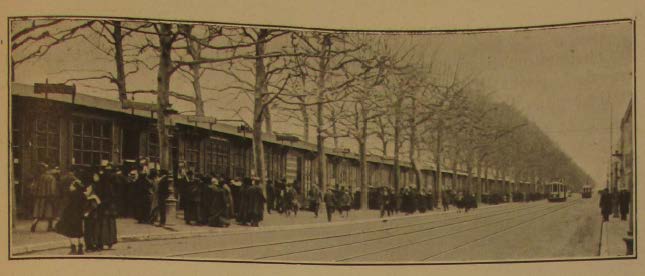
I would like to discuss an article-in-progress on the Lyon International Sample Fair during the First World War. This event was held for the first time in March 1916 and continued to convene every spring thereafter. This was the largest trade fair to be held on Allied soil during the war and it was the only one that welcomed both foreign exhibitors and buyers in substantial numbers.
While the Lyon fair initially facilitated trade in and out of Europe, by 1918 its primary function was not to support the movement of goods but rather to foster social and organizational relationships. In encouraging American firms to participate in the 1918 fair, the US consul in Lyon wrote: “It is of small moment whether or not they [exhibitors] can make contracts in view of conditions, but it is most important that they be put in touch with active buyers, and there is no better way than this.”
The First World War stimulated a remarkable proliferation of “sample fairs.” These were events where producers exhibited models and negotiated contracts for future delivery with wholesalers, commission agents and other intermediaries. While there had only been one sizeable sample fair in Europe prior to 1914, in Leipzig, there were more than thirty by 1921.
The Lyon fair, like most of the other new sample fairs, drew heavily on the financial and organizational resources of the local chamber of commerce. The Lyon Chamber of Commerce used its ties to foreign business associations and consular networks to recruit exhibitors and also to help support the execution of orders placed at the fair. During a period of flux when many firms were trying to replace longstanding relationships with suppliers and clients that had been disrupted by the war the fair was an attractive trade venue in large part because it offered a pool of potential trade partners who were generally vetted and backed by some kind of organizational guarantor, either formally or informally. In other words, the fair drew large crowds not merely because it offered a wide selection of products but also because it provided access to a large number trustworthy business networks.
Hubert Bonin, Catherine Hodeir, and Jean-François Kline eds., L’esprit économique impérial (1830-1970). Groupes de pression & réseaux du patronat colonial en France & dans l’empire, (Paris: Publications de la SFHOM, 2008).
This edited volume on elite organizations within the French empire analyzes many of the kinds of networks that operated at the Lyon fair. Many of the contributions highlight the role played by chambers of commerce and other business associations in the formation of distinct regional and municipal imperial economic systems and colonial cultures. I think that Lyon Chamber of Commerce welcomed foreign exhibitors at the Lyon Fair in part because they were trying to establish the city as an international gateway to certain trade networks within the French empire. However, the Lyon Fair had to compete with the Bordeaux Sample Fair, which was also established during the war. The Bordeaux Fair was smaller, but it was much more explicitly billed as a point of access to French imperial trade networks.
Phillip A. Dehne, On the far Western Front: Britain’s First World War in Latin America (Manchester: Manchester University press, 2010).
This work examines efforts on the part of British business associations and officials to restrict German commercial activity in Brazil, Argentina and Uruguay during the First World War. It illuminates the way transnational commercial networks responded to the disruption of international trade during the First World War. Like the local business association Dehne discusses, the Lyon Chamber of Commerce insisted that its activities were contributing to the broader “economic war” against the Central Powers. Dehne shows that the “economic war” had ramifications well beyond the formal restrictions established by the Allies because the temporary disruption of German foreign trade stimulated a flurry of private, often uncoordinated efforts to take over German commercial positions. It also produced a clearer delineation of national political allegiances within commercial communities.
Harald Batheit and Nina Schuldt, “Between Meat Grinders and Luminaries: International Trade Fairs as Temporary Clusters,” Regional Studies, Special Issue, Clusters in the Global Knowledge-based Economy: Knowledge Gatekeepers and Temporary Proximity, 42, 6 (Jan. 2008), 853-868.
I have found social scientists’ analyses of present-day trade shows useful as I have tried to think through the Lyon fair’s various social and organizational functions. Historians have generally analyzed twentieth-century trade fairs as marketing events or public spectacles. Batheit and Schuldt have shown that many activities happen trade shows beyond advertising and shopping. They have notably argued that trade shows offer lots of opportunities for informal and impromptu social interactions, which create an extremely rich information environment. They suggest this enables attendees to branch out from their established “clusters” of trade partners in relative security. This article helped me analyze the physical layout of the Lyon fair. The fair itself consisted in a collection of small, detached exhibition buildings. However, the organizers eventually began to offer common meeting spaces, social events and formal conferences, which would have allowed for a greater number of chance meetings.
Leave a Reply
You must be logged in to post a comment.