GRAINES Summer School, St Andrews, 7-10 June 2015

Author: Esther Ginestet

Borderland areas, Scales and some practical considerations

My master’s thesis deals with migrants and migrants’ expulsions from Uganda in the 1960s and early 1970s. More specifically, I focus on Kenyan and Asian minorities who were progressively excluded and expelled by the Ugandan government with the argument of redistributing economic opportunities to “nationals only”. During my own research, I came across actors who belonged to transborder communities. In particular, Kenyan citizens in Uganda had maintained transnational family and friendship networks that stretched across the Uganda-Kenya border.


During this summer school, I met people who also worked in borderland areas and thereby faced relatively similar challenges. The question of how we identify one’s national belonging came up several times during informal conversations and I was fascinated by the many common points which we could observe between otherwise extremely dissimilar geographical areas (namely, Eastern Europe and East Africa).

In my thesis, the “borderland focus” comes as a “micro” approach within a broader national narrative in which I investigate how a Ugandan nation was delimited in the postcolonial period through the marginalization of “foreigners” on the basis of race and citizenship. Therefore, the question of “scales” is paramount for me and turned out to be a crucial problem explored in this conference. Kenyan and Indian minorities were caught between a fallen British imperial space and the incipient postcolonial nations. The empire having collapsed, these former imperial minorities fell into a limbo and became foreigners in an international system of nation-states. Targeted by nationalist policies, their expulsion caused international tensions between the UK, India and the East African countries. How to integrate the “local” borderland scale with the Ugandan national frame and the international global system was a key-problem that I faced. Therefore, the discussions revolving around the simultaneous integration of various scales (global, imperial, national, local) and the way they interact with one another resonated strongly with my own experience.

However, this interplay of scales and transnational ties also raised practical problems. This point was particularly raised during Patricio’s presentation as well as the Wednesday morning “Research Symposium”. The trouble of having to visit several archival centres in a limited time and on a low budget is undoubtedly an unavoidable limitation while the adoption of a transnational angle pushes researchers to consider an ever-increasing amount of sources spread around the world. Thereby, the question arising is where one may decide to set the limits of one’s own topic and artificially “cut” a study’s ramifications.


From borderland issues to practical questions, I was glad to enjoy this opportunity to exchange perspectives and know-how with more experienced researchers. Surely, this conference will help me overcome obstacles on the road to presenting my own PhD project.
Transnational actor’s networks – Ignacius Villar de Rohde

Understanding of history evolved to transcend national narratives towards a transnational perspective. By taking into account realities and networks that go beyond national political systems and frameworks we not only learn about international and transnational networks, but also shed light on national developments that would otherwise go unnoticed.

Fabricio’s example of trade relations in the Southern Atlantic illustrates this point perfectly. A study of imperial relationships between the Spanish metropole and its colonies in South America omits the commercial exchanges which continuously took place. However, when the focus was shifted in the direction of the Portuguese empire, the ways in which colonial merchants kept trade alive were revealed and it became clear that the connection of peninsular Spain with its Viceroyalties in the Americas wasn’t lost, but rather found new channels to operate. It was through the agency of mobile individual actors that this shift was possible. Using established trade networks merchants were able to subvert war-time disruptions and limits of “national” imperial structures.

The use of personal networks, be they of a family, trading, religious or other nature, to foster such transcontinental relations is something I thought to be very insightful. I felt inspired by the ways by which individuals can transcend the boundaries of polities. I feel like this sort of relationship would have a strong impact on the migrant communities of the Southern Cone and the diasporas they form. It would be interesting to look into the connections these actors and communities maintain with their homeland and how these alternative transnational networks open up new possibilities beyond the traditional national narrative, the ways in which the networks they have in their “adopted” home interact with family and friendship networks in their place of origin and they become focal points of trans-group relationships, how they play an intermediate role between states and continents and themselves can be considered transnational actors.

Connecting Europe

                This workshop is about making connections. We started wondering what could bring us together since our research interests may seem far away from one another. Pascale works on the spatial construction in anarchist thought in the late 19th century and Esther deals with expulsions of migrants in East Africa in the 1960s. Today’s readings and presentations made us think about our ways of conceptualizing Europe in a transnational perspective.

                While reading Raj and Saunier, we noticed (but did not have time to discuss) that the authors come from different traditions and display different perspectives. Saunier’s approach to transnational history remains more centered on Europe as he is trying to recast the narrative of European integration, whereas Kapil Raj’s background is in imperial science production. As a result, “Europe” occupies a crucial but slightly different place in both accounts. Saunier is interested in how Europe emerged as “the result of connected circulatory regimes, which have eventually crystallized into a construct that has received a growing attention in the modern age, where it became the object of dedicated political and cultural engineering”. Raj on the other hand convincingly shows that these circulatory regimes involved in the construction of something perceived as “European” such as science had ramifications extending well beyond the geographical unit of the European continent. However, both authors use the notions of circulation, exchange, and contact to break up the dichotomy between the West and the rest, the center and the periphery and the boundaries of national narratives.

                In our respective projects, the spectre of Europe looms large. In Esther’s work, non-European actors, such as the Ugandan government, are concerned with imperial populations, which they see as being a part of Europe (Indian minorities). Defining which groups belong to British imperial legacy becomes a key conflict between the former metropolis and the former colony. Imperial circulations of population come to an end with the rise of Ugandan nationalism, which generates a last and final movement of population, the expulsion of Indians from Uganda (1972). Pascale works on the collaboration between two anarchist-scientists, one from the center of Europe (France) and another from the periphery (Russia). Through their common political interest and their shared experience of exile and marginalisation, they debated political and scientific matters on eye level and created a common vision of the world. While Europe is still presented as the most “advanced” region of the globe, their knowledge of the extra-European world allows them to engage critically with imperialism and racism.

From the “outside”, extra-European spaces , as well as from the “inside”, the territoriality and idea of “Europe” seems to have been shaped by circulation of people and streams of thought that crossed national – and eventually continental – boundaries.

Esther Ginestet

Pascale Siegrist

Sacking Kenyan workers in Uganda: nation-states and migrants’ trans-border (imperial) networks

As a second-year master student from SciencesPo Paris, I work on mass expulsions from the standpoint of nation-building in postcolonial Uganda (1966-1972). My master’s dissertation deals with two of these events; the sacking of about 20,000 Kenyan workers in 1970 and the expulsion of 55,000 “Asians” (meaning people of Indian descent in East Africa) by Idi Amin in 1972.

Encountering networks where they were not (initially) expected

During a fieldwork conducted in July-August 2014, I confronted the governments’ narratives of the “Kenyan sacking” (national archives) with the views expressed by the Kenyan migrants themselves (interviews). They turned out to be quite dissimilar. On the one hand, in the national archives, the narrative was taking the shape of an interstate crisis between Kenyan and Ugandan ministers in the middle of which migrants found their future in Uganda in jeopardy; but, on the other hand, the former expellees had a very different version to offer, a version in which they displayed agency through colonial-inherited networks.

Therefore, I happened to take interest in trans-border networks in East Africa and I am hoping to learn more over the analysis of transnational networks and find inspiration at GRAINES.

Integrating imperial trans-border ties to national(ist) policies

The immigration and labour policies behind the Kenyan workers’ crisis in 1970 were conceived and implemented

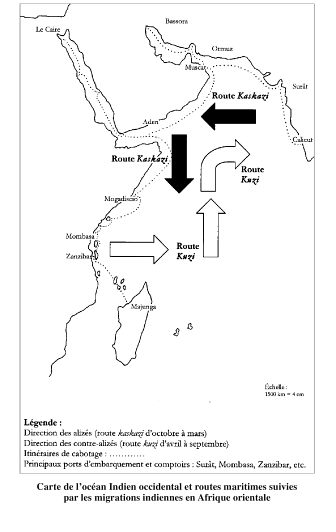
Western Indian Ocean routes of migration. Michel ADAM (dir.), L’Afrique indienne: les minorités d’origine indo-pakistanaise en Afrique orientale, Paris, Karthala, 2010, p. 12.

Western Indian Ocean routes of migration. Michel ADAM (dir.), L’Afrique indienne: les minorités d’origine indo-pakistanaise en Afrique orientale, Paris, Karthala, 2010, p. 12.

by the Ugandan Government in order to favour the employment of Ugandan citizens inside Uganda. However, this very national(ist) policy ended up being faced with the permanence of local trans-border links with Western Kenya. These connections which had been established when East Africa was still a “British” region allowed for expellees’ agency and frustrated the government’s attempt at “Ugandanizing” employment opportunities. Therefore, whereas immigration and labour policies are intrinsically seen as “national” problems, there is an equal need to combine the national approach with a more transnational outlook. Thereby, we might get a greater understanding of the role of imperial connections initiated within the British Empire and perpetuating themselves beyond independences.

Meanwhile, we are witnessing an important renewal of the historiography surrounding the so-called “Asian question” in East Africa (ie: the problems and challenges faced by the people of Indian descent in East Africa after the independences of Kenya, Uganda and Tanzania). There is an increasing pressure to re-contextualize the presence and activities of Asians in East Africa within the British imperial mobility space opened in the Indian Ocean. However, the historiography has concentrated exclusively on Asian populations and, consequently, it has so far failed to adapt its conceptual framework to other migrant populations whose fate has been forgotten (ie: Kenyans).

    We advocate for a need to review the histories of “Africanisation” and “Ugandanisation” of economic opportunities by both enlarging the “Asian focus” and by taking into account the imperial connections which migrants settled in Uganda enjoyed.

Readings

  • Broader references on the Indian Ocean imperial space may include : Thomas R. METCALF, Imperial connections: India in the Indian Ocean arena, 1860-1920, Berkeley, University of California Press, 2007 ; Sugata BOSE, A hundred horizons: the Indian Ocean in the age of global empire, Cambridge, Mass, Harvard University Press, 2006.