About me
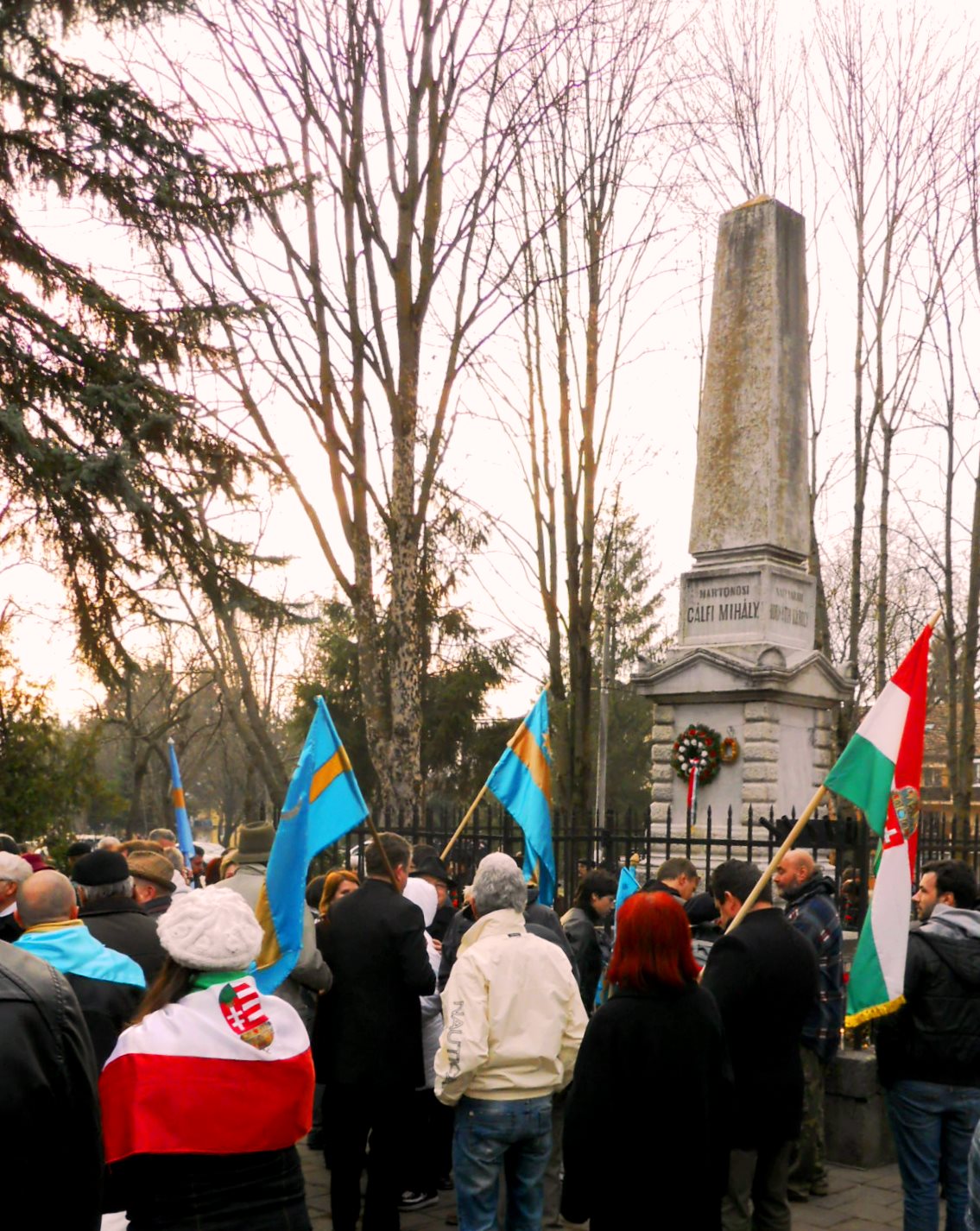
Târgu Mureș/Marosvásárhely, 2015: Commemoration of Szekler Martyrs Killed by Austrian Soldiers in 1854
I am first year predoctoral fellow of the Max Planck Institute for Human Development, Berlin and currently enrolled at the Technical University of Berlin. I also hold an MLitt (2011) from the University of St Andrews and an MA (2012) from the University of Bucharest, both in History. Generally, my PhD project concerns politics of space in mountainous regions during the twentieth century, especially the Hungarian-speaking enclave located in Transylvania, called the Szeklerland. Nevertheless, I plan to parallel similar uses of symbolic geographies in places like the Scottish Highlands, the Polish/Ukrainian Galicia and the Turkish Kurdistan. Very briefly, I argue that at the basis of local politics of space, such as claims for autonomy, lies an ideology of remoteness. According to this ideology, elements of isolated natural landscapes gain a moral value, providing a local meaning to politics. For more details on my preliminary outline: https://www.mpib-berlin.mpg.de/en/research/research-schools/imprs-moral-economies/projects/political-workings-of-the-ideology-of-remoteness
Summer school contribution
At the summer school I aim to present the role of Szekler and Scottish institutional networks, like museums and cultural associations, in the production of space imagery, as part of my doctoral research. Similarly to monuments and ceremonies, such institutions are instrumental in connecting a people to “their” land. A network-analysis perspective should illuminate the complex interactions between institutions that homogenize local characterologies.
Looking at the Transylvanian city of Cluj/Kolozsvár, Rogers Brubaker has argued that, there, Hungarian ethnicity is not territorialized. Rather, an “archipelago” of connected institutions – schools, universities, churches, literary circles – shapes Hungarian socializing in a life-world parallel to Romanian socializing. On these grounds, he implied a contrast between Cluj and the Szeklerland, where the local Hungarian-speaking community is historically rooted and strongly territorialized.
Nevertheless, I would argue that this “archipelago” is just as important in the Szeklerland, despite (or rather in addition to) its Hungarian-language territorial basis. Ever since the dissolution of Greater Hungary after WWI, Budapest supported an extensive institutional network aiming to rebuild the greater Hungarian nation, on a cultural and transnational level. Thus, up to the present, the Hungarian government has buttressed the Transylvanian Museum Association, churches and church figures, Hungarian political parties, the Association of Folk Literature, schools and universities. All these organizations furnish and represent the imagery of remoteness that enable Szekler elites to connect the Szekler people to the Szekler land.
Similarly, in Scotland, the National Trust for Scotland, the Celtic Twilight or museums like the National Museum of Scotland, although not benefiting from the support of a patron-state, like their Translyvanian counter-parts, continuously reshaped Scottish imagery – increasingly dependent on the myth of the Highlands. According to Cooke and McLean, archeological displays brought from the Celtic periphery to the Scottish Museum construct “a similarity of ways of life, in addition to constructing difference”, weaving “a symbolic thread that stretches back into prehistory, linking prehistoric Scots with the life experience of at least some contemporary Scots”.
Prospective gains from the summer school
Apart from interacting with all the participants and speakers –something I really look forward to – I hope to trace the process whereby the institutions outlined above developed such strikingly similar networks and features in the Szeklerland and Scotland. In other words, network-analysis should shed light on the transfers – of people, ideas and materials – from a common cultural baggage that assigned these institutions the mission of producing local imagery. Consequently, these bodies took part in the struggle to monopolize symbolic geographies, competing against or allied with outside forces. Whether Budapest, Bucharest or Edinburgh, centers of power continuously reshaped the function of these establishments, impacting the networks that linked them together in their endeavor to homogenize local characterology.
Suggested reading
Brubaker, Rogers; Feischmidt, Margit; Fox, John; Grancea, Liniana (2006). Nationalist Politics and Everyday Ethnicity in a Transylvanian Town. Princeton; Oxford: Princeton University Press.
This is a thorough study of contemporary inter- and intra-ethnic relationships concerning Hungarians and Romanians in the Transylvanian city of Cluj. Conducted over a period of 10 years, including extensive interviews, this research traces the main areas where ethnicity unfolds: workplaces, churches, public squares, politics, etc. Obviously, in investigating everyday ethnicity, it deals with networks; personal and institutional, national and transnational.
Bibliography
Cooke, Steven; McLean, Fiona (2002). “Picturing the Nation: The Celtic Periphery as Discursive Other in the Archaeological Displays of the Museum of Scotland”, Scottish Geographical Journal 118 (4), pp. 283–298.
Hitchins, Keith (2007). “Erdélyi Fiatalok: The Hungarian Village and Hungarian Identity in Transylvania in the 1930’s”, HStud 21 (1-2), 85-99.
Lorimer, Hayden (1999). “Ways of Seeing the Scottish Highlands: Marginality, Authenticity and the Curious Case of the Hebridean Blackhouse”, Journal of Historical Geography 25 (4), pp. 517–533.
Sturm, Tristan; Bauch, Nicholas (2010). “Nationalism and Geography: An Interview with Rogers Brubaker”, Geopolitics 15 (1), 185-196.
Török, Zsuzsanna (2001). “Planning the National Minority: Strategies of the Journal Hitel in Romania, 1935-44”, Nationalism and Ethnic Politics 7 (2), 57-74.
Recent Comments