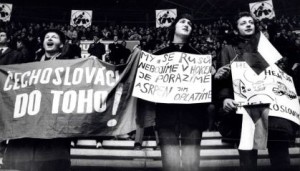
My name is Tomas Vojacek, M.A student of modern history at Charles University in Prague. In my research, I deal with the sport as the phenomenon of the twentieth century and I am trying to analyze the socio-political dimension of sport in the context of the Cold War. I also work at the Olympic Studies Centre, which is a scientific part of the Czech Olympic Committee. I obtained my bachelor degree in History at Charles University in Prague, with one year exchange in Colchester (University of Essex). This April, I completed my research at the Olympic Archives in Lausanne in the framework of one year research grant awarded by Faculty of Arts.
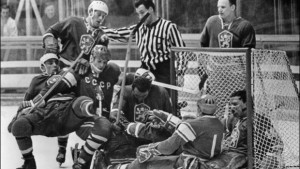
GRENOBLE, FRANCE
I partly dealt with the sport as a transnational phenomenon in my bachelor thesis The Miracle on the Ice (1980): A Contribution to the American-Soviet Sport Rivalry during the Cold War and I intend to expand this research within the framework of my dissertation: Sport, Ideology and National Identity in the Communist Czechoslovakia: Ice-Hockey in the Cold War Era 1956–1980. I also paid attention to transnational history in my study The Conquest of the Temple of the White Silence: British Sporting Traditions and Tennis as a National Sport, in which I focused on the transmission of the tennis tradition from the British Islands to the United States of America and its subsequent implementation.
My previous projects and planned dissertation are relevant to the study of networks, the theme of the Summer School. I presented a few cases in my article about the British tennis. To be more specific: the close cultural ties between Britain and the United States at the end of the nineteenth century helped to transfer the British tennis tradition on the opposite side of the Atlantic. Lawn Tennis, the sport of the British aristocratic circles, thanks to the extensive cultural exchange, became relatively soon a very popular sport in substantially more liberal United States.
The transnational aspect should be also included in my dissertation project. After the communist coup of 1948, ideology became a part of every aspect of the sporting life in Czechoslovakia. It led politicians to use the sport for the ideological purposes. The socialist sportsmen, who beat their imperial counterparts, were celebrated by state officers as national heroes. Anyway, the most of these athletes had never accepted the role of the “ideological warriors”. For this reason a very important part of my research will be an analysis of the propagandistic dimension of the sport, including the contrast how were successful Czechoslovak sportsmen understood on the both sides of the Iron Curtain. My goal is answer the question if ideologization of the sport had created a mutual socialist identity within the Eastern Bloc or on the contrary sport helped shaping national identity against communist regime?
My motivation to participate in summer school is present my research to other scholars and students, who could be interested in this topic and especially to gain new experiences and perspectives on transnational history and networks.
Key Reading: WAIC, Marek (ed.), In the Shadow of Totalitarism: Sport and Olympic Movement in the „Visegrád Countries“ 1945–1989, Praha 2014.
The collection of studies devoted to sport in “Visegrád Countries”. All aspect (political, cultural, social) connected with sport are well analyzed by outstanding Czech historians from Faculty of Physical Education.
Bibliography:
TÚMA, Oldřich – PROZUMENSCHIKOV, Michail – SOARES, John – KRAMER, Mark, The (Inter-Communist) Cold War on Ice: Soviet-Czechoslovak Ice Hockey Politics, 1967-1969, in: HERSHBERG, G. James (ed.), Cold War International History Work Project Bulletin, no. 69, February 2004.
RIORDAN, James (ed.), Sport Under Communism: The U.S.S.R., Czechoslovakia, The G.D.R., China, Cuba, London 1981.
SOARES, John, Cold War, Hot Ice: International Ice Hockey, 1947–1980, in: Journal of Sport History, vol. 34, no. 2, Summer, 2007.
NENDEL, Jim, The Cold War: Emerging From the Ice at the 1956 Cortina d’Ampezzo Winter Olympic Games, in: The Global Nexus Engaged, University of Western Ontario, October, 2002.
EDELMAN, Robert, Serious Fun: A History of Spectator Sports in U.S.S.R., Oxford 1993.
HARGREAVES, John, Sport, Power and Culture: A Social and Historical Analysis of Popular Sports in Britain, Cambridge 1986.
Recent Comments