As a second-year master student from SciencesPo Paris, I work on mass expulsions from the standpoint of nation-building in postcolonial Uganda (1966-1972). My master’s dissertation deals with two of these events; the sacking of about 20,000 Kenyan workers in 1970 and the expulsion of 55,000 “Asians” (meaning people of Indian descent in East Africa) by Idi Amin in 1972.
Encountering networks where they were not (initially) expected
During a fieldwork conducted in July-August 2014, I confronted the governments’ narratives of the “Kenyan sacking” (national archives) with the views expressed by the Kenyan migrants themselves (interviews). They turned out to be quite dissimilar. On the one hand, in the national archives, the narrative was taking the shape of an interstate crisis between Kenyan and Ugandan ministers in the middle of which migrants found their future in Uganda in jeopardy; but, on the other hand, the former expellees had a very different version to offer, a version in which they displayed agency through colonial-inherited networks.
Therefore, I happened to take interest in trans-border networks in East Africa and I am hoping to learn more over the analysis of transnational networks and find inspiration at GRAINES.
Integrating imperial trans-border ties to national(ist) policies
The immigration and labour policies behind the Kenyan workers’ crisis in 1970 were conceived and implemented
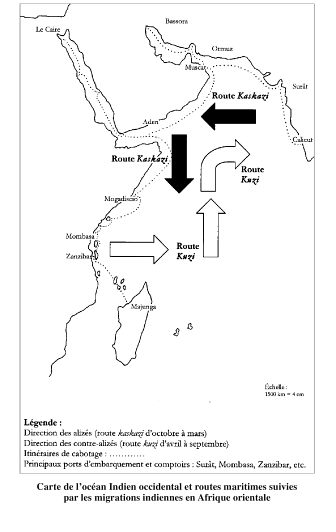
Western Indian Ocean routes of migration. Michel ADAM (dir.), L’Afrique indienne: les minorités d’origine indo-pakistanaise en Afrique orientale, Paris, Karthala, 2010, p. 12.
by the Ugandan Government in order to favour the employment of Ugandan citizens inside Uganda. However, this very national(ist) policy ended up being faced with the permanence of local trans-border links with Western Kenya. These connections which had been established when East Africa was still a “British” region allowed for expellees’ agency and frustrated the government’s attempt at “Ugandanizing” employment opportunities. Therefore, whereas immigration and labour policies are intrinsically seen as “national” problems, there is an equal need to combine the national approach with a more transnational outlook. Thereby, we might get a greater understanding of the role of imperial connections initiated within the British Empire and perpetuating themselves beyond independences.
Meanwhile, we are witnessing an important renewal of the historiography surrounding the so-called “Asian question” in East Africa (ie: the problems and challenges faced by the people of Indian descent in East Africa after the independences of Kenya, Uganda and Tanzania). There is an increasing pressure to re-contextualize the presence and activities of Asians in East Africa within the British imperial mobility space opened in the Indian Ocean. However, the historiography has concentrated exclusively on Asian populations and, consequently, it has so far failed to adapt its conceptual framework to other migrant populations whose fate has been forgotten (ie: Kenyans).
We advocate for a need to review the histories of “Africanisation” and “Ugandanisation” of economic opportunities by both enlarging the “Asian focus” and by taking into account the imperial connections which migrants settled in Uganda enjoyed.
Readings
- There are very few references concerning the Kenyan sacking of 1970. Ali Mazrui’s chapter is one of them. He compares the 1970 expulsion of Kenyan workers to the 1972 expulsion of Asians in Uganda. Beyond his Marxist understanding of both phenomena, the reader can very easily able grasp the importance of networks which characterizes the migrant’s situations in Uganda (Available on Google books).
- Sana Aiyar’s work dealing with Asians’ political activism in colonial Kenya well-illustrates the current historiographical trends which tend to review the Asian question by situating the Asian question within a broader imperial/”transcolonial” context.
- See (either): Sana AIYAR, « Anticolonial Homelands across the Indian Ocean: The Politics of the Indian Diaspora in Kenya, ca. 1930-1950 », American Historical Review, 2011, vol. 116, no 4, p. 987‑1013 ; Sana AIYAR, « Empire, race and the Indians in colonial Kenya’s contested public political sphere, 1919–1923 », Africa, 2011, vol. 81, no 01, p. 132‑154. => AIYAR SANA – Anticolonial Homelands across the Indian Ocean The Politics of the Indian Diaspora in Kenya (1930-1950) ; AIYAR SANA – Empire, Race and the Indians in Colonial Kenya’s Contested Public Political Sphere (1919-1923)
- Broader references on the Indian Ocean imperial space may include : Thomas R. METCALF, Imperial connections: India in the Indian Ocean arena, 1860-1920, Berkeley, University of California Press, 2007 ; Sugata BOSE, A hundred horizons: the Indian Ocean in the age of global empire, Cambridge, Mass, Harvard University Press, 2006.
Thank you Bernhard for your comment! Here are some answers:
In 1970, the categories of “Kenyan” and “Ugandan” were precisely “in the making”. To this extent, census operations were crucial. One of these operations was conducted in 1969 and helped identify “who was what”. The expulsion became the occasion to put in practice these categories.
The state has of course a key-role in that process. Especially because Uganda is then an authoritarian regime. However, people who have always lived in the borderland areas may have doubts concerning their own nationality or their precise place of birth (families are split on both sides of the border)- and so did the state. From the migrants’ viewpoint, the expulsion order becomes the occasion to place themselves and decide whether they are targeted/in danger or not. This is where cross-border networks become crucial (if a migrant has equal ties with Kenya and Uganda, he has more agency, he may leave for a time and come back when he feels like it). It also becomes the occasion for their employers to sort out which workers are crucial to their business and which aren’t.
In a long-term perspective, the expulsions burry the imperial space which had shaped a “British” East Africa. They also closed the Panafrican vision of a united region in which Africans would circulate freely and transcend the “colonial-inherited” borders. For the first time, the border acquires a strong meaning and becomes not only a transit-zone but also a true frontier separating two different and sovereign state.
In a way, the expulsion helped determine a population of “nationals” and also shaped a new “national” space.
I hope those quick answers will stimulate your interest!
Esther
Esther, thank you very much for this post and descriptor of a fascinating topic. Despite or because I am an ignorant and ‘innocent’ person on this period and geographical area, this topic has sparked my interest and I am curious to learn more on it.
Here are just some of my questions that came to my mind (re)reading your post:
-Around 1970 when the expulsions happened, where categories of a clear binary nature, i.e. Ugandans or Kenyans? Or (not so clear and in the making), was the process of expelling Kenyans precisely part of the making of Ugandas?
-How easily defined are Ugandans and Kenyans? Who is the driver in the process? The ‘new’ state apparatus or is the driving force elsewhere?
-Is there any link between economic or employment crisis at the time are the expulsion a purely functional means to create internal cohesion of a Ugandan population?
-In a more long-term perspective (pre-after) expulsion, how does the dynamic between the regions & newly independent states change?
These are just some first questions.
Best wishes,
Bernhard