(Project Proposal) Fists of Fury: A Transnational Guide on how Bruce Lee Punched His Way Against Asian Stereotypes in Hollywood

“To hell with circumstances; I create opportunities” is what martial arts king Bruce Lee said and did.[1] Bruce Lee adapted from his being one-quarter Caucasian and three-quarters Chinese, living both in the United States and Hong Kong. He adapted from his street-fighting abilities and utilised his skills by training in martial arts by the legendary Ip Man. Bruce Lee’s background and his roles in films – both in Hollywood and in Hong Kong – offer insight into how Asians (specifically East Asians) have been portrayed in Hollywood films during the Cold War. My project will aim to understand two fundamental questions:

  1. What does a study of Bruce Lee in a transnational context tell us about East-West relations during the Cold War?
  2. What does a study of Bruce Lee tell us about the representations of East Asian masculinity?

By researching racism experienced by Asian-Americans during the Cold War, especially during the Korean War and the Vietnam War, studying Bruce Lee as a case study could highlight perceptions of Asians and Asian-Americans in this period and how they are portrayed in films. Is Bruce Lee an exception to the general portrayal of emasculated Asians? Were perceptions of Asian masculinity changing, or did racist ideologies perpetuate them? My inspiration for this project stems from watching Murder by Death (Robert Moore, 1976) as a kid. I saw Peter Seller’s portrayal of a Chinese detective and immediately hated the stereotypical portrayal of a timid Asian man contrasted next to hypermasculine detective Sam Diamond, portrayed by Peter Falk. 

Taking a transnational approach to this project, I will examine Bruce Lee’s turbulent rise to fame and his role in both Hollywood and Hong Kong. Firstly, in Hollywood, Bruce Lee’s struggle to get hypermasculine roles and his eventual progress into him being given lead roles in films such as Enter the Dragon (Robert Clouse, 1973) will be explored. Therefore, this is significant as the lens will highlight the general trend of hypermasculine roles given to white men versus emasculated roles given to Asian men. I will then look at Hong Kong and how Bruce Lee is depicted there. How different are the two areas comparing one man? Will the lens in which Asians view other Asians be different from Americans’ lens viewing an American-born Chinese? I will use an ethnographic method in studying how the locals view Bruce Lee versus how diaspora’s view the mixed martial artist. This method will be used because, during COVID, it is hard to gain access to online primary sources. Thus, fieldwork may be necessary to interview various non-white perspectives, including Filipinos and Indians. I believe non-white perspectives in Asia on Bruce Lee is significant as this multi-scaled dimension illustrates a various interpretation on the concept of Asian masculinity. 

The sources I will be using in this project will primarily be secondary sources, examining relations between the East and the West during the Cold War and Asian representation in Hollywood. These include Jane Junn and Natalie Masurka’s article on Asian American Identity and Sangjoon Lee’s article on Cinema and the Cultural Cold War. However, I will be using primary sources such as Bruce Lee films highlighting the emasculated or hypermasculine roles played by him and white men, respectively. Ultimately, I will be using transnational history as a lens to view masculine portrayals in films. Thus I will use AHR Conversation: On Transnational History and OXO: Or, the Challenges of Transnational History by Jan Rüger as main sources for my project. Their definitions of transnational history will be useful in this project’s investigation of how studying Bruce Lee as a case study can illuminate East-West relations during the Cold War, and the difference in representations of masculinity and how different audiences view Asians in masculine roles. Going beyond Hong Kong and Hollywood, this project will analyse Bruce Lee’s contributions and legacy in other areas around the world, such as Japan (he inspired some anime and manga franchises), Bollywood (films such as Deewaar), videogames (Streetfighter) and America (UFC Championship). 

Ultimately, my project will aim not to give Bruce Lee too much agency in ‘uniting’ the East and the West. Nevertheless, studying Lee as a lens into East-West relations during the Cold War, specifically, how Asians are represented in the West and how Bruce Lee will provide insight into emasculated versus masculine roles in films. 

Working Bibliography

Primary Sources

Nguyen, Bao (dir.), Be Water (United States, 2020).

Lo Wei (dir.), Fist of Fury (Hong Kong, 1972). 

Lee, Bruce (dir.), Way of the Dragon (Hong Kong, 1972).

Clouse, Robert (dir.), Enter the Dragon (Los Angeles, 1973).

Clouse, Robert and Lee, Bruce (dirs.), The Game of Death (Los Angeles, 1978). 

Chopra, Yash (dir.), Deewaar (Mumbai, 1975).

Streetfighter (videogame).

Secondary Sources

Ascarate, Richard John, ‘About Chinese Cinema’, Film Quarterly 62: 2 (2008), pp.72-76. 

Bayly, Christopher A., et al., ‘AHR Conversation: On Transnational History’, American

Historical Review 111: 5 (2006), pp. 1441-1464. 

Dumas, Raechel, ‘Kung Fu Production for Global Consumption: The Depoliticization of

Kung Fu in Stephen Chow’s Kung Fu Hustle’, Style 43: 1, (2009), pp. 65-85. 

Goto-Jones, Chris, ‘Is “Street Fighter” a Martial Art? Virtual Ninja Theory, Ideology, and the

Intentional Self-Transformation of Fighting-Gamers’ Japan Review 29 (2016), pp. 171-208. 

Hillenbrand, Margaret, ‘Of Myths and Men: “Better Luck Tomorrow” and the Mainstreaming

of Asian America Cinema’, Cinema Journal, 47: 4 (2008), pp. 50-75. 

Jennings, George, Brown, David and Sparkes, Andrew C., ‘“It can be a religion if you want”:

Wing Chun Kung Fu as a secular religion’, Ethnography 11: 4, (2010), pp. 533-557. 

Junn, Jane and Masurka, Natalie, ‘Asian American Identity: Shared Racial Status and

Political Context’, Perspectives on Politics 6: 2 (2008), pp. 729-740. 

Kato, M. T., ‘Burning Asia: Bruce Lee’s Kinetic Narrative of Decolonization’, Modern

Chinese Literature and Culture 17: 1 (2005), pp. 62-99. 

Kolluri, Satish and Lee, Joseph Tse-Hei, ‘Hong Kong and Bollywood in the Global Soft

Power Contest’, Indian Journal of Asian Affairs 29: 1/2 (2016), pp. 101-112. 

Lee, Sangjoon, Cinema and the Cultural Cold War: US Diplomacy and the Origins of the Asian Cinema Network (Cornell, 2020). 

Mackintosh, Jonathan D., ‘Bruce Lee: A visual poetics of post-war Japanese manliness’,

Modern Asian Studies 48: 6 (2014), pp. 1477-1518. 

Rüger, Jan, ‘OXO: Or, the Challenges of Transnational History’, European History Quarterly

40: 4 (October 1, 2010), pp. 656–668.

Yip, Man-Fung, ‘In the Realm of the Senses: Sensory Realism, Speed, and Hong Kong

Marital Arts in Cinema’, Cinema Journal 53: 4 (2014), pp. 76-97. 


[1] Bruce Lee, quoted in Bruce Lee.com, Website, <https://brucelee.com/podcast-blog/2017/11/28/74-to-hell-with-circumstances#:~:text=%E2%80%9CTo%20hell%20with%20circumstances%2C%20I%20create%20opportunities.%E2%80%9D&text=Bruce%20was%20in%20dynamic%20motion,with%20a%20proactive%2C%20positive%20tone.> [retrieved 10 March 2021].

An inspiration towards academic writing and questions for Milinda.

I have been toying with the phrasing of this for a few days, because I want to present a number of questions in the hopes of gaining a better understanding of Dr Banerjee’s concept of “transversal history” and, while an assertion can be clumsily presented and written because it is a reflection of a reflexive writing/idea-formation process, to attempt to enter a discourse I need to try and communicate much more effectively than in other forms of writing. (Yes, this is the level of over analysis of the act of writing which occurs at this late an hour which inevitably leads me to pretentiousness)

                        Dr Banerjee’s piece for this week’s readings, Transversal histories and transcultural afterlives, inspired me in a number of ways. To make this relevant to the module, it has inspired me to attempt to implement more academic concepts to my analysis of the “big project” (as opposed to laying out a story of flows and discontinuities, I shall attempt to highlight the “discursive events” (this Foucauldian language is a tad intimidating) and see how these create new “afterlives” of ideas which then “die”). To this end, I wish to engage in a further discussion about the concepts presented within this piece, and so I shall attempt to layout my understanding of these concepts so that if I have misinterpreted anything (which will inevitably be the case) I can be corrected right away.

                        From my reading of the piece, I understand that “transversal history” is the analysis of the moment of intersection between a number of intellectual currents which run parallel to, or overlap, one another. At this point, the original currents die and are replaced by their reconceptualisations which offer a new outlook on the human experience: an afterlife to the original ideas. In this sense, an idea’s afterlife may have innumerable (or singular) origins while also contributing to potentially innumerable (or singular) posterities. Potentially my most significant question on this concept involves the idea of the “cultural”.

                        When deconstructing the monolith of “culture”, we create a number of discourses to analyse which exist independently of “culture”; my first question is, “without the institution of “culture” or any other structuralising binary agonisms, how do ideas retain historical continuity between transitions?” or, in other words, “what is the mechanism by which an idea attains “stickiness” across time and space?” Building upon this, I also ask whether ideas may be able to emerge ex nihilo or whether ideas may only gain legitimacy due to their connection to already existing ideas? I also ask, in an attempt to keep this blog relevant to the module requirements, “in discussing the opinion that over-contextualisation implies an anti-intellectualism, by saying that historical arguments have a form of validity due to their ability to talk to us in the modern-day, does that not suggest a form of intellectual fundamentalism, that there is a “right” and a “wrong” that underlines the ability for ideas to be able to be communicated across time and space?”

                        I do have many more questions, but I think I should keep them to myself, outside of this blog. I hope these made sense and that they can connect to other people in this module.

Project Proposal

Poverty and Labour in the Jute Industry: Home and Away 

At the height of the jute industry both Dundee and Bengal were extremely influential and rich.  However, there was still large amounts of poverty in both areas and my project will focus on why this happened.  I will specifically concentrate on labour history in the jute industry in both places to try to understand the degree of poverty and what contributed to this.  Although, there are many other connections such as the movement of people, machinery and jute, my project will be a comparative one, which will compare both the Dundee and Bengal jute industries.  This will help to recognize power structures and capitalism within the factories and mills.

The comparisons that I will concentrate on will focus on the similarities and differences between Dundee and Bengal, and in particular the labour workforce in the industry.  In combination I believe these comparisons will help me to understand why this happened and ultimately answer my questions.  I will focus my project on three main areas, firstly, will be migration of the workforce into these areas, as at the height of the jute production there was a shortage of labour.  Secondly, I will go into the working and living conditions of the men, women and children who worked in the mills.  Thirdly, I will focus specifically on living costs and wages in both areas.  These three main areas will cut across boundaries such as gender, class and culture and should give a fuller understanding to the large amount of poverty that were in both Dundee and Bengal.   

There is a large amount of literature on the Dundee jute industry and the same with Bengal.  However, there is not much in the way of comparative studies between them, this I feel gives me a gap which I can try to fill through my own research.  Both primary and secondary sources will be imperative to this investigation.  In primary sources I have already found and will continue to look for statistical information, including population and migration figures; numbers and gender of workers in factories and I will also look into wages and living costs.  I will also use maps to give a more visual component to the project.  Due to the availability of these sources, it will be very hard to get everything I need; however, I have also found some of these within secondary sources that I will try to use to fill in the gaps. 

There is a large amount of secondary sources that I will be using including literature for Dundee from Jim Tomlinson, who has many titles that encompass the jute industry.  Eleanor Gordon, who focuses on women and the labour movement in different areas of Scotland including Dundee.  Emma M. Wainwright concentrates specifically on the Dundee jute mills as spaces of production, surveillance and discipline.  Victorian Dundee: Image and Realities edited by Bob Harris, Louise Miskell and Christopher A. Watley also gives comprehensive guide into migration and also the jute mill and flax mills in Dundee.  Literature for Bengal that I have been reading are Samita Sen’s Women and Labour in the Late Colonial India: The Bengal Jute Industry, to help me understand women’s position in the jute industry. Tara Sethia, who looks at the rise of jute manufacturing in both Dundee and Bengal.  Other authors include P. Bharadwaj who discusses partition and migration in his work and Dipesh Chakrabarty who focuses primarily on the working classes.

All of these together should give a comprehensive knowledge of the similarities and differences between Dundee and Bengal.  This will in turn, give me the answers to my original question of why there was large amounts of poverty at the height of the jute industry in both places? 

(Project Proposal) Transnational Reproduction: The Commodification of Reproductive Rights and Human Beings

Transnational reproduction describes the process of using assisted reproductive technologies to create babies for parents residing in a foreign country. By questioning what factors drive transnational reproduction, this investigation will explore and problematize the ideologies and justifications which underpin the global reproductive market. It will question the human rights and ethical implications of this phenomenon, and investigate how incomplete legal frameworks fail to protect the people involved. Historiographically, the project draws on the work of feminists and postcolonial theorists. Arruzza, Bhattacharya, and Fraser locate the root of gender oppression in capitalist societies within the subordination of social reproduction to production for profit. Deomampo demonstrates how transnational reproduction is underpinned by racialized ideologies which reflect and reinforce local and global inequalities. These analyses will inform an exploration of how transnational reproduction results from a residuary colonial architecture which views subaltern women as tools in a global chain of labor, to be employed and exploited for the fulfillment of Western capitalist desires. 

The project employs a transnational perspective, going beyond the nation-state as a category of analysis, and drawing attention to the “in-between areas”, often neglected in traditional historical analyses. Comparative history will be used to analyze particularities – cost disparities, standards of care, cultural considerations, ethical and legal frameworks – which differentiate transnational reproduction processes according to country. Beyond comparative history, Subrahmanyam’s conception of connected histories will be employed to connect the disparate processes that culminate in transnational reproduction at both the micro- and macro-historical levels. 

Desai calls attention to many issues emerging from the global surrogacy industry. In her novel, intending parents travel to India to receive their baby, a product of their egg and sperm shipped to India. Luckily the English couple’s embryo is processed through Indian customs, without being stopped or sold to a third party, and safely implanted in a surrogate. However, the decision to be a surrogate is not easily accepted in India, and the woman’s agency in this situation is questionable. The money she will earn is her prime motivator, but her husband takes most of the proceeds. Commercial surrogacy is justified on the basis of mutual benefit – intending parents get a baby, and surrogate mothers earn money. However, surrogates receive less than half the money intending parents pay clinics, and this money is not enough to lift them out of poverty. 

Another alarming trend is the abandonment of children born to surrogate mothers in foreign countries. ‘Motherland’ illustrates one such case, that of Brigit, the product of an American couple’s embryo implanted in a Ukrainian woman. Despite facing significant developmental challenges which resulted in her abandonment, Brigit survives, but her parents send a letter requesting she be put up for adoption. This correspondence is legally inadmissible in Ukraine and Brigit is left without citizenship, in a country that lacks the medical and social resources she needs. Brigit is one of many children who find themselves in this legal gray area without parents or citizenship. Commercial surrogacy companies such as BioTexCom, whose registration in the Seychelles prevents Ukranian government oversight, escape prosecution by denying responsibility. 

Since commercial surrogacy for foreigners was banned in India (2017) and in Thailand (2015), the industry has relocated to Ukraine. A lack of transparency limits the availability of figures representing the industry’s scale and nature; furthermore, parents subjected to predatory commercial surrogacy practices often avoid legal action. Lamberton argues persuasively for the implementation of an international standard for the effective regulation of surrogacy to protect women and enable abandoned children to be granted automatic citizenship. Without a global framework, babies slip through the cracks, intending parents are taken advantage of, and surrogates are used without consideration for their mental or physical well-being. This money-making enterprise relies on desperate parents, vulnerable surrogates, and incomplete legal frameworks. Anything is a commodity in a free market – even reproductive rights and human beings. 

Bibliography 

ABC Australia, ‘Commercial Surrogacy Exploiting Women Of The Developing World?’, The Baby Makers, Journeyman Pictures, 6 May 2014, <https://www.youtube.com/watch?v=Rj3EodH7lcY> [accessed 4 March 2021]. 

Arruzza, Cinzia, Bhattacharya, Tithi, and Fraser, Nancy, Feminism for the 99 Percent: A Manifesto (London, 2019).  

Bayly, Christopher, Beckert, Sven, Connolly, Matthew, Hofmeyr, Isabel, Kozol, Wendy, Seed, Patricia, ‘AHR Conversation: On Transnational History’, American Historical Review, 111: 5 (2006), pp. 1441-1464. 

Deomampo, Daisy, Transnational Reproduction: Race, Kinship, and Commercial Surrogacy in India (New York, 2016).

Desai, Kishwar, Origins of Love (New York, 2012). 

Hawley, Samantha, ‘Motherland: Ukraine’s Commercial Surrogacy Industry’, Journeyman Pictures, Youtube, 31 August 2019, <https://www.youtube.com/watch?v=kLCqSSZ3ui0> [accessed 4 March 2021]. 

Lamberton, Emma, ‘Lessons from Ukraine: Shifting International Surrogacy Policy to Protect Women and Children’, Journal of Public and International Affairs, 31 (May 2020), https://jpia.princeton.edu/news/lessons-ukraine-shifting-international-surrogacy-policy-protect-women-and-children.  

MacCarthy, Julie, ‘Why Some of India’s Surrogate Moms Are Full of Regret’,  Weekend Edition Sunday, NPR, 18 September 2016, <https://www.npr.org/sections/goatsandsoda/2016/09/18/494451674/why-some-of-indias-surrogate-moms-are-full-of-regret> [accessed 10 March 2021]. 

Subrahmanyam, Sanjay, ‘Connected Histories: Notes Towards a Reconfiguration of Early Modern Eurasia’, Modern Asian Studies, 31: 3 (1997), pp. 735-762.

(Project Proposal) Transcending the Tikka Masala: The Local and Transnational Role of Garam Masala and Spiciness in the Construction and Colonisation of Indian Identity through Food Culture.

Context

Garam Masala, Tikka Masala and Spiciness are all commonly discussed terms in the realm of Indian food overseas. The sheer ubiquity and nature of the “Indian Takeout” in the United Kingdom, often with an only passing resemblance to recipes found on the Indian Subcontinent, is something that perplexes Indians that have grown up eating food made and passed down from generation to generation. Furthermore, accompanying this mass presence of Indian Takeout as a phenomenon is the Garam Masala spice blend. A blend that is ever-present and often misused in adapted “Indian” recipes, that has come to represent all spices.

Scope and Aims of Project

The primary aim of this project is to fill a key research gap in the role of spices, specifically Garam Masala and the concept of “spiciness”, in the construction of the Indian Cultural identity. Western audiences generally see Indian food as a monolithic cuisine with little variety and being limited to misconceived notions of “Curry”. This reductionist view of Indian food takes on features that are distinctly Orientalist, in Edward Said’s original description.

As a result, this Orientalist view of Indian food culture has resulted in a massive gap in written historiography on the topic of the relationship between spices and cultural identity. On the other hand, on a family and personal level, many features that would have been constitutive of cultural identity building are taken for granted and thus not recorded in a manner that is “admissible” in the court of historical analysis. In many ways, Garam Masala and the concept of “spiciness” with its limited scope, is being used as a microcosmic analytical tool to understand the wider trends in Indian food culture. 

The project will analyse Indian food identity on two levels. Firstly, the investigation of the ground-up construction of Indian food identity and culture through oral historical and social anthropological methodologies. Specifically, cookbooks, personal interviews, family histories and postcolonial literature. This bottom-up methodology aims to uncover the patterns and paradigms present in perceptions of Indian food identity, through the lens of Indians themselves. 

The oral history perspective can be understood as a genealogical study of food knowledge and the patterns of this knowledge diffusion from generation to generation. The vast variations in how different families create, mix and utilise Garam Masala are in itself a constituent part of how food identity is constructed. Furthermore, cookbooks, provide a more formalised record of specific recipe usages and identity construction through written record. Although the recipes themselves provide a rich field for analysis, the accompanying introductions to the recipes and short condensed histories surrounding fundamental Indian foods are also very useful in this regard.

Finally, the analysis of literary depictions of Garam Masala, spices and “spiciness” takes a slightly more linguistic approach, with emphasis on how the literary discourse around these two phenomena impact how people view the Indian culinary identity. 

The second level of investigation involves the colonisation of Garam Masala as a symbol of Indian culinary identity throughout the Indian Subcontinent’s history. More specifically the narratives and trends of how Indian food culture made its way from India to the United Kingdom (UK). This portion will incorporate aspects of transnational migratory history and trace the movements of specific culinary practices and ingredients that have found their way into Garam Masala, as well as the subsequent colonisation and exportation of culinary practices. 

By analysing sources that trace the transnational movement of spices and the colonial adoption of Indian spices and Indian cuisine overall, I aim to trace the threads of gradual colonisation of Garam Masala and Indian food identity. The majority of the sources that will be utilised from this section will be a combination of Imperial and Postcolonial sources, to contrast these differing perspectives. Tracing the migratory patterns of individuals and groups that brought different variations of Indian food culture will be the main basis of my research. On the ground level, research into the evolution of Indian spice usage in the local British context will be studied through a mixture of oral histories, interviewing chefs working at Indian Takeaways and possibly members of the parliamentary committee on curry in the UK.

(Project proposal) Arise, black vengeance, from the hollow hell!: Race in Othello, and its recasting in Indian and South African adaptations.

Race. Shakespeare’s Othello offers an insight into its nature in early modern Europe. My project will investigate how adaptations of Othello exhibit race, re-claiming Shakespeare in the context of racial oppression. My focus is on the post-colonial Indian Bollywood adaptation, Omkara,[1] and Janet Suzman’s 1987 production of Othello in apartheid South Africa.[2] But why did directors and writers choose Othello to adapt? How did they use the play to ‘write back’ to their oppressors? When Shakespeare played such a dominant role in disseminating English superiority in oppressive regimes, how were their adaptations received? These are the questions I will answer. 

To distance my work from the ‘west vs. the rest’ framework, my project will view Shakespeare not, as often is the obvious choice when concerning ‘global Shakespeares’, as a Bard influencing the world as his work is disseminated. Instead, the focus will be on how Shakespeare has been adapted and interpreted, influencing local audiences independently of his influence as the ‘universal bard’. Othello is a vehicle for ideas. Said’s recognition of colonial domination being just as much a cultural process as a political process allows me to understand Shakespeare’s role in asserting power.[3] From this Shakespearean assertion of English superiority in India and South Africa, I argue that adaptations allowed the colonised people to ‘write back’ to their oppressors. I present Shakespeare as a ‘rhizomatic’ figure, who’s legacy is one of a series of de-centred eruptions across the globe. These performances create their own “cultural coordinates”, from which we can map similarities and differences.[4]

Taking Othello as an idea and commodity to be moulded, I will adopt a global intellectual historical approach. Subrahmanyam has emphasised the importance of avoiding Eurocentrism in global intellectual history, and this fear is evident in my project given Shakespeare’s ‘hegemonic’ status. He points out that historians must fight to balance the familiar elements of the ‘Western pantheon’, and the unfamiliar, more obscure works which western historians have often denied interest in due to their very local context.[5] By focusing on these local adaptations, my work hopes to shift the vision of Othello from a play about race in the context of oppression, to a medium used to combat oppressors.

By choosing certain adaptations of Othello, the problem of anachronism when drawing comparisons is evident. However, both adaptations come from the environment of a prolonged period of racial oppression. The extent to which Othello is adapted differs, however, in each. In Omkara Shakespeare’s dramatic plots are used and altered to entice viewers. Contrastingly, in Janet Suzman’s Othello, while the text goes almost entirely unaltered, the performance’s motivations are political. While to Shakespeare’s audience Othello was about a racial ‘other’, a ‘moor’, in Europe, separated from others like him, when staged during the Apartheid regime, the play presented an African marginalised in Africa.

Othello’s race has been disputed, with most asserting that he was black, given the use of ‘blackness’ and its analogies with ‘evil’ in the text.[6] However, the meaning of ‘Race’ today differs from when Shakespeare wrote, when it referred to a mix of clan, lineage, and class. Moving away from binary colonial models of cultural identity, Loomba and Orkin call for a more interconnected study of colonial and post-colonial Shakespeares, factoring in the fact that the racial ideologies within a historical context shape the way Shakespeare’s text is read, portrayed, and interpreted.[7]

Though I focus on the post-oppression adaptation, I will provide an insight into how Othello’s meaning changes depending on context. I agree with Keinänen’s conclusion that our global Shakespeares are so widely dispersed that many of them, “make cultural references which no amount of clever subtitling will ever open up to a foreign audience, and are unlikely to be distributed widely outside of the initial target culture”.[8] However, by contributing to the historical analysis of these adaptations, placing them in more local contexts, I hope to show that Shakespeare’s survival owes as much to this continual reinvention as it does to the ‘universal bard’.

[1] Vishal Bhardwaj, Director. Omkara. Eros Entertainment, 2006. 

 [2] Janet Suzman, Director. Othello, 1987.

 [3] Edward Said, Orientalism, (New York, 1979), p. 11.

[4] Alexander Huang, ‘Global Shakespeare as Methodology’, Shakespeare, 2013, vol. 9, no. 3, pp. 273-290, p. 282.  

 [5] Sanjay Subrahmanyan, ‘Beyond the Usual Suspects: On Intellectual Networks in the Early Modern World.’ Global Intellectual History, 2017,vol. 2, no. 1, pp. 30-48.

 [6]William Shakespeare, Othello, (London, 2015). 

 [7] Ania Loomba and Martin Orkin (eds.), Post-Colonial Shakespeares, (New York, 2008), p. 5.

 [8] Nely Keinänen, What’s global about global Shakespeare? The case of Perttu Leppä’s 8 päivää ensi-iltaan (8 Days to the Premiere), Shakespeare, 2013, vol. 9 no. 3, pp. 330-338, p. 331.

Project Proposal: The ‘Welsh Subaltern’

This project will question to what extent was there a ‘Welsh subaltern’ in late 18th century Wales? This is addressed through the orientalist Sir William Jones’s life, relevant spheres of influence and engagement with India and Wales. Jones provides a link between the Indian and potential Welsh subalterns. Comparing the similarities and differences between the two subaltern cultures helps to determine to what extent there was a Welsh subaltern. The project will further investigate the similarities and differences in the cultural revival movements of Welsh Celtic culture and the ‘Indian Renaissance’. Jones again is the connection having links to both movements. This will be useful in answering comparative questions including: who was behind these revivals? What was the purpose of them? And how were these subaltern cultural revivals perceived by the dominant culture of the metropole? 

The working hypothesis of this project is that there was a ‘Welsh Subaltern’. Whilst sharing similar cultural characteristics with the Indian subaltern there are also substantial differences in the revival of the subaltern cultures and the purposes of their revival. For instance, it was in the interests of imperialism that the Indian revival took place to justify British colonial rule over the indigenous population through their own laws. Whereas, in the case of Wales, revivalism was a ‘bottom-up’ phenomenon which was based on the idea that Welsh culture and language was marginalised as English (a minority language in Wales) was used in legal and governmental arenas and generally looked down upon by anglicised upper-classes. However, it must be acknowledged that these were not necessarily ‘English people’ but rather ‘anglicised Welsh people. Therefore, the Welsh subaltern, unlike the Indian subaltern, was not under colonial rule but was a marginalised group within Wales. 

This project is based on the field of subaltern studies. Guha defined the subaltern as “a name for the general attribute of subordination in South Asian society whether this is expressed in terms of class, caste, age, gender and office or in any other way”.[1] According to Chakrabarty, Subaltern Studies aims to “produce historical analysis in which the subaltern groups were viewed as the subjects of history” instead of being the objects of it.[2] Therefore, this project will apply this concept to the marginalised peasant community of Wales. Highlighting a community which is often looked over. Postcolonialism is essential to this project as Jones worked for the British Empire. Said’s Orientalism is useful in deconstructing the power hierarchies present in terms of the European attitudes to India. Reapplying this to the Welsh context perhaps highlights the subtle power discourses present which are not as obvious compared to their presence in colonial India. 

As mentioned above, this project takes a comparative approach. As Bloch notes, it is foolish to look for connections likely don’t exist.[3] This is most likely the case between the populations of the Welsh and Indian Subalterns with Jones serving as the only major connection. However, comparing the Indian subaltern with the Welsh peasant culture will help us to determine to what extent there was a Welsh subaltern. As Haupt and Kocka note “historical peculiarities only become clearly visible when one refers to comparable examples.[4] Furthermore, analysing the similarities and differences of these cultures could facilitate the discovery of suspiring connections and could increase the transnationality of the project. 

This project will rely on lots of secondary literature, especially from Franklin and Cannon who have published extensively on Jones and his life’s work. They heavily reference his letters and his works. Therefore, providing a springboard to Jones’s work in Wales and India. The Asiatic Society will also be a fruitful source as it kickstarted enthusiasm for Indian studies in both Britain and India.[5] This will lead to sources about and from the Indian cultural revival, and especially in the earlier days of the society, give a particularly European view of Indian culture. This will exhibit the European and British reception to the Indian revival. Similarly, the Cymmodorion Society and other Celtic revivalist groups which Jones was involved in can similarly provide contemporary perspectives on Welsh culture. 

Bibliography

Bloch, Marc, Land and Work in Medieval Europe (New York, 1966). 

Dipesh Chakrabarty, “Subaltern Studies and Postcolonial Historiography”, Nepantla: Views from South, 1:1, (2000), pp. 9-32.

Guha, Ranajit, Elementary Aspects of Peasant Insurgency in Colonial India (Durham, 1999).

Kocka, Jürgen and Haupt, Heinz-Gerhard, “Comparison and Beyond: Traditions, Scope, and Perspectives of Comparative History”, in Heinz-Gerhard Haupt an Jürgen Kocka (eds), Comparative and Transnational History: Central European Approaches and New Perspectives (New York, 2009).

Mukerjee, S., N., “Sir William Jones and the British Attitudes Towards India”, The Journal of the Royal Asiatic Society of Great Britain and Ireland, 1/2 (April 1964), pp. 37-47. 


[1] Ranajit Guha, Elementary Aspects of Peasant Insurgency in Colonial India (Durham, 1999), p.35.

[2] Dipesh Chakrabarty, “Subaltern Studies and Postcolonial Historiography”, Nepantla: Views from South, 1:1, (2000), p.15.

[3] Marc Bloch, Land and Work in Medieval Europe (New York, 1966), p.68. 

[4] Jürgen Kocka and Heinz-Gerhard Haupt, “Comparison and Beyond: Traditions, Scope, and Perspectives of Comparative History”, in Heinz-Gerhard Haupt an Jürgen Kocka (eds), Comparative and Transnational History: Central European Approaches and New Perspectives (New York, 2009), p.4.

[5] S. N. Mukerjee, “Sir William Jones and the British Attitudes Towards India”, The Journal of the Royal Asiatic Society of Great Britain and Ireland, 1/2 (April 1964), p.47.

Project Proposal: Black Metal, Ukrainian Nationalism, and the Transnational Far-Right: How the legacy of Norwegian Black Metal feeds into the modern-day narrative of extreme right-wing politics.

Drudkh is a band in Ukraine who, despite never having performed live, given any interviews, or released any biographical information about themselves, have hundreds of thousands of streams on Spotify, even though the streaming service only expanded its operations to Ukraine in July 2020.[1] However, when one scratches the surface, it becomes clear that Drudkh is a band worthy of analysis. While only a few images of the band exist online, if one searches for the members’ original formation in the early 1990s as Hate Forest, one will find a video of the band performing at the 2002 Kolovorot, a Ukrainian pagan music festival, in front of a giant Kolovrat; a Slavonic symbol often used in lieu of a swastika.[2] As well as this, Drudkh seeks inspiration for its music from the nation’s Romanticist poets who often deal with Anti-Russian and Anti-Polish themes, release merchandise patriotically displaying the Ukrainian flag, and have, according to some fan rumours, released material that espouses white supremacy. What this analysis of Drudkh is aiming to achieve is not to confirm whether or not a single band is racist, but rather to analyse how this acceptance of the use of such symbols and themes in music reflect a wider political subculture: that of Neo-Nazism within Black Metal.

                        In order to achieve this goal, this project shall take the form of an essay whose scope begins with the introduction of pagan, Nietzschean, and Nazi themes into the Black Metal genre in Norway in the late 1980s, before analysing how this extreme and violent culture spread through its music across Europe in the 1990s. While a brief foray into anthropological theories regarding subcultures will assist in analysing why music can have political consequences, the overall theme of this first part of the essay will be to integrate the history of European Black Metal into a wider tradition which exists within political commentaries on the 1990s — those which describe it as a decade of worldwide anti-globalist backlash.[3] However, as indicated in the opening paragraph, the ultimate goal of this essay will be to draw connections and linkages between the contemporary Black Metal scene in Kharkiv to far-right militias in Ukraine and political movements in Russia, Greece, France, and beyond Europe.

                        Essentially, by taking such a broad scope in both time and space, perhaps a new metanarrative could be drawn to link modern far-right politics to transnational forces in the 1990s. However, despite such a scope, the issue remains that this is a niche question revolving around an often dismissed subculture which is barely 30 years old. Primary sources are plentiful in the form of fanzines, online forums, and photographs, but these lack verifiability. Secondary sources are also problematic since they generally lack academic rigour and fall into the trap of taking myths as truths.[4] However, there is so much material that it will be possible to make connections, and there is truth that can be grounded because we can confirm that these people exist, that the events surrounding them occurred, and that their art is published.

                        In this case, to draw a clearer and wider picture of this history, it is better to focus on the lateral connections between events, rather than the specific details of each event, as these details become mythologised by an overly imaginative fanbase, and also by participants of the events seeking to be perceived as being as extreme as possible. Therefore, a band which releases almost no biographical information is a valid starting point to this history of contemporary European Neo-Nazism, since the significance of the band does not lie within the actions and ideas of its members, but in the community and scene which surround and define it, and this analysis will, because of this, not be distracted by unverifiable details about the band itself.

                        To assist in making this project a valid analysis of these currently unconnected historical facts, the essay shall employ historiographical theories which are yet to be applied to the Black Metal scene, the sources for which shall be identified in an historiographical subsidiary essay titled “how is music viewed as a transnational vehicle for ideas in traditional historiography?” This will allow for a more in-depth analysis of the question “how do the Neo-Nazi currents which persist in Black Metal today influence far-right politics transnationally?”


[1] Drudkh, “Artists”, Spotify, <https://open.spotify.com/artist/4q5mj9YpaYesKvHzN8XYve> [accessed: 10/03/21].

[2] ΚΩΣΤΑΣ ΜΠΟΛΝΤΑΣ, “Hate Forest Live at Kolovorot 2002”, YouTube, 27/07/2019, <https://www.youtube.com/watch?v=xaxDhFeD8FM> [accessed: 10/03/21].

[3] Subculture Theory is applied to music scenes in the latest volume of the Studies in Symbolic Interaction (1978-2016) series; an obvious example of this theme in political commentary is Samuel Huntington’s The Clash of Civilizations (1996).

[4] Dayal Patterson’s Black Metal: Evolution of the Cult (2013) offers perhaps the best collection of primary source material and secondary source analysis, but it lacks academic rigour.

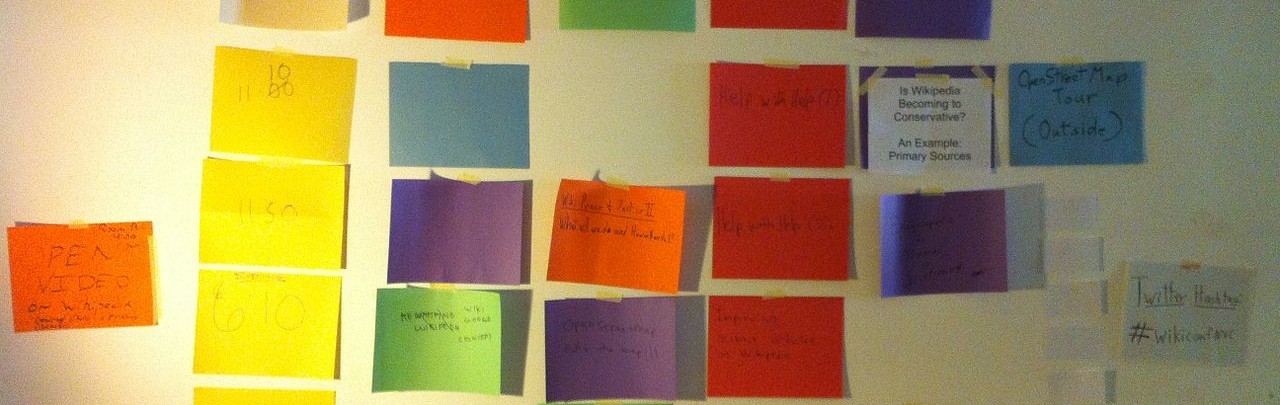
Project proposal – “the introductory wikipedia search”

“The introductory Wikipedia search” – freedom and access to information, how free is it? The historical issues raised and revisited through the lens of Wikipedia, and potential as a human resource. 

Word count 692

Information and access to it are not new concepts in history, and there is wealth of literature on the importance of it to life and development. From early hunter-gatherers to the Industrial Revolution information has played a key role in success and human life. In contemporary contexts or mass media and the internet, this is more important than ever. In both what information is presented to who and by who, but what information is sought out and the impact this has on development and social dynamics. Using Wikipedia as a departure point, and examining its data and usage, it’s possible to explore issues of censorship, inequality and information formation. Through this, it can be seen that controlling information and credibility through linguistics particularly is vital to social dynamics and education and calls into question the validity of the statement ‘freedom to information’. 

As an independent resource, Wikipedia strives to compile a catalogue of articles covering a near total range of topics. It does not claim to be expert in fields and subjects but often provides an adept starting off point in research tasks, providing rudimentary understandings, especially if you did not know where to look or have the right membership. By its nature it depends on community collaboration and the dedication of individuals, which is what opens it to such an interesting debate. Through the lens of Wikipedia and its reputation the following questions can be explored:

  • How important really is freedom to information? 
  • Where is the inequality in access to information and what produces the barriers? 
  • What does information access tell us about transnational history and networks, given the frequent interactions with national bodies and governments? 
  • How free is access to information through mass media, acknowledging the human cost and resources involved in getting to it – can it really be free? 

Issues of inequality and censorship have persisted throughout history, and in some ways Wikipedia is the latest platform for the debate to play out or be visible through. However, it gives a unique angle into ideas of ‘cultural censorship’ and how social dynamics influence what is considered information and how important/useful it is, as a humanitarian resource. 

Wikipedia is not free from bias, but when there is a dearth of information it can fill the gaps on issues like hygiene and sexual health, particularly in disadvantaged areas (be that in a global context or a local one). 

Despite its potential as an educational tool, it has a tendency to be discredited as unreliable or vulnerable to exploitation. Many in positions of information authority (meaning teachers, academics, librarians) argue against the validity of Wikipedia as a resource due to its collaborative and somewhat anonymous nature. If it was so unreliable however, it would be safe to assume that it would not be subject to as much censorship around the globe as it is. From this example through Wikipedia, it raises questions of information construction and social institutions role in producing ‘knowledge’, and the impacts this has. This topic, what is a fact and how is it constructed, is worthy of an essay on its own. The historical basis of the arguments surrounding information credibility and mass media, to be explored through Wikipedia in the project. 

To do this the approach taken will be that of a case study and branches through history, following the historical background of collaborative knowledge and censorship, and the benefit this can have as a humanitarian resource. Primary sources stating intent and effect from both Wikipedia and other interacting bodies can facilitate exploring the questions raised through linguistics, as well as historical debates on social construction of information and legitimacy, which when applied to Wikipedia, can show the inequalities and class dynamics at play in information access. Several biographical examples lend itself to this study, as the individual motivations and phrases are illustrative of the real impacts of Wikipedia as a resource in relation to the questions. This is a worthy topic to study given the casual pervasiveness of Wikipedia and its information, considering its near constant use globally and the conclusions that can be drawn from how it is regarded, and how it is used. 

Project Proposal: Narratives of Journey

Narratives of Journey: The Politicisation of Images and the Voice of the Refugee

This project aims to understand how the choice of language and definitions by international and state actors has interacted with the agency and voice of the refugee. It will require an understanding of the emerging historical approach of “Refugeedom”; a perspective that is inherently transnational.[1]

The questions at the heart of this project stem from identifying stark differences in the institutional depiction of refugees following the Second World War, and more recently in the twenty-first century. I will be seeking to discover what role language and images played in the interplay between depiction and agency, and through a diachronic approach, ask how this has changed over time. Subsequently, I hope to establish whether there are emerging institutions or groups that are challenging the historical status quo; if there are, whether they are doing this effectively, or falling into the same traps.  

This depiction does not occur only in written language; that of conventions or legal articles, but also in photographic imagery and more general media. By taking two images of a refugee family, one from the mid-twentieth century, and the other from the twenty-first, I hope to be able to trace the development of language patterns and usage, as well as the progressive politicisation of images and descriptions to influence the treatment of, and policy-making around refugees.

The analysis of language development would also need to account for a spatial awareness; that is, the influence that a refugees’ geographical background has on their reception, and ultimately their depiction. It seems as if there is a “European / Other” divide within descriptors and institutional treatment; which lends itself to a trans-spatial analysis. I believe this research would benefit from a look at Koselleck’s work with Conceptual History: understanding the development of “refugee” and “migrant” in order to gain the broader, social picture of “Refugeedom.”[2]

The politicisation of even the term “refugee”, poses subsequent questions to the discipline of oral and public history. In an attempt to avoid ‘top-down’ narratives, the obvious solution seems to suggest seeking out the “Voice of the Refugee”. However, through this project I need to maintain an awareness that this is not “black-and-white”, and there are underlying constructs of agency even within oral history. Any sources I therefore find, need to be treated with caution, for the interviewer, or photographer, had their own agenda: hearing what they wanted to hear, asking specific questions, or targeting certain subjects in their photographic compositions. This is not to avoid using these sources, but instead to approach them with the knowledge that “voice/life stories” are no more immune to politicisation than the more typical, parliamentary source.[3]

There is a quote from Prem Kumar Rajaram, who says ‘humanitarian agencies represent refugees in terms of helplessness and loss.’ ‘By stripping the refugee of the specificity of culture, place and history the refugee becomes human in the most elementary sense, dislocated from a territorial state. The resulting abstraction establishes the refugee as voiceless and without political identity or the corresponding possibilities of agency.’[4] I think that the development of this “voiceless victim”, and the subsequent treatment of them, can be traced historically over the past seventy years.

Acknowledging this politicisation and the danger of “top-down” narratives has led me to the area of Subaltern Studies, in particular Spivak’s essay, ‘Can the Subaltern Speak?’ By using this lens as a framework within which to challenge what I read, I hope to discover who has the permission to narrate when it comes to the voice, and story of, the refugee. I believe that the approach of “Refugeedom” has the capacity to break the refugee out of the ‘silent, silenced centre’, and rediscovering their place in the historical record.[5]

Sadly I do not believe that there will be a day that there will be no refugees, and therefore this conversation continues to be of utmost importance. Through trying to understand the historical process of language development and the tension of agency, I hope to discover a fresh perspective on the place afforded to the voice of the refugee.

(Word Count: 780)


[1] Peter Gatrell, Anindita Ghoshal, Katarzyna Nowak and Alex Dowdall, ‘Reckoning with Refugeedom: Refugee Voices in modern history’, Social History, 46:1, (2021), p.75.

[2] Reinhart Koselleck, ‘Social History and Conceptual History’, in Margrit Pernau and Dominic Sachsenmaier (eds), Global Conceptual History: A Reader, (London, 2016), pp.55-74.

[3] Nicki Kindersley, ‘Southern Sudanese Narratives of Displacement, and the Ambiguity of “Voice”‘, History in Africa, 42, (2015), p.203.

[4] Heather L. Johnson, ‘Click to Donate: Visual Images, Constructing Victims and Imagining the Female Refugee’, Third World Quarterly, 32:6, (2011), p.1029.

[5] Gayatri Chakravorty Spivak, ‘Can the Subaltern Speak?’, in Rosalind Morris (ed.), Can the Subaltern Speak?: Reflections on the History of an Idea, (New York, 2010), p.252.

Working with Transnational Sources in Relation to my Project

In his article, “Spatializing Transnational History: European Spaces and Territories”, Ángel Alcalde outlines the two main epistemological approaches to the problem of space in transnational history: a constructivist approach detached from geographical determinism, and one which combines different scales of analysis without challenging established definitions of space. This later approach is one which I believe will be useful in conceptualizing  transnational reproduction  in all the diseparate social and political spaces that it operates within and through. Alcalde highlights a distinction between borders and frontiers, the former being formal demarcations of ownership and the latter being  zones where social systems come into contact. For my purposes, this can be applied to human beings in that intending parents who travel to a foreign country to receive their baby born from surrogacy,  cross a physical border but perhaps more importantly, they encounter a frontier where the socio-political tendencies of their home country interact with those of the country where their surrogate resides. This becomes clear when one looks at the incompatible legal frameworks in different countries which affect the degree of difficulty intending parents have in obtaining a passport for their child born of surrogacy, as well as the  socio-cultural considerations which shape how people in different places view transnational reproduction. The space in which transnational reproduction operates is inherently constructed both transnationally and historically, by rules and regulations set by different nations, on one hand, and by social and cultural  specificities on the other. 

Alcalde draws on Muller and Torp’s (2009)  conception of transnational spaces to explain how space is a functional category constructed through economic, social, cultural or political interactions which acquires meaning  in relation to a set of perceptions and interests in a given context. In my research, the transnational space which I am looking at are all those locations throughout the globe which are involved in the process of transnational reproduction, as well as the localized spaces which  take on a global character due  to the intersection of different people, beliefs, legal precedents, and economic interests. Alcalde also mentions an article by Struck, Ferris, and Revel (2011) in which the authors advocate a focus on micro-scales in transnational research  because  these processes are often best “felt” at the local  or individual level. I believe this point is particularly important for my research due to the important ethical considerations which arise when talking about transnational reproduction. In my research so far I have gained important insights by reading articles and books and by watching  documentaries on individuals’ experience with transnational reproduction. It it my hope that the final product of my research will not only offer some interesting insights into the phenomenon of transnational reproduction, but also do justice to the people directly affected by it , especially those who are most vulnerable and have the least agency in this process: the surrogate mothers and the babies they produce. This blog post should serve as a starting point for my short essay, in which I would like to tease out some of the methodological considerations which will determine how I write my own transnational history of transnational reproduction. Although the topic necessitates a transnational lens, the methodology is less clear, and I believe that devoting this short essay to this topic will allow me to formulate a coherent plan of action for tackling the final project/essay.

Construction of Territorial Notions

The reading recommended this week was not only significant in understanding the methodological approaches used to study space in transnational history, it also helped me make sense of some aspects of my research. Alcalde made some very interesting points about how space is not just a container within which historical events take place. These historical events are also responsible for creating these spaces. The example of migrant Italian communities that settled in Toronto and Buenos Aires demonstrated how geographically independent territories could become crucial points of interaction between societies and cultures. They reflect the permeability of borders. 

The idea of a nation-state has become subject to historiographical debate by scholars. As Alcalde exclaims “even territories were constructed transnationally”. This line in itself was powerful enough for me to think of examples of nation-states that were created as a result of transnational historical processes. I could very well be wrong, but this sentence reminded me of the creation of Pakistan. It was not merely the demand of the Muslim League; it was a result of various interactions. The policymakers of India were heavily influenced by the European models of inter-state peacemaking. As Pallavi Raghavan exclaimed “The aftermath of the break-up of large multinational empires along ethnic majoritarian lines posed administrative questions that were, in many ways, also similar to the partition of the sub-continent on religious lines[1]” 

The concept of ‘transnational sphere’ discussed in the reading was linked to some of the ideas I am planning to explore in my project. International organisations, congresses, the publication of journals were all a part of this sphere. These spaces were the centre of intellectual thought. The Indian suffragettes were a part of a progressive liberal movement that helped shape the lives of women across different continents and not just the west. The anti-colonial alliances formed during this time are also an example of this. The flow of ideas transcended boundaries and created a unique space.   

  [1] Pallavi Raghavan (2020) Partition: An International History, The International History Review, 42:5, 1029-1047

Short Essay Planning

After a very helpful and beneficial unconference at the weekend, my project proposal is starting to take shape. 

It now seems appropriate to start preparing for the short essay. 

Initially, I was planning on doing a historiographical essay outlining the different approaches which I am planning of incorporating into my project. However, I now think it’s more appropriate to write a methodological essay on comparative history in order to avoid self-plagiarising when it comes to my actual project. 

Furthermore, having written historiographical essays last year in HI2001 I think it would also be beneficial to pay some attention to the methodology behind writing transnational and global history. Hence, writing about methodology is a chance to expand my skills and understanding of practicing history. 

After this weekend, I’ve decided that my project will be a comparative study and feel that it would be beneficial to do the short essay on comparative history. 

After (very) briefly looking over the Bloch and Haupt and Kocka chapters, it has become apparent that I believe that I’ve made the right choice to have chosen a comparative approach. As I’m planning on comparing two different subaltern groups and their cultures, the comparative method certainly seems the most appropriate to use. As Haupt and Kocka write ‘Historical peculiarities only become clearly visible when one refers to comparable examples, which are sufficiently similar in some respects, but differ in others’ (p.4). This is a good place to start when trying to establish to what extent there was a ‘Welsh subaltern’, as by comparing it to the well-known example of the Indian subaltern, the answer will (hopefully) become clearer. 

“Why do you ask?” Forays into Social Microhistory, and Asking the Right Questions

“Sil Batta” A traditional grindstone used to break down spices

After finding disparity in general literature with the sources, I have begun to look at another angle of research, interviews (or more formally, Oral Histories). As of today, 2 interviews have been conducted with the family members of friends, asking about their specific blend of Garam Masala and the connections to the place they came from. As of now, most of the families I have lined up are from the Northern regions of the continent, namely Punjab. The only exception was one family that was originally from Punjab but then migrated to Bombay. Considering the individual and personal nature of this style of primary source collection, the point is not necessarily to try and get as many as possible, or even that much of a range. However, I will have to do some searching to find families that represent the South of India to get a better understanding of the part of my essay concerning food nationalism and regionalism.

The question now is how to make it work within the context of my essay. Although in the past I have worked with primary source material, most of them were related to political history or specific events. How do historians analyze primary sources when looking at social history? This is especially challenging as interviews are notorious for digressing if the interviewer is not careful in selecting the right questions. This form of research seems to lend itself well to a combined framework of micro and comparative history (strangely enough) where the narratives and customs of individual families can be subsumed under the larger questions regarding health, perceptions and spices. Most of the questions I have asked fall largely into three categories. Firstly, the contents of the spice mix itself, what are the proportions? What are the main spices that feature? Secondly, you have the rationale or story behind the spices used.

Thus far, the overarching narrative found in popular media and literature (including the famous, Wikipedia) is that Garam Masala is a mix that is used to introduce heat to the dish. The very name Garam is taken from the Hindi word for “Hot” ( गरम), and Masala is used to refer to a spice mix of any sort. From the current understanding I have, the word Garam is used to describe a “warming” heat that hits the palate gradually and towards the end of the bite of food, whereas a “sharp” heat is referred to as Mirchi (मिर्ची) also used as the term for chilli. This very linguistic difference in understanding how “spiciness” is understood lends itself well to the kind of cultural analysis that transnational history is suitable for. From this small culturo-linguistic difference, I can examine literary perceptions from a variety of sources but in particular colonial and post-colonial sources. In my mind, this would fall under social history of sorts, extrapolated under the lens of microhistory. This entire conceptualisation of Garam Masala being used for heat was entirely overturned when one of the interviewees described how their family used Garam Masala not as a way to add heat to the dish, but rather aroma. This simple variation from mainstream views of the mix alone is a testament to the utility of microhistorical interviews as a form of research. Albeit when the right questions are asked.

The second overarching topic that was broached was family origins and regionality. The purpose of this question was to tease out whether geographic and/or cultural features have an impact on the constituent spices of Garam Masala. The most obvious “common sense” point is that families and people in certain regions will have access to different ingredients because of regional availability, but I wanted to figure out whether there were spices that transcended regional differences and were present in all Garam Masalas. Thus far, Cumin seems to be an inescapable staple in most mixes, but we await further information. I also endeavoured to ask about perceptions between north and south, in an attempt to tease out the similarities and differences across the subcontinent. The perception that Tamarind is widely used to introduce an acidic component to dishes was something that was mentioned by both interviewees, whereas in the North the usage of Amchur (dried mango powder) and Anardana (dried pomegranate seeds, and unique to Punjab) were used. The relationship between regional food differences and perceptions of why these differences occur were very useful in creating the basis for understanding possible avenues of cultural and political divides, as well as the formation of regional identities.

The final question was regarding the relationship between health and spices. This question was mostly driven by the existing research that I had seen in the preliminary search for sources. The main difference was that the information available on engines such as google scholar were primarily focused on scientific analysis of compounds in spices, whereas one interviewee expressed that the knowledge being passed down about the anti-inflammatory nature of certain spices was passed down generationally. This contrast between generational and academic knowledge is something that will be further discussed in historiographical analyses on the topic.

All in all, with the sources, that Charmaine (thank you very much!) has provided as a baseline source for reading, and several interviews conducted, has formed a solid basis for some sections of the essay. Now several questions come to the fore. Firstly, whether interviews are “admissible as evidence” for essays, and how to make the best use of the information provided.

Long last, the road forward is beginning to look a little clearer.

The Politics of Language

I don’t think I’d have to put forward that hard a case to get people to agree that language is intrinsically political. The awareness of this over the past few years has grown exponentially: people are now wary of things being PC (politically correct), and trying to find the right terminology, especially when discussing topics that are not so known to us.

And so, before my ideas about this project really were written down, I knew I’d have to address the issue of language; its political nature, and the imbued power that language (and its holders) can have.

In the case of my project, it comes down to this: “What is a refugee?”

  • What is the difference between a refugee and a migrant?
  • Where do migrants and exiles fit into the conversation?
  • What about “asylum seekers”?
  • If someone is a displaced person, does this make them a refugee?
  • What are the political connotations of each of these words? And what kind of atmosphere do they conjure?

.

The United Nations 1951 Refugee Convention declare that a “refugee” is as follows:

“any person who, owing to a well-founded fear of being persecuted for reasons of race, religion, nationality, membership of a particular social group or political opinion, is outside the country of his/her nationality and is unable, or owing to such fear, is unwilling to avail himself/herself of the protection of that country.”

United nations, 1951 Convention on the Status of Refugees, p.16, at www.unhcr.ch

The convention itself, given its historicity, has issues. It was initially only applicable for those people displaced due to events that occurred pre-1951, and only to Europeans. While these have been widened and shifted as the twentieth-century progressed, there are still short-comings in this definition.

An individual cannot choose this designation or identity for themselves; at least not legally. They can only be designated as a “legal refugee” when that status has been granted, via application, as a result of meeting certain requirements.

.

So – if there is an issue over who or what is a refugee, then what alternatives are there?

There are some news outlets, such as Al Jazeera, who chose to no longer use the term “migrant” because they believed it ‘dehumanises and distances the individual in need from the reader’ – and so they’ve chosen ‘refugee’ instead.

On the other hand, Alexander Betts, director of the Refugee Studies Centre at Oxford University, believes that “migrant” used to be neutral, but now means “not a refugee.” He says that the term “economic migrant” ‘is used to imply choice rather than coercion.’

One article I read, written by Loren Voss for the YJIA, chose to use “asylum seeker”; even though they recognised it was not neutral, she used it ‘because it does not prejudge whether the person has a valid refugee claim under the law, but still invokes the dire situation from which they came and the larger social policy issues that are implicated.’1

In all of this, there may not be a neutral term. That may not be possible. But – it is worth asking, how does the language we use impact our assumptions, and consequently our historical analysis?

.

My current thinking is that for my short essay, with a more theoretical approach, I should look at the history of “refugee/migrant”. This, I believe, is tied in with the ideas of “Refugee-ness” and “Refugee-dom”, which have begun to emerge alongside the popularity of “Life Stories”.

The labels placed on these displaced people have been used to inform policy and shape people’s opinions; we don’t have to look far to find examples. In Israel, their conventions claim that asylum seekers are “infiltrators” – regardless of why they’re coming.

If my project progresses as I hope – then this is crucial for me to understand as I seek to look at narratives. Because; whether I like it or not, even the stories from the refugees themselves are not neutral accounts. My methodological essay may also need to look at oral history; and its advantages and disadvantages. I can’t seem to escape the question of agency – something which I think is at the heart of subaltern studies.

Psychology has helped ‘us with the “why” and “how” of government and media campaigns: (1) vocabulary affects how people think about asylum-seekers and state responses to them, and (2) that framing bias allows a national security framing to narrow the solution set avoiding those that might address social issues.’2

.

I’m trying hard not to get stuck in an ethical trap with all this research, but I’m afraid I may need help at some point soon. As I said in my presentation on Tuesday – I want to avoid discrediting the agency of the refugee, either through taking the wrong approach, or by giving too much, or not enough importance to institution.

But then again – all of this is hypothetical – I don’t have access to first-hand stories, or get to ask the questions myself. And so I’m having to put on my “glasses of critical thinking” in order to challenge what I read, and hopefully, not fall into the trap I can see looming.

.

(On a side note however, any ideas about how to put these questions into something practical; I’d love to hear them and chat them through. Sometimes too much theory just baffles my brain!)

.

.

1 Loren Voss, ‘Choosing Words with Purpose: Framing Immigration and Refugee Issues as National Security Threats to Avoid Issues of Social Policy’, Yale Journal of International Affairs, 13:1, (Spring 2018), pp.40-41.

2 Voss, ‘Choosing Words with Purpose’, pp.46-7.