Two Americans, two Scots, and an Englishwoman walk into a lease agreement…

And somehow, miraculously — after almost two years — not a drop of blood has been spilled.

At least, unless you count a minor incident on Pancake Day 2018, when the three representatives of our respective nations stepped up to the pan in a deadly culinary battle; a valiant attempt to prove that theirs alone was the true pancake, not a soggy-bottomed scone or a glorified crepe as the various opponent forces would have you believe.

Let’s just say we’ll be sticking to the Waffle Co for our batter-based consumables this time around.

But, minor skirmishes aside, the living arrangement works. We have the advantage, perhaps, of a common language, a similar level of education, and no irreconcilable differences in terms of political views, religious beliefs, or a lack thereof. Against this backdrop, our difference in nationality seems trivial, if not entirely immaterial. Certainly, it has have proven no barrier to either our cohabitation or our friendship.

As fellow members of the University, I am sure these experiences will seem very familiar. And I am sure you will agree when I suggest that the St Andrews network is a phenomenon which deserves attention all on its own.

A web of students, staff, and academics from across the globe coalesce here in a tiny bubble: our own small hive of international, interdisciplinary, and interpersonal connections, and surely as good an example for transnational activities as any. Add the seasonal influx of tourists, golfers, and holidaymakers into the mix, and a whole new dimension begins to emerge.

And it can, of course, prove deeply controversial.

Indeed, amongst my housemates, who I have listed as two Americans, two Scots, and myself (English, though I will somewhat vainly default to British in my paperwork in recognition of the peculiar transnationalism of my own family), it has become something of a grim running joke to refer to our small North Sea town as if it were a modern Anglo-American colony.

And for all of us, the intense transnationalism of our university is a self-conscious experience. The fact that neither of our Scots speak with quite the same accents as their grandparents, parents, or peers back home is itself enough to generate some small feeling of disconnect from their sense of locality.

Now in the presence of others, they are instead galvanised to find further common ground in nationality — often, shared dialect words or pronunciations, shared experiences in education, or even familiar food and drink.

Think less haggis, neeps, and tatties, and more Barr’s bubblegum ‘fizzy juice’ drink (“You can’t call it pop, nobody says pop!”), steak pie with a pastry top (“What do you mean it’s supposed to come with a pastry case? That’s not the point of a steak pie!”) or cauliflower pakora from your local Glaswegian Indian takeaway, which my housemate swears is like no other.

Because while, on a larger scale, certain markers of identity become more difficult to distinguish – the little details lost on a larger-scaled map, the tiny organelles of a cell that blur together under lower magnification – so too do new shapes and contours come into focus, even if they were previously unseen, unknown, or simply irrelevant.

One of the interesting things about St Andrews, however, is that what comes into view very clearly as an English or an American student is how surprisingly easy it is to fit in here.

Allow me to explain.

Before coming to St Andrews, I attended a series of statistically average comprehensive schools which, though I loved, were not the ones expected to produce the best university applicants in my area.

Nonetheless, my academic profile was promising, and though, ironically, I was afraid that my history grade or my upcoming exam retakes might hinder my chances at entry, my careers advisers, as well as representatives of the university that I spoke with at UCAS fayres were always open-minded to my potential as an applicant.

Similarly, though you might put it down to cultural differences, the overwhelming message received by both of my American housemates was simply to go for it.

Often, for the Scottish students I have known, quite the reverse has been true. From their own schools to the level of university representatives, the number of prospective students told plainly that they won’t get in— or told by friends and family that they certainly won’t fit in –is quite alarming. Even more so when you usually hear these stories directly from students who did get in, and who have proven themselves more than worthy to be a student here, in their classes and beyond.

We could easily argue about the other factors which might generate this pattern of stories: assumptions about education and attainment, about socioeconomic background, even— or more conspiratorially, as many certainly do —the controversial calculus of funding, quotas, and tuition fees.

Yet I cannot help but perceive a stubborn national element here, and I do wonder what it says about us and about our institution that this imbalance exists. That it is frequently the Scottish students who feel the outsider here— and, indeed, who often feel an outsider on their return home —while most English and American students are absorbed quite easily into the mix.

We might boast of a highly international intake, but how diverse is it, really? Do we really experience a strong current of internationalism at St Andrews? Do we hear four different languages waiting in the library lobby, as you might at Aberdeen? Do we hear the voices of people of colour in every hall of residence and every class cohort, as you would in London or Leeds?

Are we, I ask my fellow English or American students, routinely challenged in our assumptions by people of other nationalities, cultures, or backgrounds?

Or, by and large, is our esteemed St Andrews network dominated by a transplanted Anglo-American culture, flavoured with a dash of orientalist Scottish whimsy worthy of Sir Walter Scott’s pageant for Queen Victoria in 1842?

I wonder. I wonder.

[Project] The Breaking of the Fellowship: The Second International on the Eve of the First World War

“No! no!” cried Frodo. “The Council laid it upon me to bear it.”

“It is by our own folly that the Enemy will defeat us,” cried Boromir. “How it angers me! Fool! Obstinate fool! Running wilfully to death and ruining our cause. If any mortals have claim to the Ring, it is the men of Númenor, and not Halflings. It is not yours save by unhappy chance. It might have been mine. It should be mine. Give it to me!”

If we could categorize historical settings into different “types”, I would probably say my favorite type of setting is one in which ideologies and social movements meet violently with existing economic and social realities. Under this categorization would be most revolutions, military, social, or industrial, as well as historical moments such as the one I intend to center my project on.

The Second International was an organization tying together the different Marxist political parties of the world (though primarily Europe) together; the organization held Congresses in which a unified ideological platform across parties was debated and established. A crucial part of this platform was internationalism and antimilitarism; from the perspective of socialist theorists, it made no sense for workers to die in battle against their fellow proletarians for the benefit of industrialists and aristocrats. By the outbreak of the First World War, parties affiliated with the Second International were the largest or second largest parties in the majority of continental Europe, though in almost all cases they were excluded from government.

While outright preventing the war would have been immensely difficult given their lack of direct political power, the Second International’s constituent parties were bound by the 1912 Congress to not vote for declarations of war or funding bills for said wars. Despite this, the vast majority of elected officials in belligerent countries voted not just for the original declarations of wars, but for funding for the war for severals years after. Socialist parties formed wartime coalitions with centrist and right-wing parties, and promised to prevent strike action and undue criticism of the war effort. While counterfactuals aren’t terribly useful, it is hard not to note that given that massive strike action and mutinies were crucial in eventually forcing German capitulation in 1918, it is likely that socialist collaborationism meaningfully lengthened the war. The near universal betrayal of one of the Second International’s core principles proved too much for the fellowship, which shattered during the war into separate organizations composed of pro- and anti-war leftists. These political descendants then continued the quest to throw capitalism into Mount D-er, rather, the dustbin of history.

At the core of what I want to investigate in my project is the internal conflict faced by persons associated with the Second International in the leadup to the First World War. In part this will be the conflict faced by leftists between their belief in class solidarity and internationalism and their conscious or unconscious belief in the ideals of nationalism and patriotism, and in part the material conflict faced by politicians between ideological purism and the need to engage successfully in electoral politics. In terms of what I know will definitely be in the project, I intend to analyze the existing conflicts over antimilitarism before, during and after the 1912 Congress, as well as conduct some in depth research on particularly interesting figures that might help illustrate the larger work. In particular, Jean Jaurès, the committed anti-militarist leader of the largest French socialist party, who was assassinated days before the outbreak of the war by a revanchist Frenchman; also Georges Weill, SPD member of the German Reichstag for Metz, who scandalized Germany by signing up for the French Army shortly after the outbreak of the war. If possible I’d like to strike a balance between looking at prominent intellectuals and politicians like Rosa Luxemburg with the views and opinions of everyday people who supported Second International parties. These may be difficult to source in English translation but I think it’s worth the try, as the motivations of the two groups were likely different and shouldn’t be grouped together.

Given this “core” topic and timeframe, that being the failure of antimilitarism at the start of the First World War, I want to expand the project both chronologically and topically. The more historically obvious expansion would be to look at the end of the war and the impact of the Bolshevik revolution, particularly with regards to the reasons figures on both sides of the antimilitarist split had for either supporting or opposing the Bolsheviks and their methods and/or platform. From my limited knowledge, the earlier anti-war faction tended to support the Bolsheviks and the pro-war faction tended to oppose them; looking at the reasons why this was the case would be a logical extension of the core of the project.

That being said, a more interesting expansion would be to construct the project as a comparative study of the Second International’s internal conflict with regards to antimilitarism with a very similar conflict, occurring around the same time, with regards to anti-colonialism. In my preliminary research for this project, I have found that while the Second International was formally opposed to colonialism, there was extensive internal debate over the nature of that anti-colonialism, and in some cases, the necessity of such a doctrine at all. This seems to represent a similar conflict, this time between socialist doctrines of racial egalitarianism and anti-imperialism and the notions of European racial or cultural superiority that were pervasive in Europe at the time, as well as ideals of nationalism and patriotism.

Also worth investigating would be the nature of the Second International as a de facto whites-only organization, as the only non-European member parties were located in the United States, Argentina, and Uruguay. The vast majority of participants, politicians and civilians alike, had limited to no interaction with colonized peoples. It occurs to me now that this aspect might be worth comparing to the physical and linguistic barriers faced by ordinary members of International-affiliated parties when considering their ability to directly meet with and relate to their ostensible brethren in other European countries. While it might be outside the temporal scope of this project, it’s worth considering that while no Second International party directly “betrayed” the anti-colonial ethos in the same way as took place with antimilitarism, this may simply be because no Second International party led a government of a colonial power prior to its dissolution. In the post-war period, formerly affiliated parties came to power in countries such as France and the Netherlands, and refused to begin the de-colonization process or to give colonial subjects equal political rights; this could be seen as a comparable betrayal to that of the July Days of 1914.

To conclude, and to tie my last post to this one, I am very tempted to take on the more ambitious comparative project with anti-colonialism. My only worry is that I will find myself unable to do both antimilitarism and anti-colonialism justice and end up not investigating either as deeply as they deserve; the Second International is well attested to in both primary and secondary sources so there is likely no “bottom” to how deeply a committed student could investigate certain aspects of it (ignoring the time limitations). That being said, I think if I plan the project out correctly, this could be some of the most interesting and, hopefully, best work I have done at St. Andrews.

An Emphasis on Character and Interaction

Tonio Andrade’s “A Chinese Farmer, Two African Boys; and a Warlord: Toward a Global Microhistory” was one of the most entertaining historical pieces I have ever read. I found its flowing narrative to be refreshing as it contained vivid imagery not often seen in academic articles. In his micro-historical approach, Andrade grounds his writing in a linear narrative and rarely digresses from the storyline, allowing himself more leeway for description and greater entertainment value. Within the story, we are able to get a sense of the character and agency of a number of individuals, including the Taiwanese farmer called Sait, the warlord Koxinga and two Dutch naval officers named Caux and Coyet. The decisions and struggles of these characters in addition to the interactions they have with each other, make the story readable as well as believable. Rather than focusing on broader questions of intersectionality and transnational networking, Andrade chooses to focus on individuals and their interactions during an instance of confluence between nations.

I found that this style and approach contrasted with Heather Streets-Salter’s “The Local Was Global: The Singapore Mutiny of 1915.” Streets-Salter uses both micro and macro levels of analysis in what is a far more technical approach to writing global/transnational history.  She begins by describing the events as they happened categorically, laying the groundwork for the rest of the essay when she looks at the causes, ramifications and vast global networks involved in the mutiny. The combination of micro and macro elements requires densely packed information as it includes a discussion of wider historical movements that may have contributed to the event. The article starts with a group of Indian sepoys being tried and executed for staging a mutiny in British-controlled Singapore and the network steadily expands to another, Indian nationalist military group called the Malay States Guides to a Japanese ship in Vancouver called the Komagata Maru and all the way to Kaiser Germany’s First World War propaganda machine. While the reach of the Singapore Mutiny’s transnational network is certainly astounding, I found myself lost in the complicated and at times tenuous connections between the Mutiny itself and its far-reaching global connections. This may be the result of my preference for concise, anecdotal writing, but I think there is something to be said of Andrade’s ability to create an informative story with an abundance of drama out of a little known 17th century struggle between a Chinese warlord and some Dutch sailors.

Andrade’s article showed that transnational history could take place through a series of personal interactions. As I solidify a topic for my project, I hope to follow his example and find a situation in which I can tell a story of transnational interaction taking place between individual people and cultures, not necessarily institutions or government apparatuses.

Can transnational history be written without the mention of the “nation”?

Can transnational history be written without the mention of the “nation”?

Reflecting on the Week 4 Readings, I was intrigued by the discussion regarding “nations.” As poignant stated in the Introduction. Space and Scale in Transnational History’ article, the scale by which transnational history can be measured far outshines the limitations of “nation-states.” The argument was cogently made that history can be studied through the more fluid categories of identity, region, and even ethnic group (p.578). Similarly Ian Tyrell in Transnational Nation references looking at history in terms of the local scale, finding the balance between local and global history. While I agree with Tyrell and acknowledge the merits of looking at history through other perspectives than just the nation-state, I find it hard to abandon the notion of the nation entirely when writing any history. In other words, I agree with the statement that some accounts of transnational history benefit from being assessed through the documentation of religious groups or regional ties. However, I disagree with the notion that the nation-state can be entirely abandoned in accounts of transnational history.  Notably, some histories might cater more towards regional studies or specific state case studies (like that of the United States), but the overarching influence of the nation is hard to separate from any narrative.

With this in mind, I pose the question of “why do we need to seperate transnational history from the nation?” It can be coherently argued that looking at national histories can be a telling starting point for international movements. For example, in my proposed project focusing on EU identity, it is helpful and some would argue (like me) necessary to start from the building blocks of nation states and state actors. My fear is that if historians separate or feel they need to separate the idea of the nation entirely, important historical parallels will be lost. To illustrate, in A Chinese Farmer, Two African Boys; and a Warlord: Toward a Global Microhistory, Sait a Chinese farmer is an actor in a larger movement, but described as a Chinese farmer. Sait helps the Dutch prepare for oncoming attacking from Koxinga’s army, and therefore acts against his nation. The reason this story is so significant within history is the movement of ideas and actions across nations. It would seem difficult to remove this concept of a nation and still defend the prominence and importance of the historical narrative of Sait.

Why is there so much hesitation towards a narrative based around the “nation”? To some, a possible reason could be the implications of the word “nation.”  “Nation” denotes a place with set boundaries, isolating a group of peoples rather than connecting them. However, a counter argument would be that by recognising the presence of nations within historical narratives it is easier to draw and see connections, politically, economically, and culturally when a fixed scale of “boundaries” are in place. For example, tracking the movement of Yiddish speakers in during World War II could be more easily done by accessing the number of speakers in each country, and using those statics to contribute to a more holistic picture. By looking at national boundaries, a larger image of global collaboration, globalisation, and transnational ties come into focus. For example, in order to make sense of terms such as “globalisation”, one must understand how commodities and ideas spread from one country to the next. These links defy borders but in order to understand how connections blur national boundaries, there needs to be talk of these national boundaries. To abandon the idea of the nation entirely would be doing a disservice to the discipline of transnational history.

I believe it is difficult to think of a situation that is benefited by completely discarding the nation. For example, even tracking the movement of technology or cybersecurity still gets wrapped up in specific national legislation and policies. The nation is always part of the conversation whether it is used as a scale of measure, or whether it is absent from the conversation (speaking in more global terms as a method of contrast)– it is nevertheless talked about. So in sum, while the nation must always be present in historical dialogue, it is not necessarily the strongest method for accessing a historical study.

Ocean Liners at the V&A

Last weekend I took my mum to see the wonders of Dundee. The main reason we’d gone, other than the fact we’d managed to cover most of St Andrews in about a day, was to see the Victoria & Albert museum. I live in London and my mum is a jewellery designer, she makes and designs her jewellery using semi-precious stones, so of course my childhood Sundays were often spent perusing around London’s many art and design museums, in particular the V&A. Though I unfortunately did not inherit any of my mum’s arty genes (they all went to my sister), I have always been able to appreciate art and decorative objects as historical artefacts, allowing you to get a glimpse of what a certain time or place would have looked or felt like. What kind of person would have owned or wanted to own these objects? Why did they mean something to someone? Who had created them and why? We are inherently material beings, prone to creating, flaunting and hoarding aesthetically beautiful things and I think often as historians we neglect looking at objects and art as primary sources, leaving them to the art historians.

Despite having quite low expectations (I mean we’re just looking at boats right?), I found the exhibition incredibly inspiring as a way of practising Transnational History. Ocean liners are connectors; they forge connections between places by transporting people from A to B, often crossing national borders in the process. As the principal method of travel across oceans until the invention of planes, ocean liners served the world in many ways: transporting immigrants to new lives, servicing global empires and carrying cargo from place to place. Shipbuilding also became crucial to many industrial economies, while an expanding network of ports created cosmopolitan hubs where international products were exchanged and people of different cultures and backgrounds interacted.

The exhibition mainly focused on ocean liners when shipping companies began targeting wealthier first- and tourist-class passengers travelling for business and leisure in the early 20th century. Until then, intercontinental travel was difficult, sometimes dangerous, and was mainly undertaken by those who had to: imperial servants, or those emigrating in search of a better life. As the demand for luxury travel was increasing, the transnational customer came to connote a particular class of individual – you think of Kate Winslet in a black beaded dress and white gloves, descending the ornate wooden staircase to enter the first-class dining room. These were transnational people because they could afford to be.

Ocean liners were increasingly seen as symbols of state and intensifying national rivalries gave them a new political resonance as embodying the wonders of the modern, industrial world. As companies competed for wealthier passengers, interior design became an important feature that bridged both commercial and national concerns.

What I found particularly interesting was the way the interior design of the ship reflected the specific route. ‘Exotic’ decoration and materials often characterised ships on colonial routes, which may have influenced the expectations these people had when they arrived to their destination. This idea made me reflect on Derek Gregory’s ‘Scripting Egypt’. In it he directs our attention to the ways travel writing is involved in the ‘staging’ and ‘scripting’ of particular places. He argues travel scripting (like travel guides), “produces a serialized space of constructed visibility that allows and sometimes even requires objects to be seen in specific ways by a specific audience”[1].

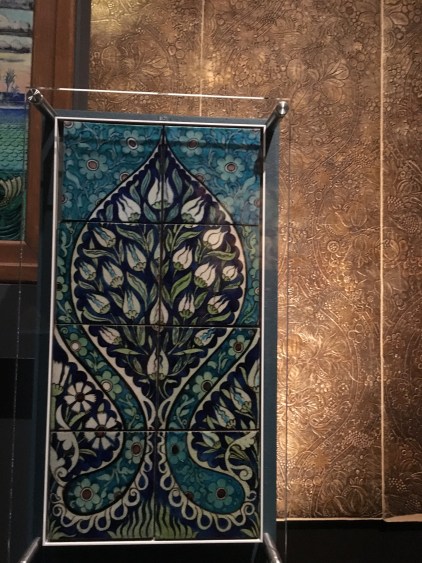
This panel was designed by William de Morgan for the saloon and displayed on the Sutlej, a P&O liner named after a river in the Punjab, India. Below, are further panel designs he sketched for other P&O liners.

The display below it read, “His designs were inspired by destinations in India and Asia, and by Iznik ceramics of the 16th century Ottoman Empire which he encountered at the South Kensington Museum”. It’s almost ironic to consider William de Morgan never crossed a national border himself whilst making these designs, instead drawing on objects from other museums himself.

Whilst researching the SS Sutlej at home, I found out the ship also made 10 journeys between 1908 and 1916 transporting Indian indentured labourers to the West Indies whilst on its return journey from Calcutta.[2] These labourers emerged when European merchants and businessmen began recruiting Indians who were enlisting to go abroad in hope of a better life to work in plantations after the abolition of slavery. The influx of docile and manageable Indian workers diminished the competitive leverage and bargaining power of the freed slaves in the West Indies, reinforcing the so-called ‘plantocracy’ system there.[3]

Whilst researching the SS Sutlej at home, I found out the ship also made 10 journeys between 1908 and 1916 transporting Indian indentured labourers to the West Indies whilst on its return journey from Calcutta.[2] These labourers emerged when European merchants and businessmen began recruiting Indians who were enlisting to go abroad in hope of a better life to work in plantations after the abolition of slavery. The influx of docile and manageable Indian workers diminished the competitive leverage and bargaining power of the freed slaves in the West Indies, reinforcing the so-called ‘plantocracy’ system there.[3]

The paradox of coerced yet mobile indentured labourers compared to the unrestricted yet immobile English artist reminded me of Clare Anderson’s discussion of geographical immobility being bound up with social immobility. “The ‘modernity’ of colonial governance was constituted in part through representations of the ‘pre-modernity’ of Indians who belonged to static, unchanging and timeless religious or caste communities. The possibility of travel across social, cultural or geographic borders was thereby imaginatively erase”[4].

Overall, the exhibition provided me much to reflect on as an example of transnational history on display for the public. I very much enjoyed looking through these objects as historical artefacts once again, even if the description did not reveal the whole story.


[1] Gregory, Derek, ‘Scripting Egypt: Orientalism and the cultures of travel’ in James Duncan and Derek Gregory (ed.), Writes of Passage: Reading Travel Writing (London, 1998), p. 116

[2] http://guyanachronicle.com/2009/05/05/the-coolie-ships, http://www.theshipslist.com/ships/descriptions/ShipsSS.shtml

[3] Misir, Prem The Subaltern Indian Woman: Domination and Social Degradation (Berlin, 2017), p. 20.

[4] Anderson, Clare, Subaltern Lives: Biographies of Colonialism in the Indian Ocean World 1790-1920 (Cambridge, 2012), p. 19


‘Is My Project Possible?’ – A Response to John

I completely understand your frustration. Like you, I’m interested in applying the transnational lens to the early modern world and those non-state actors who traversed it. I share your skepticism about the existence of relevant source material though, and your anxiety as to exactly why individuals should be discussed in the transnational context. 

First off, I’m convinced the transnational perspective is applicable to the early modern era: this is something I’ll tackle in my short essay. I was irritated by the transcripts of those transnationalists in the AHR conversation piece who expressed uncertainty as to the prospect of applying the ‘lens’ to the pre-19thcentury period. My ego took another knock when I turned to the Palgrave Dictionary of Transnational History, in which ‘Discipline or subdiscipline were not discriminating factors, as long as a potential author had a bent for grappling with time and the history of the last 160 years’.[1] 

We shouldn’t take this too much to heart though. A number of ‘transnationalists’ (like me and you perhaps) find the term ‘transnational’ rather unhelpful. Take a look at this – ‘‘I have to confess that I find “transnational” a restrictive term for the sort of work which I am interested in’.[1]Bayly’s Birth of the Modern World drew connections and comparisons between nations, societies and cultures in the 18thcentury. 

Anyway, I think there’s scope for suggesting that ‘nations’ existed in the pre-modern world. Liah Greenfeld made this argument in her Nationalism: Five Roads to Modernity, as did Anthony Smith. In his article (‘Nations in Antiquity?) he conceived ‘the nation’ as a ‘moving-target’ (always in the making and never really ‘made’). You might be able to use that type of reasoning to ‘prove’ that the writing of transnational history is applicable to the early modern world. If you do, it wouldn’t be too much of a stretch to write a trans – ‘national’ history of a traveller like al-Nahrawali in the 16thcentury. I think it’s more than possible.

The lack of source material on your protagonist must be frustrating. Of course, I know next to nothing about his life, but one way to explore it in a ‘transnational’ context (and make it ‘worth discussing’) might be to explore how he (or others) moved between Mecca and the Ottoman interior: via specific trading networks or waterways for example. Or you could explore how the Ottoman interior managed its imperial periphery in a much broader context. This might explain al-Nahrawali’s capacity to move across imperial space (more ‘transcultural’ than ‘transnational’ perhaps, but maybe worth considering). 

I think if you take a ‘macro’ approach in the first instance it might shed light on al-Nahrawali’s more or less ‘micro’ history.  


[1]Bayly, Christopher A. et al. ‘“AHR Conversation”: On Transnational History’, The American Historical Review 111 (2006), p. 1442. 

[1]Iriye, Akira and Saunier, Pierre-Yves (eds.), The Palgrave Dictionary of Transnational History(London, 2009), p. XIX. 

I Want To Break Free

Who’d of thought a Queen classic would so aptly sum up transnational history. As the first verse goes:

I want to break free
I want to break free from your lies
You’re so self satisfied I don’t need you
I’ve got to break free
God knows, God knows I want to break free

Much like Queen, transnational history seeks to break free, in this case from traditional grand national narratives, narratives which Wendy Kozol would argue are more often than not ethnocentric and imperialistic. Although the extent to which these histories can be conclude as lies is highly debatable, it represents an archaic form of historiography which translation history seeks to challenge. As Sven Beckert states, transnational history offers a “way of seeing” which focuses on mobility, seeking to subvert the significance of the nation state which has chained historians down for too long. The application of this can be seen in the introduction of Transnational Lives, for by taking mobility rather nation as its frame work it seeks to explore the lives of those who have previously been ignored and misunderstood by national biographers.

If the methods of anthropologist George Marcus are examined, a transnational approach to writing biographies would in fact, seem the most appropriate. Marcus argues that biographers must ‘follow the people’ examining the “chains, paths, threads, conjunctions, or juxtapositions of locations”, all attributes encouraged within transnational history.

Transnational history, therefore, seeks to break the reader free from preconceptions of national identity which have continuously defined the hierarchies of scholarly thought. A reaction against a binary presentation of world i.e. North vs South, West vs East, First world vs Third world, where lesser developed nations are too often simplified and overlooked. Transnational Lives takes this one step further, focusing on the significance of cultural history and feminist analysis, arguing that transnational history has too long been dominated by economic and political approaches. Traditional forms of study which have been found to display an underlying gendered schism. In this way, I want to break free is again comparable, for within the music video Queen decided to dress up as women. A funny coincidence and yet, the reaction to the video saw it banned from MTV for simply challenging social norms. Although transnational history has never produced such an extreme response, much like Queen, it seeks to challenge and push boundaries, offering new exciting ways to examine history.

An example of this can be found in the first chapter of Transnational Lives “A Story with an Argument: Writing the Transnational Life of a Sea Captain’s Wife”, a work which I took great pleasure in reading. The transnational approach to Eunice Richardson Stone Connolly life illustrating racism cross national boundaries, revealing a fluidity which goes against traditional understanding.

So as this semester progresses I hope to embrace my inner Freddie and break free from the national narratives which transnational history seeks to challenge.


Historical Empathy and Practising Biographical History

Delving into biographical histories this week brought me back to what I have always found so interesting in history: storytelling.

I am, and have always been, an avid reader of fiction, biography and autobiography. Whether it’s 1950s rural Naples (My Brilliant Friend, Elena Ferrante), the fictional town of Macondo in rural Colombia (One Hundred Years of Solitutde, Gabriel García Márquez) or mid-20th century Kyoto (Memoirs of a Geisha, Arthur Golden), it’s these characters and their settings that reveal to me most vividly, the intricate complexities of history.

I do not mean to oversimplify the method of practising biographical history by comparing it to reading or writing fiction since that is not the purpose of this historiographical approach. However, what I can say is how pleasantly surprised I was to find how similarly gripping I found these stories to be. These individual’s transnational lives – convicts, wives, nobles and the like – made for incredibly interesting, page-turning history.

Nevertheless, I also understand the criticisms of biographical history as anecdotal or obscure. One life, out of the billions that have existed, cannot possibly represent a historical process, a structure, an idea. Furthermore, as voiced by Clare Anderson, the choice of the subject is ultimately that of the biographers, in which some peoples’ lives, but not others, are seen as important or interesting enough to be committed to biography. The presentation of these subjects can often tell you just as much about the biographer as it can about the lives that are being portrayed.

However, criticisms of this form stems from the assumption that individual’s emotions, experiences and ideas have only anecdotal value in describing the great narrative of history; that the purpose of history itself is to describe and understand this great historical narrative rather than individual’s stories. If you take this view when writing biographical history, describing a life as representational of other lives in a country, a religious community, an era for example, you can end up putting people into categories, which can obscure the complexities biographical writing is so good at revealing.

On the other hand, if we look for discord and resistance in anomalous lives, particularly that which looks at colonial subjects, we can arguably lose sight of colonialism’s universal attributes and grander power structures and thus undermine an anti-colonial politics that is responsive to the commonalities of experience among the colonised.

The tensions between the micro and the macro, the particular and the universal, the individual and their contexts, are all inherent to the practise of transnational history. Yet, the biographies in the readings this week struck me, not for their value in confirming or challenging larger issues or narratives, but for their ability to evoke a more empathetic kind of historical understanding, like that gained when reading literature.

Biographies allow historians to be more sensitive to lived experiences of individuals whilst gaining an insight into the complex networks of wider, transnational historical processes, be it inter-colonial constructions of race or contradictions in the social hierarchies of the British imperial world. It is often also written in a way that is often more accessible and engaging to a procrastination-prone individual (like myself). I’ve never tackled a biography before, and have very little idea as to how to even begin to go about it, but perhaps it is the answer I’ve been waiting for, to get back to the root of what I thought history was all about, telling a story.

From People to Place

When place is central to the construction of one’s identity, perhaps it is only natural that humans, and especially historians, make sense of the world through strictly defined spaces. As a unit of analysis, the nation-state is often taken to be the most legitimate representation of a defined space. The flaw in this tendency, as Deacon, Russell and Woollacott point out, is that “the mobility, confusion and sheer messiness of ordinary lives threatens the stability of national identity and unsettles the framework of national histories.” (Pg. 2) Their stories of transported convicts and the wives of both explorers and sailors demonstrated that an individual’s history is by no means confined to the state. While reading through the various chapters, I wondered if one could refocus this type of transnational history and shift the unit of analysis from an individual to a place or geographic area. Rather than focusing on how an individual or product circulated space, I wanted to discern how a singular space can be circulated by a diverse, transnational array of groups or individuals. This would stipulate that the history of a town, city, or even a state can shake off the confines of one single political and cultural identity. This seemed logical to me, as at some point in history every politically defined territory was established out of some previous entity. When each place undergoes a historical transition, individuals moved through those spaces, some of them settle and others simply passed through.

In the case of my home state, Hawaii, I find a shining example of how the history of a place cannot be defined by a one cultural and/or political identity. In realising this, I drew on what I know of the history and demography of Hawaii. Simply put, it is one of the most diverse places on Earth. It is a ‘majority-minority’ state and the only state within the U.S. that has never had a majority white population.

For some context, the Pacific archipelago that I grew up on was originally settled by Southern Polynesian people over 1,500 years ago. An indigenous culture flourished on the islands until the arrival of the British explorer James Cook in 1778. European diseases brought by explorers and missionaries decimated the indigenous population and led to increased Western involvement in the political affairs of Hawaii. Once the rich agricultural potential of the islands was realised, foreign companies poured money into establishing plantations, primarily for the production of sugar. While the largest sugar companies were owned by Americans and Englishmen, those who worked the plantations came from across the world. The largest immigrant groups were from Japan, China, Portugal and the Philippines. A distinctive local culture flourished out of the diversity on the plantations. One of the most identifiable products of cosmopolitanism on the islands remains Hawaiian pidgin, the English-based creole that became the dominant language as immigrants and native Hawaiians sought to communicate amongst each other and their Caucasian employers.

The central location of the islands in the pacific along with its deep ports has made it a prime location for strategic military operations. In the late 19th century the U.S. government’s annexation of the islands became increasingly likely, leading Japan to send a warship in a show of strength and determination in protecting its interests on the islands. Half a century later during the Second World War, Hawaii was the primary staging ground for U.S. naval operations in the Pacific and was subject to the only foreign attack on American soil during the duration of the war. The Japanese military is even said to have had plans to take over the islands should the U.S. navy had capitulated at the Battle of Midway in 1942. The military tug-of-war ended after the war but the islands to this day hold deep cultural ties to Japan and the Western Pacific. Having grown up in a small town on an outer island, I’ve always believed that the lifestyle and values of Hawaii more closely resembled that of Southern Polynesia – like Samoa, Tahiti and Fiji – rather than the contiguous United States. Is Hawaii’s history and demographic makeup transnational? If so, how can we look at the history of other places or states as transnational?

Military.inc

This month I was reading an excellent article from the Economist reporting on the role of Private Military Companies (essentially mercenaries) in Syria. The more I’ve delved into the issue, the more tangled it becomes. Mercenaries are becoming increasingly prevalent across the world during late modern history, from conducting counter insurgency and piracy in Somalia to staging coups in Central Africa. By the end of the Second Gulf War, private military personnel outnumbered the national militaries. Especially concerning are the accusations levelled against contractors over potential unlawful killings in war zones which forced one of the largest contemporary companies: Blackwater to cease operations in the region and rebrand. Under intense pressure and scrutiny, the CEO and owner Erik Prince stepped down and sold the company.

In 2004, backed by British financiers including Mark Thatcher, Simon Mann is alleged to have led a group of mercenaries into Equatorial Guinea with the intention of deposing the government and securing oil rights for their western backers. Even during the current conflict in Syria, Wagner, a private paramilitary organisation has been operating largely as an extension of the military providing job opportunities for thousands of young Russian adventurists. Wagner also reportedly operated in the Crimea alongside separatist forces. Alongside reports of Chinese private military companies protecting national interests, it seems that many States are increasingly employing the non-state actors of private military companies to pursue essentially neo-colonialist and geo-strategic objectives in theatres as diverse as Africa, the Middle East and Eastern Europe. Indeed so many south Africans were emigrating to fight against Alongside this there are also private sponsors of military ventures for ideological reasons or personal gain.

Contemplating this has led me to the conclusion that this is something I would like to base my project around. The concept of corporations operating outside the traditional state system and control of national government whilst exerting very real physical power is both exciting and presents a great deal of issues. Furthermore, private companies with the capabilities of a nation state operating across borders seems to me like an issue custom made for the transnational historical approach.

In undertaking this project there are a variety of new skills which I would like to explore and develop. I think it could be potentially very useful to map the theatres in which these companies have been acknowledged to operate against the country of their origin to see the correlation between states’ geo-strategic objectives and private military companies operations. This would help in both seeing why there is a large growth in the use of military companies as well as seeing to what extent nations in contrast to private employers are the main proponents of the private sector. I also would like to asses the origins of these military companies, what motivates people to fight for companies rather than their national armies? Where do their skillsets come from? I’d welcome feedback, suggestions and thoughts on how I could further apply transnational ideas and the transnational model to this area!

‘Travelling Knowledge in Western Australia’s Southwest’

Reading Transnational Lives this week I stumbled across Shellam’s ‘Travelling Knowledge in Western Australia’s Southwest’. Her article dismantled the ‘binary’ model of ‘power and passivity’ assumed to characterize 19thcentury indigenous-European relations in Australia by charting the career of Manyat; an Aboriginal man from King George’s Sound (an ocean inlet on the south coast of Western Australia) who assisted with the European exploration process in the Southwest. I live roughly 216 miles north-west of that inlet in Bunbury, a quiet coastal city situated roughly 105 miles to the south of Perth. Being able to visualize that same Australian terrain Shellam described in her article really encouraged me to read on. 

I should admit that Shellam’s account really heightened my awareness of those pretty serious misconceptions I held about British-indigenous exchanges in the colonial south. Not all ‘transnational’ (Indigenous-European) relationships in the colonial Southwest were characterized by violence or shaped by European racism. 

In 1832 (just two years after the establishment of the Swan River colony in Perth) Manyat was asked to join Scottish doctor Alexander Collie as a guide on an expedition roughly 50 kilometers north from King George’s Sound into the Porrongorup mountain range. From that year and until his retirement, he served as a guide on several more expeditions that traversed Australia’s Southwest region, and even worked as a mediator between indigenous groups and white settlers.

A portrait likely to be that of Manyat, I think
Dr Alexander Collie

I think Shellam’s description of spatial or ‘travelling knowledge’ as a commodity whose worth was mutual to European and Aboriginal societies was her most interesting point. She emphasized the similar values attributed to ‘transnational travelling’ by British and Indigenous peoples. In both Aboriginal and European cultures, travel served to support local ‘knowledge economies’ and functioned to provide social prestige for the explorer. Collie’s expeditions took him from Scotland to those same Aboriginal ‘nations’ that were foreign to Manyat. Both were ‘transnational’ voyagers. Collie acquired the same type of ‘fame’ that Manyat received for his moving beyond the borders of his indigenous society.   

‘Travelling knowledge gained high currency in the Aboriginal knowledge economy where such information was a valuable commodity, as it was among nineteenth century naturalists and metropolitan savants who traded in natural history objects and anthropological information’.

There are a couple of things I took away from Shellam’s piece which I think might help me as I move forward. First, (and building on our discussion about the importance of the ‘national’ in the ‘trans’) her work speaks to the possibility of applying the transnational lens to spaces and times where the ‘nation’ cannot be understood to have existed in any ‘modern’ / Westphalian sense (pre-federation or indigenous Australia for example). The relationship between Collie and Manyat could certainly be described ‘transnational’, though not fashioned ‘above’, ‘below’ or ‘across’ any particular sovereign territory. I think there is some value then in prioritizing the ‘trans’ over the ‘national’.  

I also think her work highlights the value in using anthropological perspectives to explore transnational relationships. Collie’s exploration was made possible as much by the ‘culturally defined process’ of colonial record as Manyat’s ‘cartographic mind’ in which maps had been ‘danced in story and ceremony’. Reconstructing culturally informed ‘ways of thinking’ is surely crucial to the understanding any ‘transnational’ relationship.That’s something I hope to keep at the forefront of my mind as I continue to practice transnational history in the future.

Trying to figure out my project

So I got started on my project early, because the proposal is due within two weeks of two psych assignments and the short essay for this class. My original topic idea was that I wanted to do something about romantic relationships across national and cultural boundaries. My initial idea was to focus on marriage mainly because this is a more concrete search term than “romantic relationships”, still I feared my idea was too broad and vague. I tend to be a overly big picture thinker and that’s a habit I’d like to get away from.

So I started to think about concentrations of transnational marriages or romantic relationships, I was still thinking about this when I went out to dinner with my friend Gemma. Gemma is a neuroscience student, and she’s brilliant, but she is not an expert in history and doesn’t know the jargon. This makes her a good person to bounce history ideas off of to make sure they make sense. I was telling her about my general idea, and then I had a more specific idea, that I don’t remember having before I said it. This actually happens to me a lot. I’ve always thought in words, back when I was little I used to narrate my life out loud. Sometimes I think by talking, rather than talk by thinking, even if I’m just talking to myself.

Anyway my idea was to explore the lives of the women in the Ottoman Imperial Harem. Their relationships to the Sultan did not often involve marriage and were often far from romantic, but they still had that contrast between personal bonds and wide cultural separation that I wanted to explore. Plus I’m kind of obsessed with the Ottomans. Aside from my fascination with Islamic art, what I find interesting is their abnormal (at least from a western perspective) power dynamics. Aside from the Sultan the empire was mostly administered and influenced by slaves or former slaves. People who were simultaneously powerful, and at the same time often powerless outsiders. What is especially interesting from a transnational history perspective is that these elite slaves were often born outside the empire or on its periphery, but slaves were used so heavily by the imperial court because they were thought to be loyal only to the empire and to the ruling family. It is surprising that these people were assumed to be loyal to an entity that owned them, and in many cases directly kidnapped them, or was allied with their kidnappers. It is even more surprising that they usually were loyal to this empire. Although perhaps those were disloyal never attained elite status.

One question I want to try and answer with this project is wether they also retained loyalty to their homelands. Their is significant evidence that they did. Murat Iyigun an economist has actually done a statistical analysis of wether a sultan with a european mother was less likely to attack Europe. He has concluded that they were, but he claims this was mostly due to the way the Sultan was raised not the actions his mother took a court. In addition at least one mother of a sultan did seem to encourage better relations between the Ottoman Empire and her native Venice.

I’m currently trying to decide on a more precise approach to the project and that brings me once again to the question of scope and scale. Should I also discuss eunuchs? How many women in the harem should I focus on? Should I focus on just women whose sons went on to become sultan? Only ones who bore the official title of Valide Sultan? What time period should I focus on?

I’m currently leaning towards a more personal approach after reading about transnational lives for this weeks tutorial. Transnational Lives: Biographies of Global Modernity, 1700- Present is honestly a delightful read. I really like stories and I want to be able toe examine some of this fascinating people in greater depth. In addition I think I want to write my short essay on “What makes a life transnational?”. The main possible issue with taking a more in depth approach with just a few individuals is that these are not for the most part people whom have had lengthy biographies written about them, so I may have difficulty finding enough detail.

The place of the ‘Individual’ in Transnational History

The sheer scale and ambition of transnational history initially seems to restrict the potential of the individual as a level of analysis. Though an essential part of what we can conceive as being ‘transnational’ in character is the individual human actor, individuals are but one in a list of forces from ideas, institutions, capital and language (to name a few) that cross national boundaries. The temptation to go beyond the nation as the central unit of historical analysis can run the risk of losing sense of the complexities and impact of people and events at a local level. However, thinking about the readings done so far, it seems that a key benefit to doing transnational history is the potential to interweave the individual and the transnational in historical analysis.

Beginning her article Defining Transnationalism, Patricia Clavin uses the example of the German Jew Julius Moritz Bonn, and his diverse life experiences – as an agent in the League of Nations, a professor in several countries and a travelling propagandist – to demonstrate that transnationalism is ‘first and foremost about people’. The patterns of his life symbolised the ‘cosmopolitanism of the inter-war period’. Yet Clavin also points to how individuals do not merely symbolise transnational history but also shape the nature of transnational events, people she refers to as ‘somebodies’. The potential impact of individual agency features in her discussion of ‘border crossings’ and her reference to Aida Hozic’s article detailing how merchants in nineteenth-century Europe were able to exploit the western Balkans as a ‘dual periphery’ for illegal trade –  resurrecting old routes from the late Ottoman and Austro-Hungarian empires (Hozic, 2006: 244).

The individual also has a unique and flexible role in relation to a central issue/theme of transnational history – and that is how to address the ‘nation’. Transnational historians have clearly differed in the extent of their abandonment of the nation-state framework, partly influenced by the subjects they are researching. The cultural approach to transnational history in particular has found it difficult to shake off the national container, with trends like ‘glo-cal’ history showing how individuals engaged in international relations and foreign policy naturally ‘reflect the culture of their nation-state’ (Clavin, 2005: 437). Jan Rüger’s article on the development of the OXO meat cube further shows this in how certain key people like Lord Hawke made the previously transnational character of the product an increasingly British one in the run up to 1914.

It is in this context where transnational history has further benefited from the insights of other social sciences like political science. Benedict Anderson’s seminal work on nations as ‘Imagined Communities’ comes to mind here. Though in name this work seems to be another quintessential 20th century nation-centred historiographical account, in offering an account of the nation as a cultural construct he was able to show how local communities defined aspects of their nationalist movements through transnational influences, Creole groups being particularly relevant in this context.

Initially we can see how tempting it can be to situate the ‘individual’ as a cog in the larger machine of analytical frameworks of space and scale used by transnational historians. However, in its focus on the ‘go-betweens’ of an increasingly connected modern historical landscape, the forces which flow between and within established constructs like the ‘nation’ or ‘empire’, transnational history can use the individual to its unique advantage. Individuals clearly do have agency in reality to shape transnational outcomes, they are certainly affected by them as well, and lastly, we must not forget that they too have their own perspectives and conceptions of what was beyond the nation in their time.

An individual-centred analysis provides us as historians with a lot of difficult methodological questions to grapple with, yet so long as the openness of transnational history as a historical perspective remains (and doesn’t succumb to splintering), it also offers us potential to discover greatly rewarding insights that can help build the future of the field.

Scoping and Framing the MO3351 Project, or: “Is 5000 Words Really Enough?”

A perennial enemy of mine the last two and a half years at St. Andrews has been the Department of History’s word count limits, which are usually set between 1500 and 2500 words. I inevitably find myself tearfully saying goodbye to entire paragraphs the night before the due date because cutting anything else would be even worse. In the most severe cases, I stay awake until the wee hours looking for new and inventive contractions that will get the word count just a little lower.

This is all my fault, of course. One of the biggest issues I have had with my writing is that I usually bite off more than I can chew, using too wide a geographic, temporal, or topical frame for the amount of space I have. For example, last semester I attempted to write about Justus Lipsius’ legal legacy with the initial scope being Western Europe, Catholicism+Calvinism+Lutheranism, and the period from 1550-1650. By the time I finished the paper, it was much less ambitious (though much tighter and focused) with the scope being limited to Catholicism and Calvinism in the Low Countries, France, and Spain in the 1575-1625 period.

With that in mind, the limit of 5000 words for our project would initially seem to be greatly freeing. Yet I have the feeling that properly framing the project and accurately scoping out geographical and temporal limits will be just as important, if not more, than it was the past few years. Transnational history imposes no geographical limits on what we (the students) can focus on, and the term “late modern” in our course description is open to a degree of interpretation.

In any case, we have few natural guides as to where we should draw boundaries, geographic or otherwise, in our research and writing. In addition to concerns about word count, we also have to consider that we do have limited time to work. Taking too broad of an approach to research might sacrifice a certain “depth”; a 5000 word paper about American interventionism globally between 1900 and 2000 is likely to be inferior to a more in depth paper about American intervention in Central American between 1910 and 1940.

All this makes it imperative that we be honest with ourselves about both the limits of our writing and research abilities and the limits of ink and paper. 5000 words may seem like a lot, but I have a feeling that by May (If I’m not careful) I’ll be contraction-hunting once again.